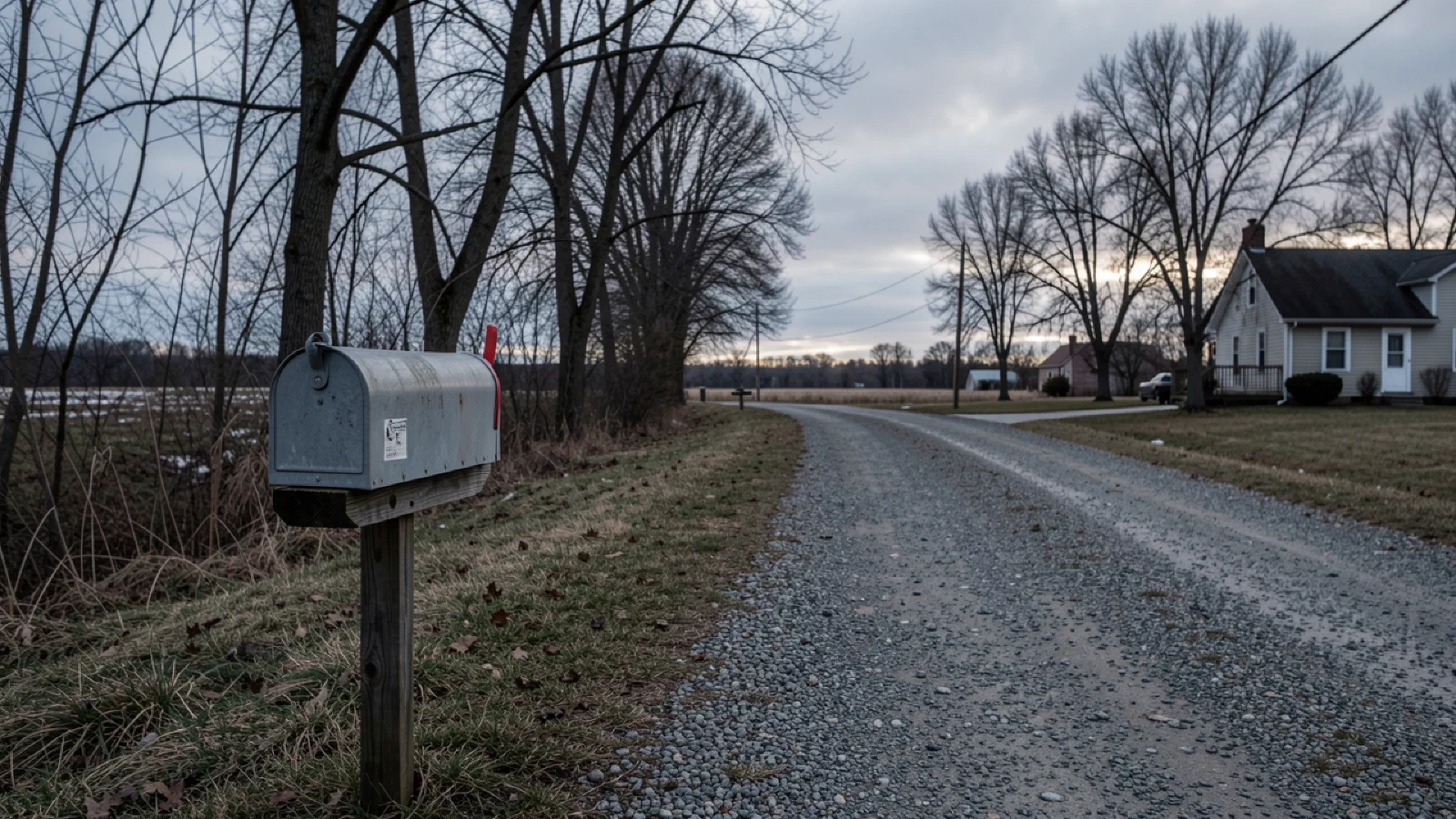
Your Prescriptions Delivered by Air
Series 16: The World You Still Live In
The ice storm hit Elkin, North Carolina on a Wednesday. Donald Pace had four days of COPD medication left. The pharmacy was twenty-six miles away in the next town. The roads were not passable for three days, and by the time they cleared, Donald had been off his maintenance inhaler for four days.
He knows what happened next. The rescue inhaler stopped being enough. He called his son, who drove him to the emergency department, forty-three miles away. He spent two nights in the hospital.
The emergency and hospital charges came to approximately $14,000.
Four pills. Twenty-six miles. An ice storm. Fourteen thousand dollars.
Donald read about drone delivery of prescriptions operating in some parts of North Carolina the following spring. He did not read it in a healthcare newsletter. He read it in the local paper. The question he asked his pharmacist, who could not answer it: why can’t this come to me?
What Four Missed Pills Actually Cost#
The healthcare system has a term for what happened to Donald: medication non-adherence. It is documented as a major driver of preventable hospitalizations and is estimated to cost the US healthcare system around $300 billion annually. The term implies the problem is the patient’s. The geography is rarely accounted for.
Donald took his medication every day for eleven years. The pharmacy is twenty-six miles away and has been for as long as he has been a patient. In eleven years, the ice storm came once. But the ice storm was not the only risk. His COPD is managed with three prescriptions. Each has a different refill schedule. The drive to the pharmacy tires him. He has, twice in the past four years, delayed a refill by a few days because the timing was inconvenient, the weather was poor, or his energy was low. He did not end up in the emergency department those times. He was closer than he knew.
A drone that delivers his prescriptions to his mailbox on schedule eliminates the logistical failure mode entirely. The ice storm becomes irrelevant. The drive becomes irrelevant. The fatigue becomes irrelevant.
Where Drone Delivery Actually Operates#
Drone delivery of medications and medical supplies is not theoretical. It is operating in the United States, in specific places, with specific limitations.
Zipline, which began delivering blood products and vaccines in Rwanda in 2016, now operates partnerships with health systems in the US, primarily delivering medications and medical supplies between facilities and to patients in certain service areas. Wing, the drone delivery arm of Alphabet, has received FAA approval and operates in limited commercial areas including parts of Texas and Virginia. Amazon Prime Air is expanding its delivery footprint in a small number of markets. UPS Flight Forward holds FAA certification for drone delivery and operates within healthcare logistics.
The honest geographic answer for Donald: drone prescription delivery does not currently operate in Elkin, North Carolina. The nearest operating area with pharmacy-to-patient delivery is almost certainly not within his county. This is not a minor gap. It is the gap between a technology that works and a technology that works for him.
What does operate across most of North Carolina, as across most of the country, is mail-order prescription delivery by ground. His pharmacy may offer delivery. Amazon Pharmacy ships prescriptions with Prime membership. GoodRx’s delivery network covers many rural areas. These are not as fast as a drone, and they do not arrive on a specific schedule unless the patient sets up auto-refill. But they eliminate the drive. Donald’s pharmacist could set up auto-refill delivery today. Nobody appears to have told him that option existed.
The Regulatory Landscape, Simply#
The Federal Aviation Administration governs drone delivery, and its regulatory evolution over the past five years has been the primary driver of where commercial drone delivery can and cannot operate.
The key constraint, currently, is the requirement that drone flights maintain a line of sight to the operator or operate within FAA-approved beyond-visual-line-of-sight corridors. Most commercial delivery drones still operate within a few miles of a depot and at relatively low altitudes. The FAA is expanding the approval framework for longer-range, autonomous flights, but the process is deliberate and geographically specific.
For a person trying to understand what this means for her neighborhood: drone delivery requires approved flight corridors, which are currently concentrated in areas where drone operators have invested in regulatory approval. Rural areas are not the priority for that investment, because the commercial case is harder. The regulatory framework is evolving. The commercial deployment decisions are made on population density and delivery volume, not on medical need.
What Drones Cannot Deliver#
Even when drone delivery operates in an area, the technology has limitations that matter for medical supply delivery.
Weight limits on current commercial delivery drones are typically two to five pounds. Most prescription medications are well within this range. Some medical equipment, including certain home monitoring devices and larger supplies, exceeds it. Temperature-sensitive medications, including some insulin formulations, require specialized delivery containers that maintain cold chain integrity; this is solvable but adds cost and equipment requirements. Controlled substances face additional regulatory constraints that are largely separate from drone delivery regulations and add a layer of complexity that most drone operators have not fully resolved.
The pharmacist who catches a dangerous drug interaction is not part of a drone delivery. When Donald picks up his medications in person, the pharmacist can review his complete medication list and flag a problem. Mail-order delivery has this capability through remote review. It depends on the pharmacy having a complete medication list. For the person managing multiple prescriptions across multiple prescribers, the pharmacist who sees everything at the counter is doing something that the logistics system alone cannot do.
The Integration Move#
The system that could prevent Donald’s next ice storm emergency does not require drone delivery to work today. It requires coordination.
Donald’s personal AI knows his three prescriptions, their refill schedules, and the ten-day buffer that would prevent a crisis if the pharmacy is inaccessible. It checks the weather forecast. Ten days before the projected ice storm window, it alerts Donald that his inhaler refill is due and that the weather window suggests ordering now rather than waiting. It arranges delivery, by ground or by drone depending on what is available, and confirms receipt.
That is not far-future technology. The medication tracking exists. The weather data exists. The refill reminder exists. The delivery option exists. What does not exist is a single system that connects them proactively, without Donald having to manage each component separately.
The integration argument, made first in Series 01 for health management, applies here as a logistics problem: each piece of Donald’s medication management exists as a separate system he must coordinate himself. The coordination gap is where people fall through.
Donald’s Question#
Why can’t this come to me?
The honest answer is: in some places, for some medications, it can. In Elkin, North Carolina today, it cannot. The timeline for when drone delivery reaches Donald depends on regulatory evolution, on whether a commercial operator finds the case compelling enough to build the approved flight corridor, and on whether anyone building these systems decides that a 69-year-old retired mechanic with COPD in a town of 4,000 is a customer worth reaching. That calculation has not historically favored Donald. The economics of drone delivery currently favor dense populations with many short deliveries, not sparse rural populations with long routes.
What Donald can do today: call his pharmacy about auto-refill with mail delivery. Set up the ten-day buffer. Tell his prescribing physician what happened last February, so the medical record reflects that access is a factor in his adherence, not his intent.
What is genuinely close: expanded FAA corridor approvals, pharmacy partnerships with delivery operators, and the refill-plus-delivery integration that makes the buffer automatic rather than requiring Donald to manage it. The one-to-two-year horizon for Donald is meaningful.
The ice storm that cost $14,000 was a logistics failure. The system that fails was designed for someone who lives close to a pharmacy. Donald does not live close to a pharmacy. He lives in Elkin, North Carolina, and for most of the history of that town, the distance was manageable because the pharmacy was open and the roads were clear. The four times a year the weather made the trip impossible were a known risk that nobody in the healthcare system had ever been paid to solve. Drone delivery would solve it. The question is whether it reaches him before the next ice storm.
How this article connects to others in Blue Mirror.
Sources cited in this article.
- "Drug-Related Morbidity and Mortality: Updating the Cost-of-Illness Model." Journal of the American Pharmaceutical Association, 2001.
- FAA. "Beyond Visual Line of Sight (BVLOS) Drone Operations.".
- Zipline. "Healthcare Delivery.".
- Wing. "Wing Delivery Overview.".
- Amazon Pharmacy. "Prescription Delivery." pharmacy.amazon.com.