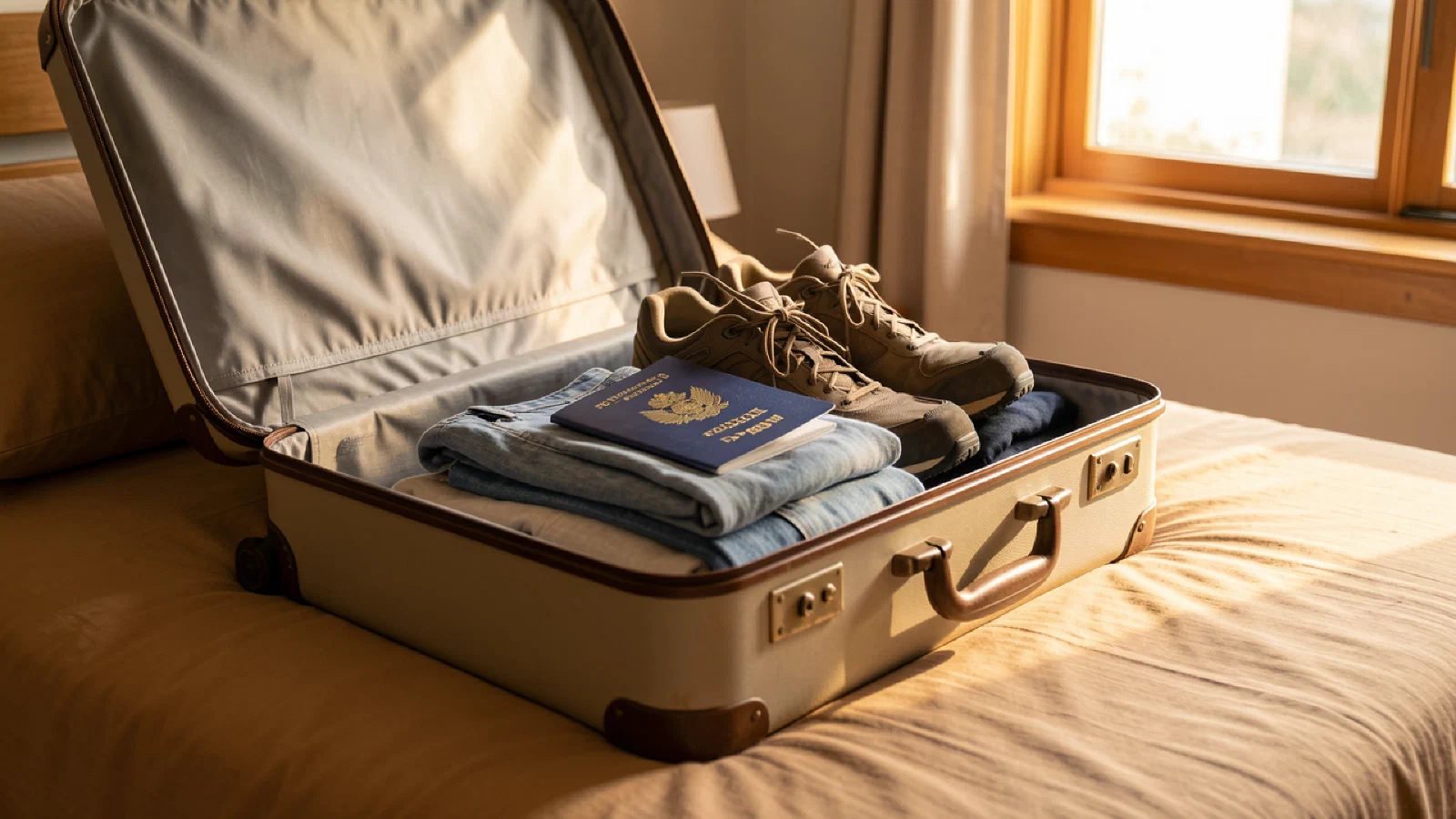
The Trip You Can Still Take
Series 16: The World You Still Live In
Harold and Mae Chen have been talking about Portugal for eight years.
Portugal came up first at their son’s wedding in 2018. Harold had been to Lisbon once on a business trip thirty years ago and thought about it ever since. Mae has always wanted to see the tiles, the blue azulejos that cover buildings and churches and train stations. They put Portugal on the list. They kept it there.
Their grandson Matthew offered to help them book a trip last spring. He booked Lisbon, Porto, and Sintra in forty-five minutes on his phone, using his own booking apps and his own airline miles. He had flights, hotels, and a train between cities. He sent them a summary.
They looked at it and then spent three months trying to figure out why it would not work for them.
Harold needs an aisle seat. His knee replacement makes sitting in a center or window seat for a ten-hour flight painful enough that he cannot walk well for two days afterward. The airline’s website lets him select a seat at check-in, which is after the fare is purchased and which may show the aisle seats as sold or charged as a premium. Matthew’s booking method does not guarantee anything about the seat.
Mae has a cardiac history. A pulmonary embolism seven years ago, controlled since. Standard travel insurance excludes pre-existing conditions, which means Mae is uninsured if she has a cardiac event in Lisbon. The travel insurance with a pre-existing condition waiver exists, is expensive, and requires finding it, which is not the same as the standard insurance the booking platform offers at checkout.
Three months in, they have not booked the trip. They are close to deciding that Portugal is no longer practical.
The Accessibility Booking Gap#
The standard travel booking experience asks the traveler’s name, travel dates, destination, number of people, and payment method. It does not ask whether she can climb stairs to a hotel room. It does not ask whether her medication is legal in the destination country. It does not ask whether she needs oxygen on the flight. It does not offer insurance that covers her specific medical history. It does not flag that the historic hotel in the center of Sintra has no elevator.
These are not rare needs. They are common needs among the population that travels with most frequency and longest duration: older adults whose children are grown, whose work schedules no longer constrain them, and whose savings include a travel budget they have been building for twenty years. The standard booking flow was designed for a 34-year-old choosing between window and aisle as a comfort preference. For Harold, it is a medical need. The flow does not know the difference.
Medical Travel Insurance#
Mae’s cardiac history does not disqualify her from travel insurance. It disqualifies her from the cheap standard travel insurance that the booking platform offers at checkout. What she needs is a policy that includes a pre-existing condition waiver, which most policies will grant if the policy is purchased within a specific window after the first travel deposit, typically ten to twenty-one days.
The key term is “pre-existing condition waiver” and the key question is the time limit on purchasing. Policies that include this waiver generally require that the policy be purchased within fourteen to twenty-one days of the first trip deposit. Mae and Harold need to know this before they pay for the flights, not after.
Insurers that specialize in travel insurance for travelers with complex medical histories include Allianz, Travel Guard, and Travelex, among others. The site InsureMyTrip.com compares policies across insurers and allows filtering for pre-existing condition coverage. The price for a comprehensive policy with pre-existing condition waiver on a $8,000 trip for two with Mae’s medical history is likely $600 to $900. It is not cheap. It is the difference between insured and uninsured in Lisbon.
Medicare does not cover medical care received outside the United States, with narrow exceptions. This is one of the most important things an American traveling internationally should know. If Mae has a cardiac event in Lisbon, Medicare pays nothing. The travel insurance that covers medical evacuation and emergency medical care is not optional for Mae. It is the thing that makes the trip safe to take.
Accessible Hotels and Destinations#
Hotel accessibility information is inconsistent. The term “accessible room” in a European hotel booking may mean a roll-in shower. It may mean a room on the first floor with a two-inch step at the entrance. The definition is not standardized, and the photographs on the booking site may not show the relevant features.
For Harold’s knee, the relevant features are: no stairs to the room (or an elevator), a shower with a seat or a bathtub that is easy to enter, and a bed at a standard height. For most travel, a firm query to the hotel through the booking platform or by direct email, asking specifically about room layout and any stairs between the entrance and the room, gets a specific answer. Hotels that do not respond specifically are worth avoiding.
Portugal, as a destination, is reasonably accessible by European standards. Lisbon’s historic neighborhoods, including Alfama, are built on steep hills with cobblestone streets that are challenging for a person with limited mobility. The modern neighborhoods and most hotels in the Baixa and Chiado areas are much more navigable. Harold’s knee can manage Lisbon if the hotel is in a walkable area and he is not expected to hike the hills.
Sintra’s historic palaces are on steep terrain and require significant walking. For Harold, a half-day visit with selective site choices is more realistic than a full-day itinerary. The train from Lisbon to Sintra is accessible. The town itself requires negotiation.
The database AccessibleGO lists accessible hotels and attractions with user reviews from travelers with disabilities. It covers European destinations. Mainstream platforms including Booking.com allow filtering for accessibility features, though the accuracy of those filters varies by property.
The Flight#
Airlines are required under US law to accommodate travelers with disabilities, including providing wheelchair assistance at airports and not charging for boarding assistance. The requirement exists. Its consistent delivery does not.
Harold’s aisle seat need is medical rather than regulatory: he can walk on a ten-hour flight, but sitting without the ability to stand on the aisle side makes his post-flight recovery significantly worse. The way to secure an aisle seat for a medical reason is to contact the airline’s accessibility desk, not the standard customer service line, and explain the orthopedic need. Documentation from his orthopedic surgeon strengthens the request. Airlines have a process for this. It requires knowing the process exists.
If he books with airlines that allow seat selection at booking without a premium, the aisle seat is secured before any uncertainty arises. Most major carriers allow seat selection at booking for economy fares; the fees and restrictions vary.
Medication in carry-on bags is permitted by TSA in amounts that exceed the standard liquid limits, provided the medication is declared and inspected. Mae’s cardiac medication should be in its original labeled containers. A letter from her cardiologist documenting the medications and the medical necessity is useful but not required; it is most useful when a foreign customs or security agent asks questions.
What AI Could Do#
The personal AI travel agent that knows Harold’s knee and Mae’s cardiac history would not book the trip on Matthew’s apps. It would build the trip around their constraints as the starting point: pre-existing condition insurance purchased within fourteen days of the first deposit, aisle seat requested through the accessibility desk before tickets are issued, hotels filtered for elevator access and no stairs to the room, Sintra itinerary adjusted for limited walking, cardiologist and emergency medical contacts in Lisbon identified.
That level of integration is genuinely close. AI travel planning tools that incorporate accessibility needs are being built. They are not yet at the point where Mae and Harold could describe their situation and receive a complete, integrated booking plan. They are one to two years from that. The current situation is that the components exist but the integration requires human coordination.
Matthew’s forty-five-minute booking was fast because Matthew does not have Harold’s knee or Mae’s cardiac history. The forty-five-minute booking for Harold and Mae is not yet available. The three-month ordeal is what the accessible traveler currently manages instead.
Lisbon#
Harold and Mae book the trip. The insurance is purchased the day after the deposit, within the waiver window. The airline’s accessibility desk secures the aisle seat. The hotel in the Baixa neighborhood has a lift to all floors. Mae’s cardiologist writes a brief letter.
They eat pasteis de nata at a bakery in Belem. Harold can see the Jerónimos Monastery across the square. Mae photographs the azulejos in the Igreja de São Roque until the light changes. They stay eight days.
Eight years of talking became eight days of living. The technology did not take them to Portugal. The technology removed the barriers that were keeping them from going. Some of those barriers were always removable. Nobody told them where the doors were.
How this article connects to others in Blue Mirror.
Sources cited in this article.
- InsureMyTrip. "Travel Insurance Comparison.".
- AccessibleGO. "Accessible Travel Search.".
- US Department of Transportation. "Air Travel Consumer Report: Airline Accessibility Services.".
- . "Medicare Coverage Outside the United States." medicare.gov.
- TSA. "Traveling with Medications.".