The Electric Bill That Goes Down
Series 16: The World You Still Live In
Last August, Raymond and Shirley Boone’s electric bill hit $340.
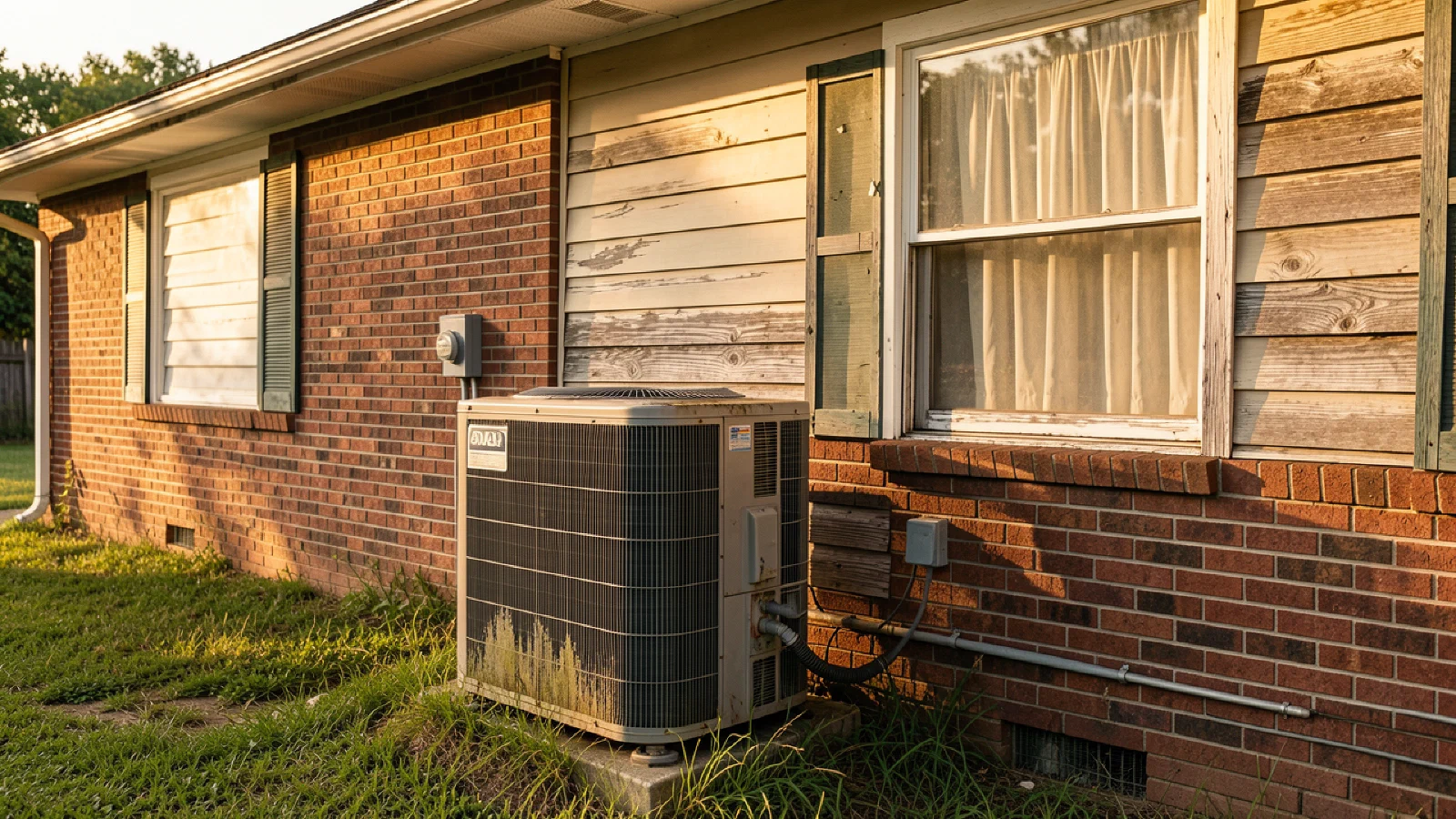
They have lived in the same 1,400-square-foot house in Greenville, South Carolina for thirty-eight years. The insulation is original. The HVAC system is fifteen years old. The August heat in the South Carolina upstate is serious, and it was a hot summer. The $340 was real.
Shirley takes blood pressure medication. The copay is $34 a month. In August, she took half doses for two weeks to make the numbers work. Her prescription says one tablet daily. She took one tablet every other day. She did not tell her doctor.
Their grandson mentioned solar panels that fall. Raymond said they could not afford it. He was thinking about the roof installation, the upfront cost, the decades-long payback. He was not wrong about solar panels for their situation. He was also not aware that the energy transition has something else to offer them, something that exists now, that is often free, and that nobody has told them about.
The Weatherization Program Nobody Told Them About#
The Weatherization Assistance Program, funded by the federal Department of Energy, provides free energy efficiency improvements to low-income households. The income eligibility threshold is 200% of the federal poverty level, which means a household of two with a combined income at the Social Security level qualifies in most states.
What WAP covers: attic insulation, wall insulation, duct sealing, air sealing throughout the house, heating and cooling system upgrades including full replacement when the existing system is beyond efficiency improvement, and in some cases window replacements. The program sends trained contractors to the home, does the assessment, does the work, and charges the household nothing.
Raymond and Shirley’s 1,400-square-foot house with original insulation and a fifteen-year-old HVAC system is, on paper, a strong candidate for WAP benefits. If they qualified, the program could insulate their attic, seal their ductwork, and potentially replace the HVAC system with a modern unit that uses significantly less electricity. The savings on a house with these characteristics are typically $300 to $600 per year or more, depending on how far out of efficiency the original house is.
The program is administered through state agencies and local community action agencies. In South Carolina, the weatherization program is managed through the state’s Department of Commerce, with applications taken by regional community action agencies. There is usually a waiting list. The wait can be months. Applying now is the right move.
To find the local contact: the federal government’s Low-Income Home Energy Assistance Program website at liheap.acf.hhs.gov includes state-by-state contacts. Their county’s community action agency is listed there and handles both WAP and LIHEAP applications.
Community Solar Without the Roof#
Raymond and Shirley do not need to install anything on their roof to benefit from solar energy.
Community solar programs, which exist in most states including South Carolina, allow households to subscribe to a share of a solar installation built elsewhere in the region. The electricity the installation generates flows to the grid, and subscribers receive credits on their utility bills, typically 10% to 20% below their standard rate. The subscriber pays a monthly subscription fee and receives a credit larger than the fee. No installation. No contractor on the roof. No long-term lease.
The savings are modest. On a $280 average monthly bill, a 15% community solar credit saves about $42 a month, or $500 a year. On a fixed income of $3,100 monthly, $500 a year is not nothing. Applied over several years, with the weatherization savings, the household’s energy costs shift meaningfully.
Duke Energy, which serves much of upstate South Carolina, has community solar programs. Their website lists enrollment options. The waitlist can be long in high-demand areas; getting on the list now is the first step.
The IRA Rebates, Explained Simply#
The Inflation Reduction Act of 2022 includes two sets of benefits for household energy efficiency that Raymond and Shirley should understand before someone explains them incorrectly.
Tax credits: the law offers a credit of up to 30% of the cost of qualifying energy improvements, including HVAC systems, heat pumps, insulation, and windows. A tax credit reduces the taxes owed. For Raymond and Shirley, whose retirement income generates a small tax liability, the credit is only useful to the extent they owe taxes. If their annual tax liability is $600, a $2,000 tax credit saves them $600, not $2,000. Tax credits are less valuable to low-income households than to higher-income households.
Income-qualified rebates: the law also funds a program called Home Efficiency Rebates (HEAR), delivered through states, that provides cash rebates for qualifying improvements. These are not tax credits. They are payments. For households at or below 80% of the area median income, rebates can cover up to 100% of the cost of qualifying improvements. For households between 80% and 150% of area median income, rebates cover up to 50%. Raymond and Shirley’s income level determines which bracket applies. Their state energy office has the enrollment details.
The rebates are not yet available in all states. South Carolina’s implementation timeline can be checked through the SC Energy Office. The rebate programs are worth watching and applying for when they open.
The Smart Thermostat That Pays for Itself#
The intervention with the best cost-to-savings ratio for Raymond and Shirley’s situation is not solar panels. It is a smart thermostat.
A programmable smart thermostat that learns their schedule and adjusts heating and cooling automatically costs $130 to $250 depending on the model. Most utilities, including Duke Energy, offer rebates on smart thermostat purchases that reduce the cost to $50 to $100 or make them free. The thermostat adjusts the temperature when the house is unoccupied, before Raymond and Shirley wake up, before they return home, and at night when the sleeping temperature is different from the daytime temperature. The energy savings are consistently documented at 10% to 15% of heating and cooling costs.
On their current bill, 10% is $23 to $28 per month. The thermostat pays for itself in four to five months. The utility’s rebate makes it faster.
Installation requires connecting the thermostat to their existing HVAC wiring. Most smart thermostats have installation guides designed for homeowners. A home warranty service, a handyman, or a family member with basic electrical comfort can handle it in under an hour.
What They Should Not Buy#
The solar lease with a twenty-year term and an annual escalator clause is not designed for Raymond and Shirley. The upfront cost is zero, which sounds right. The terms require monthly payments over twenty years, with the payment increasing each year. The equity in the house is affected. The lease is difficult to exit if they need to move or sell. The product was designed for homeowners with long time horizons and reliable income growth. That is not their situation.
The “free home energy audit” offered by a company that follows up with a sales presentation for $15,000 of improvements is not a free audit. It is a sales call. A genuine energy audit from a utility or certified auditor does not require purchasing anything.
A home battery system at $12,000 to $18,000 serves as backup power and allows participation in utility grid programs. For Raymond and Shirley, the payback period is longer than the useful life of the battery under most pricing scenarios. It is not for them.
The $340 Bill#
If Raymond and Shirley apply for WAP and receive weatherization services, subscribe to a community solar program, and install a smart thermostat with the utility rebate, the $340 August bill becomes approximately $195 to $215 under the same weather conditions. The monthly savings across the year average $60 to $90.
Shirley does not halve her blood pressure medication. The $200 saved each month stays in the household budget.
The interventions that get them there are available right now. WAP is a federal program with local contacts in every county. Community solar is offered by their utility. The smart thermostat rebate is on their utility’s website. The application for each of these requires time, phone calls, and some paperwork. It does not require capital, credit, or a roof capable of supporting panels.
Nobody told them. The solar salesman told them about the product he sells. The utility bill does not include a note about WAP eligibility. The community action agency’s weatherization program is not advertised on television. The people who most need these programs are the people least likely to know they exist.
Now they know.
How this article connects to others in Blue Mirror.
Sources cited in this article.
- US Department of Energy. "Weatherization Assistance Program.".
- US Department of Health and Human Services. "Low Income Home Energy Assistance Program." liheap.acf.hhs.gov.
- IRS. "Energy Efficient Home Improvement Credit.".
- US Department of Energy. "Home Efficiency Rebates (HEAR) Program.".
- ENERGY STAR. "Smart Thermostats.".
- Lawrence Berkeley National Laboratory. "Energy Savings from Programmable and Smart Thermostats." 2020.