The Resources That Already Exist
Series 14: Geography Is Not Destiny
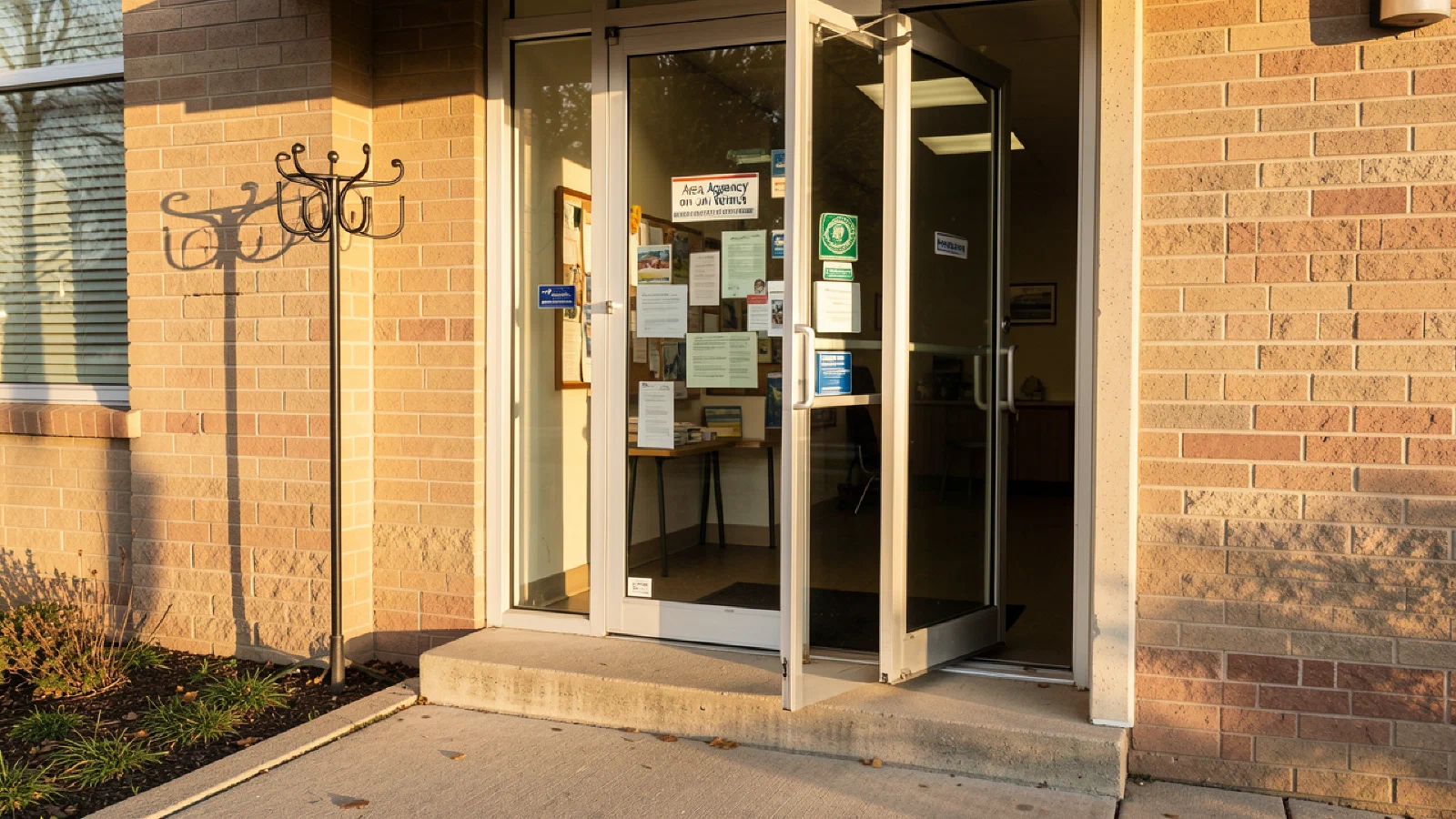
Every county in America has an Area Agency on Aging. There are 618 of them. They were established by the Older Americans Act in 1973 and they have been operating, in most cases, for over fifty years. They administer transportation programs for older adults who cannot drive. They coordinate home-delivered meals for people who cannot cook or cannot shop. They provide caregiver support services, legal assistance, benefits counseling, health and wellness programs, and fall prevention classes. They are funded by federal, state, and local governments. They serve anyone 60 and older regardless of income.
Most older adults have never heard of theirs.
This is the fact that the previous four articles in this series have been building toward. Earl Hanson’s health AI in eastern Montana (14.01) bought him a 47-minute window because it could detect a cardiac event in progress. Agnes Littlefeather’s AI on the reservation in South Dakota (14.02) manages her diabetes when the satellite holds and reverts to a clipboard when it does not. Barbara Fitzgerald’s AI in Scottsdale (14.03) handles her groceries and prompts her calls but cannot give her somewhere to walk. Leonard Okafor’s AI in Stockton (14.04) knows his ZIP code is a health variable and connected him to a CSA he did not know existed. Each piece identified a geographic failure mode. Each piece identified what the AI can and cannot do within that failure mode. This piece asks a different question: what already exists in every one of those geographies that most people have never been connected to?
What the AAA Does#
The list of services administered through the AAA network is long enough that most people who hear it assume they cannot all be free. Most of them are.
Transportation assistance for medical appointments, grocery shopping, and social activities. In most AAA service areas, this means a phone call to schedule a ride with a volunteer driver or a subsidized van service. The rides are free or income-scaled. The service exists in 90 percent of AAA regions nationally. Most older adults who need transportation assistance have never called.
Congregate meals at senior centers and community sites, plus home-delivered meals for those who cannot attend. The Older Americans Act nutrition programs serve roughly 2.4 million older adults annually. The meals are free. They are available to anyone 60 and older. In many communities, the congregate meal site is the last remaining third place where older adults see other people in person on a regular basis.
Caregiver support programs, including respite care, training, and counseling. The National Family Caregiver Support Program, administered through AAAs, provides services to caregivers that most caregivers do not know exist. Respite care, which gives the caregiver a break while a trained substitute provides care, is the single most requested caregiver service in every survey ever conducted. It is available through AAAs in most states. Most caregivers have never heard of the program.
Benefits counseling through SHIP, the State Health Insurance Assistance Program. SHIP counselors help Medicare beneficiaries understand their coverage options, compare plans, resolve billing disputes, and identify benefits they are eligible for but not receiving. The counseling is free. It is available in every state. The average SHIP interaction identifies $1,200 to $2,400 in annual savings or additional benefits for the beneficiary. Most Medicare beneficiaries have never spoken with a SHIP counselor.
Legal assistance for issues including advance directives, power of attorney, landlord disputes, benefits appeals, and consumer protection. AAA-funded legal services are free for older adults in most jurisdictions. They handle the legal documents that Series 2 of this publication identified as necessary for every aging adult. Most people who need those documents do not know that free legal help is available to prepare them.
Fall prevention programs based on evidence-based curricula such as A Matter of Balance and Tai Chi for Arthritis. These programs are offered through AAAs and community partners, typically at no cost. They reduce fall rates by 30 to 50 percent in participants who complete the program. Series 1 described the AI that predicts falls. The AAA runs the program that prevents them. Neither knows the other exists in most communities.
The FQHC System#
Federally Qualified Health Centers, introduced in 14.01, are the healthcare safety net that most Americans have never heard of. There are roughly 1,400 of them, operating in over 14,000 service delivery sites, serving 30 million patients annually. They exist in rural counties, in urban neighborhoods, and in suburban communities where the poverty rate qualifies the area for federal designation.
FQHCs provide primary care, dental care, mental health services, substance abuse treatment, and pharmacy services. They accept Medicare, Medicaid, private insurance, and uninsured patients. The sliding fee scale adjusts the cost to the patient’s ability to pay. A patient at 100 percent of the federal poverty level pays a nominal fee. A patient at 200 percent pays more, but still less than a private practice visit. A patient with no income pays nothing.
The FQHC in Leonard Okafor’s area of Stockton provides bilingual primary care, diabetes management, and mental health services. Leonard’s AI identified it. Leonard’s physician 22 miles away did not mention it, because the physician’s referral network does not include FQHCs. The system that cares for Leonard and the system that could care for Leonard do not talk to each other. The AI is the first tool that could make the introduction.
State Pharmaceutical Assistance Programs#
Every state has a pharmaceutical assistance program for older adults, though the programs vary in generosity and visibility. SPAPs provide prescription drug assistance for Medicare beneficiaries who fall into coverage gaps between standard Part D coverage and catastrophic coverage. Most people who qualify have never enrolled. Most do not know the program exists. The National Council on Aging estimates that older adults leave $30 billion in benefits unclaimed annually across all programs.
The benefits navigation agent described in Series 2 can determine a person’s SPAP eligibility in less than a minute and initiate enrollment where online applications are accepted. Without the AI, the person needs to know the program exists, find the application, determine their own eligibility, and complete the paperwork. Most do not.
The Library as Social Infrastructure#
Public libraries are the most underused resource in the aging services landscape. They provide public internet access, which for Agnes during her offline months is the connection that makes the health AI functional again. They provide social programming that serves as the only free, regularly scheduled, intergenerational gathering in many communities. They increasingly provide services that have nothing to do with books: tax preparation through VITA, notary services, Medicare enrollment guidance, social worker hours, digital literacy classes, and in some systems, telehealth stations.
The library 0.8 miles from Leonard’s house has a VITA site during tax season, a social worker on Wednesdays, and a blood pressure screening on the first Tuesday of each month. Leonard discovered the screening from a flyer on the bulletin board. His AI did not tell him about it, because his AI is not yet connected to the library’s program calendar. When it is, the library becomes the physical complement to the digital infrastructure the AI provides.
The Connection Problem#
The resource infrastructure described in this article has existed, in most cases, for decades. The 618 AAAs have been operating for over fifty years. The FQHC system has been serving patients since 1965. Libraries have been public institutions for over a century.
The problem is not that the resources do not exist. The problem is that the person who needs them cannot find them, does not know they exist, cannot complete the enrollment process, calls the number and gets a busy signal, or is told the wait for an intake interview is six weeks. Agnes does not call the AAA because she has never heard of it. Barbara does not know her AAA offers transportation to the grocery store she cannot reach on foot. Leonard does not know that the FQHC three miles from his house could manage his pre-diabetes at a fraction of what he pays 22 miles away. 2-1-1, the national information and referral helpline, can connect callers to these resources. It is available in most of the country, staffed by trained specialists. Most older adults have never heard of it.
What the Location-Aware AI Does#
The personal AI that knows the person’s geography, income, health status, language, and eligibility profile can do what 2-1-1 does, at the moment of need, without the hold time, and with the persistence to follow through.
It knows where the nearest AAA is and what transportation services it offers. It knows whether the person qualifies for home-delivered meals and can initiate the referral. It knows which FQHC is closest, whether it has services in the person’s language, and whether it has capacity for new patients. It knows whether the person qualifies for their state’s SPAP and can handle the enrollment. It knows what the library offers beyond books and when the social worker is available for a walk-in consultation.
This is the resource connector that the previous fourteen series have been building toward without naming it. Series 1 described the health AI. Series 2 described the benefits navigation agent. Series 7 described the social infrastructure. Series 13 identified who the system excludes. Series 14 has identified where the system cannot reach. The resource connector that ties all of these together, the AI that knows not just the person’s body and finances but their geography and what that geography provides, is the function that closes the loop.
It is not yet at scale. The agent from Series 2, connected to comprehensive local resource databases, is one to two years from standard deployment. The full integration, where the AI knows every applicable program in the person’s geography, confirms eligibility in real time, and initiates enrollment at the moment of need, is three to five years away. But the components exist. The databases are public. The eligibility rules are documented. The enrollment processes are increasingly digital. What remains is the integration that puts the person and the resource in the same room at the same time.
The Thirty Seconds and the Six Weeks#
A person in rural Montana calls a state benefits hotline. She waits 35 minutes on hold. She is told she may qualify for three programs and is given phone numbers. She calls the first number the next morning. Voicemail. She calls the second. The next available intake interview is in six weeks. She needs eight documents. She is not sure she has all of them. She puts the envelope on the kitchen table. It is still there in March.
The AI, connected to the complete resource map for her geography, income, and eligibility profile, identifies the same three programs in thirty seconds. It confirms current eligibility for two of them in real time. It initiates the application for the one with online intake, pre-populating the form. It schedules the in-person interview for the third and generates the document list.
The resources existed in both scenarios. What changed was the connector.
What This Series Found#
In eastern Montana, the AI’s early warning function is life-safety infrastructure because the hospital is 58 miles away. On a reservation in South Dakota, the AI functions fully only when the weather permits a satellite connection. In a Scottsdale suburb, the AI manages the logistics of daily life but cannot fix a built environment designed for cars. In a Stockton food desert, the AI knows the ZIP code is a health variable before the physician does.
The AI cannot build a hospital. It cannot lay fiber. It cannot redesign a suburb. It cannot clean the air. What it can do, in every geography, is connect the person to what already exists: the 618 AAAs, the 1,400 FQHCs, the 50 state pharmaceutical assistance programs, the 2,400 SHIP counselors, the 17,000 library locations. The invisible infrastructure of aging services in America is vast and underused. Underused not because people do not need it but because people do not know it is there.
The AI’s greatest contribution to the geography of aging may not be monitoring or prediction. It may be connection: knowing what exists in a person’s geography, at their income level, in their language, and getting them to it at the moment they need it. The resource existed. The connection is what changes.
How this article connects to others in Blue Mirror.
Sources cited in this article.
- Administration for Community Living. "Older Americans Act." , 2024.
- Administration for Community Living. "Area Agencies on Aging." , 2024.
- Administration for Community Living. "National Family Caregiver Support Program." , 2024.
- Health Resources and Services Administration. "Health Center Program: Impact and Growth." HRSA, 2024.
- National Council on Aging. "Benefits Access for Older Adults." NCOA, 2024.
- State Health Insurance Assistance Program. "About SHIP." , 2024.
- United Way. "About 211." , 2024.
- American Library Association. "Libraries Transform: Trends." ALA, 2024.