The Body Keeps Score Too
Series 12: The Reverse Cascade
James Okafor is 70, a retired endocrinologist from Memphis who spent thirty-four years managing metabolic disorders at a teaching hospital. He knows what cortisol does to the body at a level that most people who use the word “stress” never reach. He can read a metabolic panel the way a mechanic reads engine diagnostics: not just the numbers, but what the numbers are about to do.
Twenty months ago, he began a BGO deployment to a network of community health clinics in the Mississippi Delta, advising on diabetes management protocols for a population with some of the highest rates of Type 2 diabetes in the country. He deploys two days a month, paired with a Native named Deshawn Morris, 28, a public health data analyst who turns James’s clinical judgment into protocols the clinics can sustain after the engagement ends.
James did not enter the deployment for health reasons. He entered it because someone asked him to do the thing he is best at, in a place that needs it, and he said yes. The health data from his twenty months since is what this piece is about. It is also what his primary care physician, Dr. Yolanda Reeves, cannot explain through any intervention James has undertaken. He has not started an exercise program. He has not changed his diet. He has not begun a new medication. He started a deployment.
The Four Measures in One Person#
The health AI monitoring infrastructure that BML described in Series 1 tracks physiological health continuously through wearable sensors, periodic biomarker collection, and integrated health records. James has been on this monitoring for twenty-two months: two months of baseline before his deployment began, and twenty months since.
His data shows four patterns that, taken individually, would each have a plausible independent explanation. Taken together, they describe an integrated physiological shift that tracks the deployment timeline with a specificity that individual explanations cannot account for.
Sleep quality improved at six weeks. James’s sleep architecture, measured through continuous wearable monitoring, shows an increase in slow-wave sleep duration beginning approximately six weeks after his first deployment session. The improvement stabilized at roughly month three and has held. The magnitude is modest: approximately twelve additional minutes of slow-wave sleep per night on average. The direction is consistent with what the sleep research literature predicts for individuals experiencing increased purpose engagement.
Inflammatory markers shifted at four months. James’s quarterly blood work, integrated into the health AI’s longitudinal tracking, shows a decline in high-sensitivity C-reactive protein beginning at the four-month mark. His IL-6 levels, which had been trending upward in the two years before the deployment, leveled off. The absolute changes are small. The trend reversal is not.
Resting heart rate came down gradually over the first eight months, declining from a baseline average of 72 beats per minute to a sustained average of 67. Heart rate variability, a measure of autonomic nervous system regulation, increased over the same period. Both changes are consistent with reduced chronic stress and improved parasympathetic tone.
Physiological resilience measures, tracked through the health AI’s response-to-stressor protocols, show improved recovery times from standardized autonomic challenges. James recovers from the orthostatic stress test more quickly at month eighteen than he did at baseline. His blood pressure variability in response to cognitive load testing has decreased.
What Dr. Reeves Expected#
Yolanda Reeves has been James’s primary care physician for nine years. She reviewed his twenty-month data at his most recent annual physical and told him she would have expected this pattern in a patient who had just started a vigorous exercise program. The sleep improvement, the inflammatory marker shift, the cardiovascular changes, and the resilience measures are the profile of a physiological system that has received a sustained positive intervention.
James has not started an exercise program. His exercise habits are unchanged: a daily walk of approximately thirty minutes, the same walk he has taken for five years. His diet is unchanged. His medication regimen is unchanged. The only new variable in his life, with the timing that matches the data, is the deployment.
Dr. Reeves is cautious about attributing the changes to a single cause. She notes that the placebo effect of feeling useful is real and physiologically measurable, that having a regular schedule and social obligation can independently improve sleep, and that the cognitive engagement of the deployment may be producing neurological benefits that cascade into autonomic function. She is not making a causal claim. She is noting that the data is consistent with what the purpose and connection research predicts, and that the timing alignment is difficult to attribute to coincidence.
The Loop That Closes to Pillar I#
The physical health evidence is the pillar that closes the loop back to the health AI infrastructure from Series 1. The medication tracker, the baseline monitor, the pattern recognition engine, the appointment preparation system: all of these tools exist to track and protect physical health. What James’s data suggests is that physical health is not a separate node in the cascade. It is an integrated one.
The same person whose cognitive health is protected by purpose, according to the evidence in 12.01, is the person whose sleep improved six weeks into the deployment. The same person whose brain is protected by social connection, according to the evidence in 12.02, is the person whose inflammatory markers shifted at four months. The same person whose crystallized expertise does not expire, according to the evidence in 12.03, is the person whose resting heart rate came down because the expertise is being used.
The four evidence pillars are not four separate arguments. They are four measures of the same underlying condition. The person who has purpose, connection, expertise in use, and physical health is not experiencing four independent benefits. They are experiencing one integrated state, measured from four directions, and the directions reinforce each other.
James’s health AI tracks all four. His cognitive monitoring from Series 4 shows stable performance across the twenty months. His social contact monitoring from Series 8 shows increased reciprocal contact frequency since the deployment began. His purpose engagement is tracked through the deployment itself. And his physiological health, the subject of this piece, shows the pattern Dr. Reeves would have expected from a vigorous exercise program.
The AI does not produce the benefits. It measures them, from all four directions, in the same person, continuously. That measurement resolution is what makes the integrated argument visible for the first time.
What James Knows as an Endocrinologist#
James understands his own data at a level his primary care physician does not expect from a patient. He can read the cortisol trend. He understands what the inflammatory marker shift means at the cellular level. He knows what improved heart rate variability signals about autonomic regulation.
He is also honest about what the data does not show. Twenty months is not ten years. His data is one person, not a cohort. The timing correlation between the deployment and the physiological changes is suggestive, not causal. He retired into a life that was comfortable, financially secure, and physically healthy. He was not declining before the deployment. He was stable. What the data shows is that stable became better, and the timing of the improvement matches the deployment with a specificity that interests him as a scientist.
He tells Dr. Reeves that if a pharmaceutical company had produced a drug that generated this data profile in a single patient, they would have funded a Phase II trial. No pharmaceutical company produced this. A deployment did. The difference is that the deployment cannot be patented, bottled, or prescribed through the existing infrastructure. It can only be measured, which is what is happening now.
The Honest Qualification#
The physiological evidence for the reverse cascade is the least mature of the four pillars. The purpose research in 12.01 has two decades of longitudinal data. The social connection research in 12.02 has established biological pathways with large-sample replications. The expertise research in 12.03 has decades of performance data across multiple domains. The physical health evidence, as presented here, has a plausible mechanism, a consistent direction, and a sample size of one.
James Okafor’s data is not proof. It is a signal that is consistent with what the other three pillars predict. If purpose protects cognition through cortisol regulation, and connection protects the brain through inflammatory suppression and sleep improvement, and expertise engagement sustains the crystallized intelligence that anchors cognitive function, then the person experiencing all four should show exactly the physiological profile James shows. He does. That is interesting. It is not definitive.
The BGO cohort data that 12.05 will present places James’s individual data into a comparative framework. The question is whether the pattern visible in one person is visible across many, and whether matched peers who did not deploy show a different trajectory. That is the question the next piece addresses.
What Dr. Reeves Will Watch#
Yolanda Reeves adds a note to James’s chart: “Sustained physiological improvement across multiple domains, temporally correlated with structured purpose deployment. Monitoring ongoing.” She does not have a clinical protocol for this. No clinical protocol exists for a patient whose health improved because they started doing the thing they were trained to do, in a place that needed them to do it.
She will watch the data. The health AI will continue tracking all four domains. If the pattern holds through year three, she will have a longitudinal record that matches the purpose research’s predicted trajectory with a precision that annual checkups could never capture. If the pattern reverses, that too will be recorded.
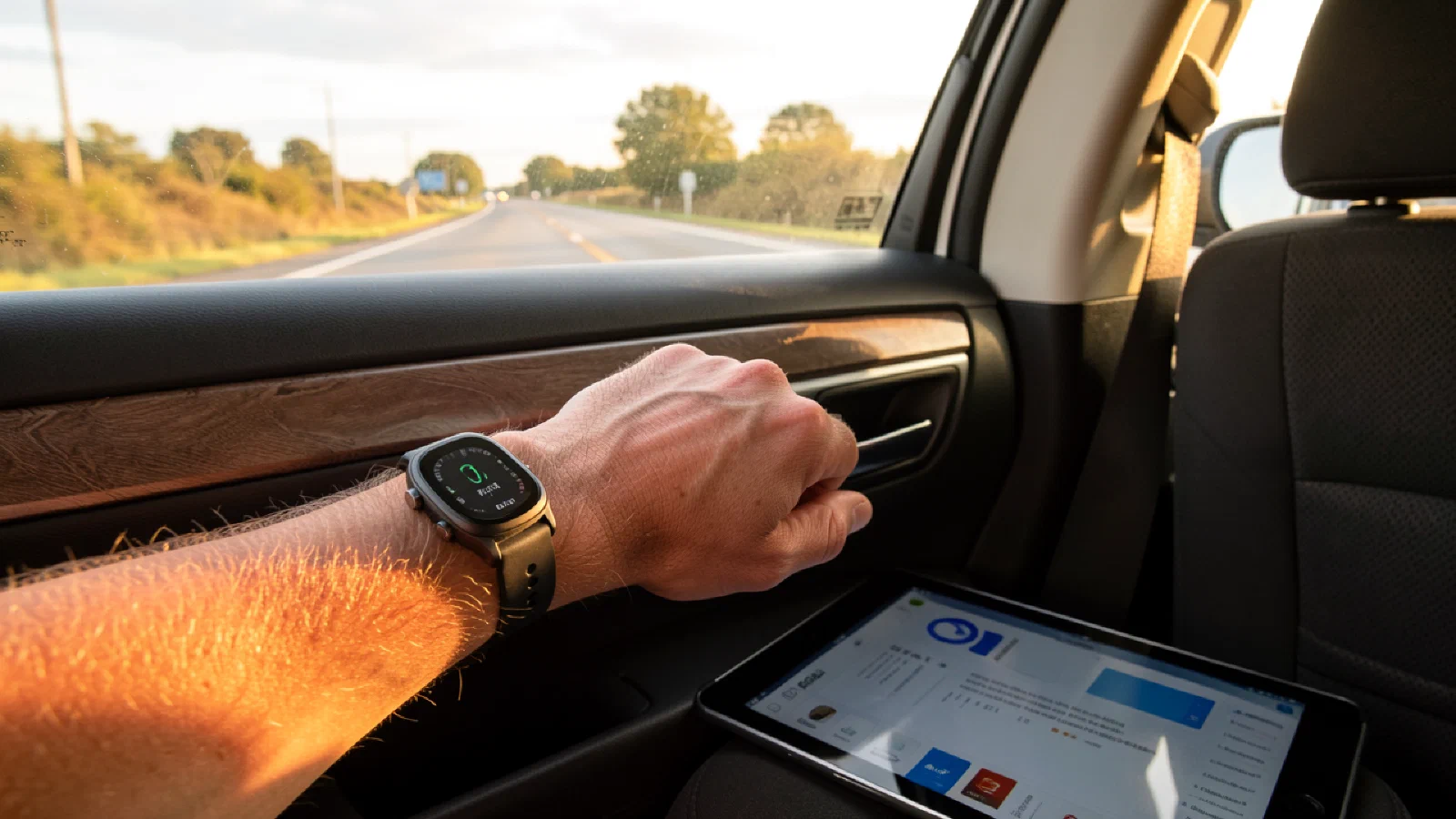
James walks out of her office and drives to the Delta on Thursday morning. Deshawn has the data from the last clinic visit organized. The diabetes management protocol they designed together has reduced average A1C by 0.4 points across the three clinics that adopted it. James reads the data in the car, on his tablet, and his resting heart rate, tracked by the watch on his wrist, is 66.
He did not start an exercise program. He started a deployment.
How this article connects to others in Blue Mirror.
Sources cited in this article.
- Ryff, Carol D., et al. "Purposeful Engagement, Healthy Aging, and the Brain." Current Behavioral Neuroscience Reports, vol. 3, no. 4, 2016, pp. 318-327.
- Fredrickson, Barbara L., et al. "A Functional Genomic Perspective on Human Well-Being." Proceedings of the National Academy of Sciences, vol. 110, no. 33, 2013, pp. 13684-13689.
- Steptoe, Andrew, et al. "Subjective Wellbeing, Health, and Ageing." The Lancet, vol. 385, no. 9968, 2015, pp. 640-648.
- Irwin, Michael R., and Richard Olmstead. "Mitigating Cellular Inflammation in Older Adults: A Randomized Controlled Trial of Tai Chi Chih." The American Journal of Geriatric Psychiatry, vol. 20, no. 9, 2012, pp. 764-772.
- Xie, Lulu, et al. "Sleep Drives Metabolite Clearance from the Adult Brain." Science, vol. 342, no. 6156, 2013, pp. 373-377.
- Kim, Eric S., et al. "Purpose in Life and Reduced Incidence of Stroke in Older Adults: The Health and Retirement Study." Journal of Psychosomatic Research, vol. 74, no. 5, 2013, pp. 427-432.