Your Vote Still Counts, So Does Your Voice
Series 10: The Citizen You Still Are
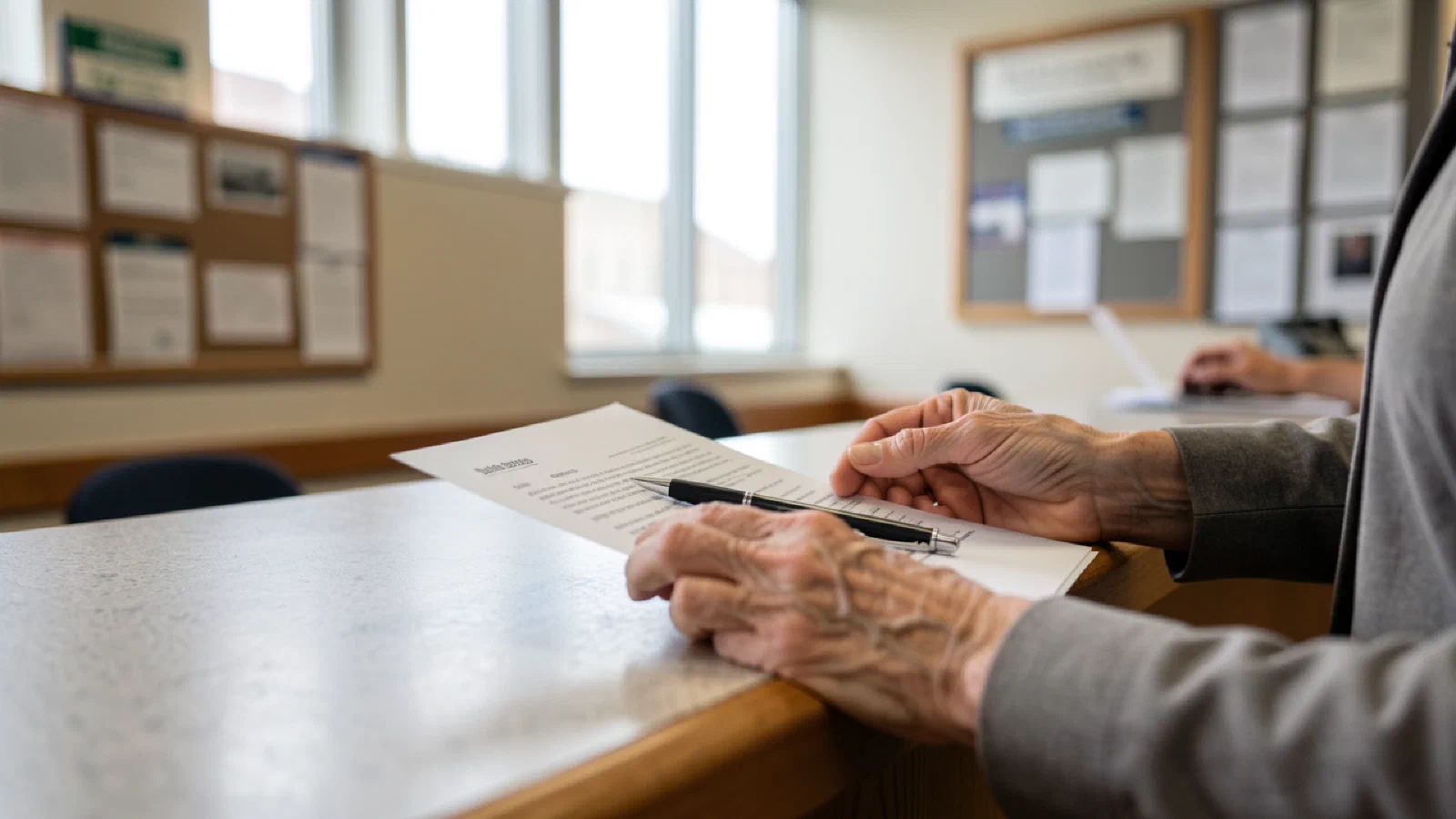
Evelyn Marsh has voted in every election since 1968. Presidential, midterm, primary, school board, city council. She has a folder in her kitchen drawer with her voter registration card, her polling place address, and a photocopy of her ID. She does not miss elections. What she misses is everything else.
Last March, a proposed zoning amendment came before the Tucson City Council that would have eliminated accessory dwelling units in her neighborhood. ADUs are the small secondary structures on residential lots that allow adult children to move home, allow older adults to rent space to a part-time caregiver, allow multigenerational housing to exist in neighborhoods that would otherwise price it out. The amendment had been introduced quietly, routed through a subcommittee, and scheduled for public comment on a Wednesday afternoon in March. Evelyn had not heard about it. She was not in the room when it failed by one vote.
She was in the room because three weeks before the hearing, her AI flagged the amendment. It had been tracking local zoning policy based on positions she had expressed in previous correspondence with her city council member. It summarized the amendment in plain language, explained what eliminating ADUs would mean for her street, and offered a draft public comment based on what she had already said she believed. She edited it. She filed it. Her AI added the hearing to her calendar and sent her a reminder the evening before. She testified. The amendment failed by one vote.
She does not know if her testimony was the vote. She knows she was there. She knows she was prepared. And she knows that without her AI, she would not have known the hearing was scheduled.
Why This Matters Beyond the Ballot Box#
The research on civic engagement and cognitive health has grown cleaner over the past decade. Political participation and civic monitoring specifically demand the cognitive functions that aging most threatens: reading comprehension, inference across complex documents, contextual memory that connects this week’s vote to last year’s position, and structured argument when giving testimony. These are not incidental benefits. A 2021 analysis in The Gerontologist found that sustained civic engagement predicted lower rates of cognitive decline independent of education, income, and baseline health status. The mechanism appears to be genuine cognitive exercise of the kind that civic work demands, not social contact alone.
Voting is the floor of civic participation, not the ceiling. And the floor itself has barriers. Polling place accessibility varies dramatically by county. Voter ID requirements change with state legislation. Mail ballot complexity increases in states that require witness signatures or notarization. People with cognitive impairment have the right to vote unless a court has specifically removed it, and most families do not know this. For mobility limitations, most counties provide curbside voting on request, though the request process is not widely publicized. AARP and the League of Women Voters both maintain updated, state-by-state guides to accommodations. These barriers are real and solvable with specific information.
But the ceiling is where the interesting work happens.
What the AI Monitors#
The specific list matters. At the federal level, a well-configured personal AI tracks Medicare Part D formulary changes, Social Security benefit calculation adjustments, Medicaid waiver renewals affecting home and community-based services, and any legislation moving through committee that touches these areas. It tracks your representatives’ voting records on issues you have said you care about and flags when they vote in ways that contradict their stated positions.
At the state level, the monitoring extends to Medicaid home care coverage, state pharmaceutical assistance programs, property tax relief for older homeowners, and transportation funding that affects whether rural and suburban older adults can reach services. State legislatures move faster than federal ones and attract less national press coverage. Relevant bills can pass out of committee and onto the floor in weeks.
At the local level, the monitoring covers zoning and land use decisions (ADUs, accessory structures, parking requirements, density rules that affect where affordable senior housing can be built), transit route changes, library service modifications, and property tax assessments. Local decisions are the ones most directly attached to daily life and the ones least covered by any publication the older adult is likely to read.
The AI does not make decisions. It makes the person informed in time to act. These are different things, and the difference matters.
What the AI Drafts#
Public comments require a specific structure: who you are, what you are commenting on, what your position is, why, and what you are asking the governing body to do. Most people know roughly what they think. Few people can structure it in the form a city council clerk will accept and a council member will read. An AI that has access to your previous correspondence with elected officials, your documented positions, and your personal history with the issue at hand can draft a comment that sounds like you because it is drawing from what you have actually said.
The same logic applies to letters to representatives, testimony outlines for state hearings, and responses to proposed regulations in federal agency rulemaking. Federal rulemaking is public. Every proposed Medicare regulation goes through a public comment period. Comments from real people with real stories carry more weight than form letters from advocacy organizations, and most people do not know the rulemaking comment process exists.
This is the monitoring and drafting function: surfacing the moment when action is available and reducing the preparation time to near zero.
What Currently Exists and What Is Coming#
Today, civic monitoring tools exist but require the user to set them up, check them actively, and translate what they find into action. GovTrack and Congress.gov track federal legislation. Most state legislature websites have bill tracking with email alerts. AARP’s advocacy network sends issue-specific alerts. The League of Women Voters publishes detailed voting guides before major elections. These resources are genuinely useful for people who know to look for them and have the time to read them regularly.
The integration layer is what does not yet exist in standard form. A personal AI that connects the legislative monitoring to the user’s documented interests, generates plain-language summaries, and surfaces actionable moments without the user having to actively monitor anything is in active development but not yet in standard commercial deployment. Early versions are appearing in advocacy organization tools and in some personal AI companion platforms.
Within one to two years, the monitoring function will be standard in personal AI companions: tracking legislation relevant to the user’s documented interests, summarizing in plain language, tracking voting records, and surfacing action moments with specific recommended responses. Within three to five years, this layer will be routine infrastructure, making the informed and prepared citizen the default condition rather than the achievement that it currently is for people with the time and energy to maintain it by themselves.
The Prepared Citizen#
Evelyn Marsh considered herself an engaged citizen before her AI. She voted. She wrote occasional letters. She attended city council meetings when she could. What she lacked was a system. She learned about relevant legislation when a friend mentioned it or when something reached the front page. She prepared for testimony by reading whatever she could find the night before.
Her AI turned passive attention into sustained, systematic, timely participation. The zoning amendment was not in the news before the hearing. The hearing was not announced in any publication she read. The only reason she knew it existed was that her AI was watching. The only reason she was prepared when she arrived was that her AI had drafted her comment from her own previous words.
The civic infrastructure runs on people who show up prepared. Most of the people who do are paid staff, professional advocates, or retirees with the time and energy to maintain active monitoring of government at three levels simultaneously. The AI does not manufacture engagement. It removes the preparation barrier for people who already care and already have something to say, which is a much larger population than the one currently showing up.
For the specific application of AI preparation to advocacy and testimony, see “Advocacy: The Thing You Are Allowed to Be Angry About” later in this series.
How this article connects to others in Blue Mirror.
Sources cited in this article.
- Lum, Terry Ya-Ling, and Elizabeth Lightfoot. "The Effects of Volunteering on the Physical and Mental Health of Older People." Research on Aging, vol. 27, no. 1, 2005, pp. 31–55.
- Ellison, Nathan B., et al. "Political Participation and Cognitive Function in Late Life." The Gerontologist, vol. 61, no. 4, 2021, pp. 612–621.
- . "Voting Accessibility." vote.gov/register/accessibility.
- League of Women Voters. "Voter Registration and Polling Place Assistance.".