The Neighborhood That Knows Your Name
Series 10: The Citizen You Still Are
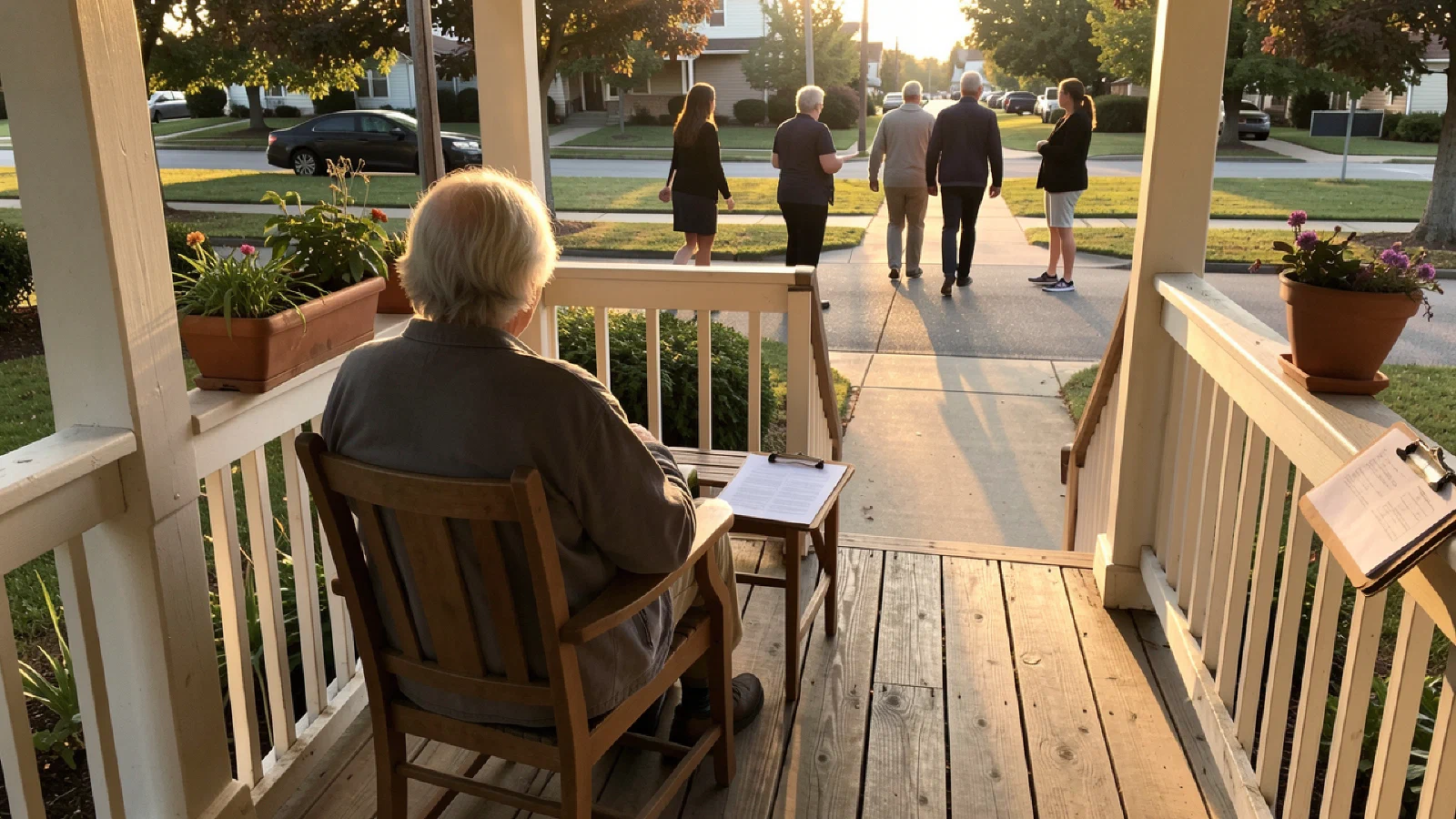
On the third Friday of May, Connie Fitzgerald put a flyer in twelve mailboxes on her street in Roswell, Georgia. The flyer said: Front Porch Friday. Third Friday of every month. 5 PM. Her porch. Iced tea. Twelve neighbors came. Nine of them she did not know by name, though they had lived on her street for a combined total of 112 years.
That is the whole architecture. A date, a time, a porch, a pitcher.
By September, forty-one people came to the third Friday. She had started bringing a sign-in sheet with name and house number. By the end of the month she had a list of 78 names, people who had attended at least once. Three of them were widowed and alone, and she had learned, by talking to them, that before the first Friday none of the three had spoken to a neighbor in the previous month.
What Neighborhoods Require#
The World Health Organization’s Age-Friendly Cities framework covers eight domains of urban life that affect aging: outdoor spaces and buildings, transportation, housing, social participation, respect and social inclusion, civic participation, communication and information, and community support and health services. More than 500 American communities are enrolled in the framework. Most of them have adopted the language. Fewer have changed the substance.
The framework is worth naming because it gives Connie’s porch its structural location. What she built in three months, informally and without a budget, is a social participation and community support structure. It is exactly what the framework calls for in its social participation domain: regular, geographically accessible, informally organized opportunities for residents to know each other. The framework endorses it. Most enrolled communities have not built it.
This is not a criticism of municipal government. Formal programs require staff, funding, insurance, and governance structures. They tend to serve people who already participate in formal programs. The retired widow who would not join a neighborhood association and would not attend a senior center program came to a porch for iced tea. The threshold for the porch was lower.
What Formal Structures Provide and Miss#
Neighborhood associations are the closest parallel to what Connie built, and they are genuinely useful for some things: coordinating with municipal government, managing shared infrastructure, organizing larger events. They also require dues, governance, meeting attendance, and a level of formal engagement that excludes many of the residents who would benefit most from neighborhood connection. The person most isolated on any block is rarely the one attending the neighborhood association meeting.
The Village model, organized through the Village to Village Network, operates differently. Villages provide mutual aid between neighbors: rides to medical appointments, help with small household tasks, coordinated social events, and regular wellness check-ins. They charge annual membership fees, typically between $200 and $600, with income-based reduced rates. There are approximately 400 Villages operating across the country, covering about 60,000 members. The evidence on Village participation and health outcomes is good: members report significantly lower rates of social isolation and higher rates of aging in place than demographically comparable non-members.
The Village model adds structure, reach, and accountability to what informal neighbor practices like Connie’s Front Porch Friday provide informally. The Village can organize a ride to a medical appointment. Front Porch Friday cannot. Front Porch Friday can reach the neighbor who would not pay a membership fee or fill out an intake form. The Village cannot do that. They are not competing. They are complementary tools for the same purpose.
The Faith Community Dimension#
The most consistently maintained neighborhood-level social infrastructure in most American communities is the faith community. Churches, synagogues, mosques, and temples show up every week. They have buildings. They have existing social networks. They have long histories of mutual aid and community care. The evidence on faith community participation and older adult health is addressed more fully in this series’ piece on third places, but the summary is consistent: regular participation in a faith community is one of the strongest predictors of social connection and cognitive health in older adults that the literature identifies.
Connie is not affiliated with a congregation. Her Front Porch Friday exists independently. But the three residents on her list who are most regularly isolated are not connected to any faith community either, which is why the porch reaches people that other infrastructure misses. The faith community and the front porch are not alternatives to each other. They serve overlapping but not identical populations, and the neighborhood with both is better served than the neighborhood with only one.
The Technology That Can Help and the Technology That Cannot#
Connie’s AI maintains her sign-in list and sends a monthly reminder to everyone who has attended at least once. She uses a free Nextdoor account to announce each gathering to a wider neighborhood radius. That is the technology. It took her fifteen minutes to set up and requires nothing from her on the day of each Friday except showing up.
There is no technology that makes neighbors know each other’s names. There is no platform that produces the specific social contact of sitting on a porch in September watching the neighborhood pass. There is no AI that replaces the experience of a person you have lived beside for nine years finally learning your name. The technology can maintain a list and send announcements. The porch is the thing.
This matters because neighborhood social infrastructure is sometimes described as a technology problem: the right platform, the right app, the right notification system. Nextdoor has been deployed in tens of millions of American neighborhoods. It has not solved residential isolation. The platform is not the barrier. The decision to put a flyer in twelve mailboxes and sit on a porch is the barrier, and that decision requires a person, not a platform.
Replication#
Front Porch Friday is replicable anywhere a person has a porch, a front step, a patch of sidewalk, or access to a community space. The elements are: a fixed date and time, a location that is easy to find, something to drink, a sign-in sheet after the third gathering. The organizer provides presence and the willingness to learn names. The AI provides a list and a monthly reminder. Everything else is the decision to begin.
Connie’s three widows were on her street. They were not known to the social services infrastructure of Roswell, Georgia. They were not in anyone’s outreach database. They were not on any program’s caseload. They were in the third house from the corner and the yellow house at the end of the block and the apartment above the converted garage. They came to a porch because a flyer appeared in their mailboxes.
The architecture is not complicated. Seventy-eight names by September. Three widows who had not spoken to a neighbor before the first Friday. The decision to begin is the only constraint.
How this article connects to others in Blue Mirror.
Sources cited in this article.
- World Health Organization. Global Age-Friendly Cities: A Guide. WHO Press, 2007.
- Village to Village Network. "Find a Village.".
- AARP Public Policy Institute. Livable Communities: An Evaluation Guide. AARP, 2022.
- Lum, Terry Ya-Ling, and Elizabeth Lightfoot. "The Effects of Volunteering on the Physical and Mental Health of Older People." Research on Aging, vol. 27, no. 1, 2005, pp. 31–55.