The Knowledge That Walks Out the Door
Series 09: Across the Years
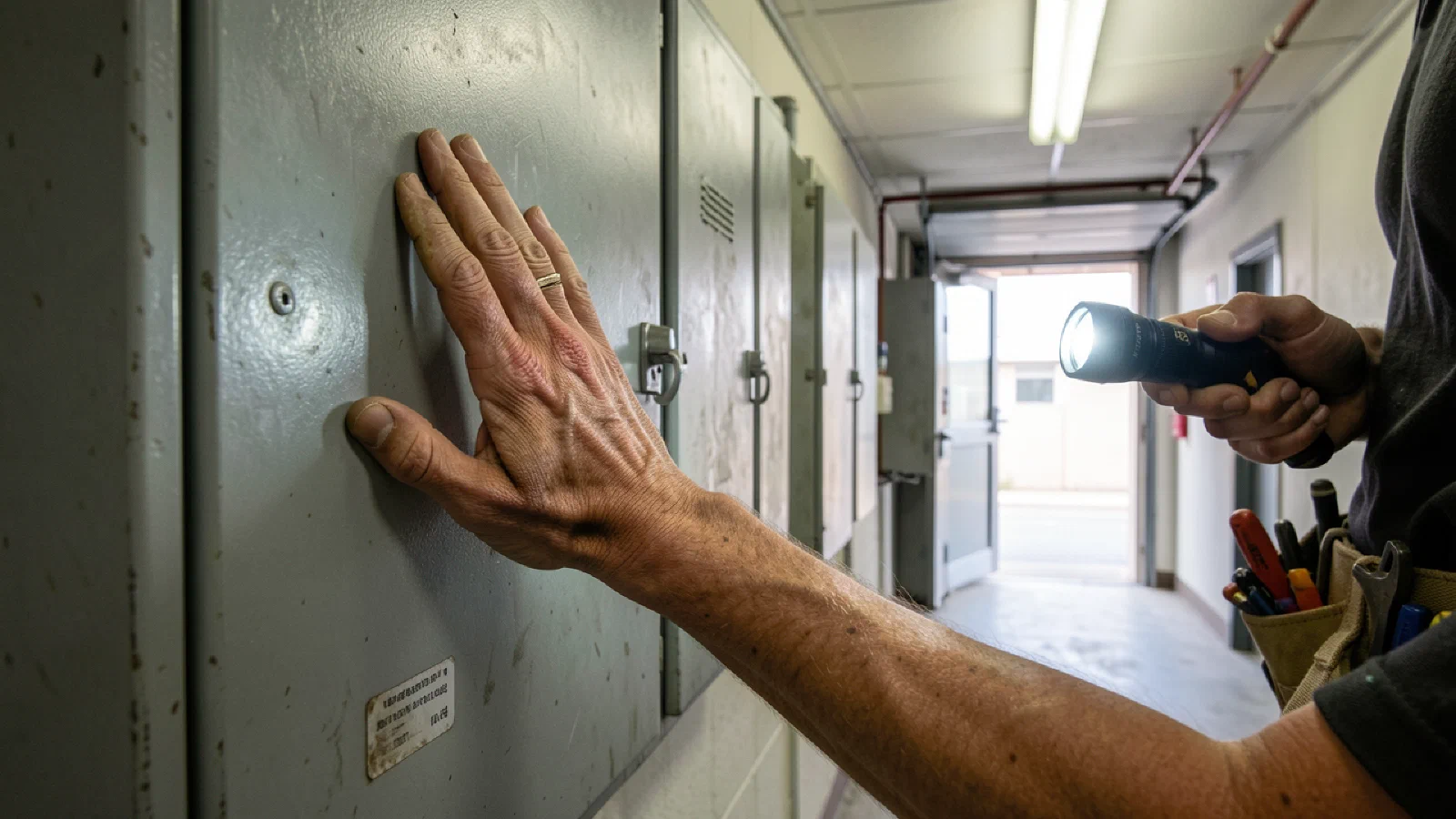
Frank DiMaggio puts his hand flat against a panel and listens. Kevin Osei, standing beside him, watches. There is a hum from this particular panel, in this particular building on Penn Avenue, that Frank has heard for eleven years. It changed three weeks ago. Frank knows what the change means: the capacitors in the third bank are beginning to fail. No instrument in his van has confirmed this. None of them will for another two to three weeks, by which point the failure will be accelerating and the repair will be larger. Frank knows it from the hum.
“You hear that?” Frank says.
Kevin listens. He is 26, two years out of his apprenticeship, with enough experience to know how much he does not know and not yet enough to know what he is not hearing. He hears a hum. He does not hear what the hum means.
Frank explains it: the frequency, the slight drop in pitch from where this panel usually runs, what that drop indicates about the capacitors, how to distinguish this specific failure signature from three other conditions that sound similar. The explanation takes eleven minutes. The AI in Frank’s phone is recording the explanation, not as a transcript but as a structured diagnostic reasoning chain, tagged to the building, the panel type, and the failure mode. Kevin is taking notes. The AI is doing something the notes cannot do.
Frank is 73. He retires next spring. Forty-two years on the same commercial and industrial sites in Pittsburgh. When he goes, Kevin is the only person who will carry forward what Frank knows. With the AI, Kevin will not be the only copy.
What Tacit Knowledge Is#
The philosopher Michael Polanyi named the problem in 1966: we know more than we can tell. Every expert does. A surgeon knows things about tissue response that she cannot fully articulate in a training manual. A teacher knows which specific intervention works for which specific student in which specific moment. A master electrician knows a hum that predicts a failure two weeks before instruments confirm it.
This is tacit knowledge: expertise that lives in pattern recognition, in the intuition that developed from ten thousand instances of doing the thing and learning from what happened. It is not irrational. It is not mystical. It is knowledge that cannot be made fully explicit because its structure is too complex, its context-dependence too fine-grained, for language to contain it completely.
The gap between what Frank knows and what Frank can write in a training manual is the tacit knowledge at risk when Frank retires. The training manual can capture the procedure: how to inspect an electrical panel, what instruments to use, what readings indicate problems. It cannot capture the hum. It cannot capture forty-two years of pattern recognition compressed into the way Frank’s hand rests against the panel casing before he says anything.
The Scale of the Problem#
This is not a story about one electrician. The generation of Americans retiring now contains the largest accumulation of professional, craft, and civic expertise in the country’s history. They built the institutions, the infrastructure, the clinical practices, the civic organizations, and the institutional knowledge that the people replacing them are now trying to maintain. They are leaving faster than any apprenticeship system can transfer what they know.
Hospitals losing nurses with thirty years of pattern recognition. The nurse who can read a patient’s affect before the numbers change, who knows which attending physician to call and how to frame the concern so it gets acted on, who knows what “off” looks like in a patient who cannot fully articulate what has changed. When that nurse retires, the knowledge leaves. The younger nurse who replaces her gets the procedure manual, the orientation checklist, and whatever institutional memory her colleagues can share during the first months.
Farms losing generations of knowledge about specific land, specific soil, specific crop behavior that cannot be found in an agricultural extension publication. The farmer who knows that this low field floods in May not because the county drainage map says so but because she has watched it flood for forty years. When she sells the farm, that knowledge does not transfer with the deed.
Schools losing teachers who know which specific students respond to which specific interventions, built over decades of watching children learn and fail and learn again. The teacher who knows that this particular child shuts down when corrected publicly and opens up when corrected privately, who knows this not from theory but from watching it happen sixty times. That teacher’s departure is, for the students she was still going to teach, a loss they will not be able to name.
Why Writing It Down Does Not Work#
Knowledge management systems capture what can be made explicit. Procedures. Checklists. Protocols. Decision trees. These systems have value: they ensure that the explicit knowledge an organization holds is accessible to the people who need it, even when the original experts are not available.
What they cannot capture is the knowledge that cannot be made fully explicit. Frank could write a checklist for electrical panel inspection. The checklist would not contain the hum. It would not contain the forty-two-year pattern recognition that tells him which hum means which thing, or the contextual judgment that says this building’s panels have always run slightly warm so the threshold that matters here is different from the threshold that matters in the building three blocks over. The checklist captures the procedure. The tacit knowledge is what Frank does between the steps.
This is not a limitation of effort or intelligence. It is a structural feature of how tacit knowledge works. It lives in context, in relationship, in the specific accumulated pattern of experience. Language can point at it. Language cannot contain it.
Why Apprenticeship Works and Is Disappearing#
Tacit knowledge transfers through relationship: watching, doing, asking, failing, being corrected. The apprentice stands at the master’s side and watches the hum diagnosis happen in real time, with Frank explaining the reasoning while he works. Kevin hears what Frank says and watches what Frank does and asks what Frank means and makes mistakes and hears why the mistake was a mistake. Over time, the pattern becomes Kevin’s own. The tacit knowledge transfers because the relationship makes transfer possible.
Apprenticeship is the oldest knowledge transfer technology humans have. It works. It is declining in every sector except skilled trades, and it is declining there too, as the economics of training time compress apprenticeship periods to the minimum required for certification rather than the duration required for genuine expertise acquisition. Frank had a full four-year apprenticeship under a master electrician who had thirty years on him. Kevin had two. The difference is in how much of Frank’s pattern recognition Kevin has been able to observe.
The institutional pressure is real: training time costs money, apprentices are not producing at journeyman rates while they are learning, and the economy of a skilled trades operation has limited patience for the duration that genuine expertise acquisition requires. The result is a systematic undertransfer of tacit knowledge across every sector where apprenticeship structures still exist.
What AI Capture Changes#
The AI in Frank and Kevin’s sessions is not replacing the apprenticeship. Kevin still needs to stand at Frank’s side, in this building, with this hum, and watch Frank’s hand on the panel and hear Frank’s explanation. The tacit knowledge transfers through the relationship. There is no substitute for that.
What the AI provides is a second copy. A structured representation of the reasoning chains Frank expresses during the showing and talking. When Kevin has an electrical panel problem that Frank has never walked him through, in a building Frank has never entered, Kevin can query the reasoning library: what does Frank check when the pitch drop is in this frequency range? What are the three conditions Frank distinguishes from each other and how does he distinguish them? The AI answers from forty-two years of captured reasoning. Frank does not have to be in the room.
The knowledge library the AI is building from Frank and Kevin’s sessions is not a manual. It is a structured representation of Frank’s diagnostic reasoning, organized by problem type, building condition, panel type, and failure mode. It is queryable in the way a manual is not, because it contains the reasoning, not just the conclusions. When Kevin is standing in front of a panel in a building Frank never visited, and he hears something that sounds like the Penn Avenue hum but is not quite the same, he can ask the library: what does Frank check next when the frequency is close but the pitch is different? The library can tell him.
The Institutional Dimension#
Frank and Kevin are one pair. They represent a problem that exists in every sector where tacit expertise is retiring faster than it can be transferred. Hospitals, schools, utility companies, government agencies, manufacturing plants, civic organizations: all face the same retirement wave, all have the same inadequate mechanism for preserving what is leaving.
BGO pairings with AI capture are the first scalable approach to this problem. An organization that is losing ten expert employees to retirement over the next three years can pair each of them with the person who will fill their role, structure the pairing around explicit knowledge transfer sessions, and run AI capture throughout. The capture does not replace the relationship. It supplements the relationship with a reasoning library that persists after the expert is gone.
This requires organizations to make decisions they have not yet made: allocating pairing time during the transition period, committing to the AI capture infrastructure, treating knowledge preservation as a retirement transition deliverable rather than an optional benefit. These decisions have not yet been made systematically at any scale. The cost of not making them is the knowledge that walked out the door.
Frank, Five Years from Now#
Frank retires next spring. Kevin will be a journeyman electrician who has heard the hum and knows what it means, because Frank stood at enough panels with him and explained the reasoning often enough that the pattern began to become Kevin’s own.
Kevin will train his own apprentice, in time. The apprentice will be standing at Kevin’s side when Kevin puts his hand on a panel and explains why the hum means what it means. The explanation will use the reasoning Frank gave Kevin, shaped into Kevin’s own language and his own pattern of observation. The AI library Frank and Kevin built will still be there: forty-two years of diagnostic reasoning, organized and queryable.
The knowledge did not walk out the door. It walked into Kevin, and into the library, and eventually into whoever Kevin trains. That is what the relationship was for. That is what the AI was recording.
How this article connects to others in Blue Mirror.
Sources cited in this article.
- Polanyi, Michael. The Tacit Dimension. Garden City: Doubleday, 1966.
- Nonaka, Ikujiro, and Hirotaka Takeuchi. The Knowledge-Creating Company. New York: Oxford University Press, 1995.
- DeLong, David W. Lost Knowledge: Confronting the Threat of an Aging Workforce. New York: Oxford University Press, 2004.
- Collins, Harry, and Robert Evans. Rethinking Expertise. Chicago: University of Chicago Press, 2007.
- U.S. Department of Labor. Apprenticeship: Addressing the Skills Gap. Washington: Employment and Training Administration, 2023.
- Billett, Stephen. Learning Through Work: Workplace Affordances and Individual Engagement. London: Routledge, 2001.
- AARP Public Policy Institute. The Aging Workforce and the Coming Knowledge Gap. Washington: AARP, 2020.