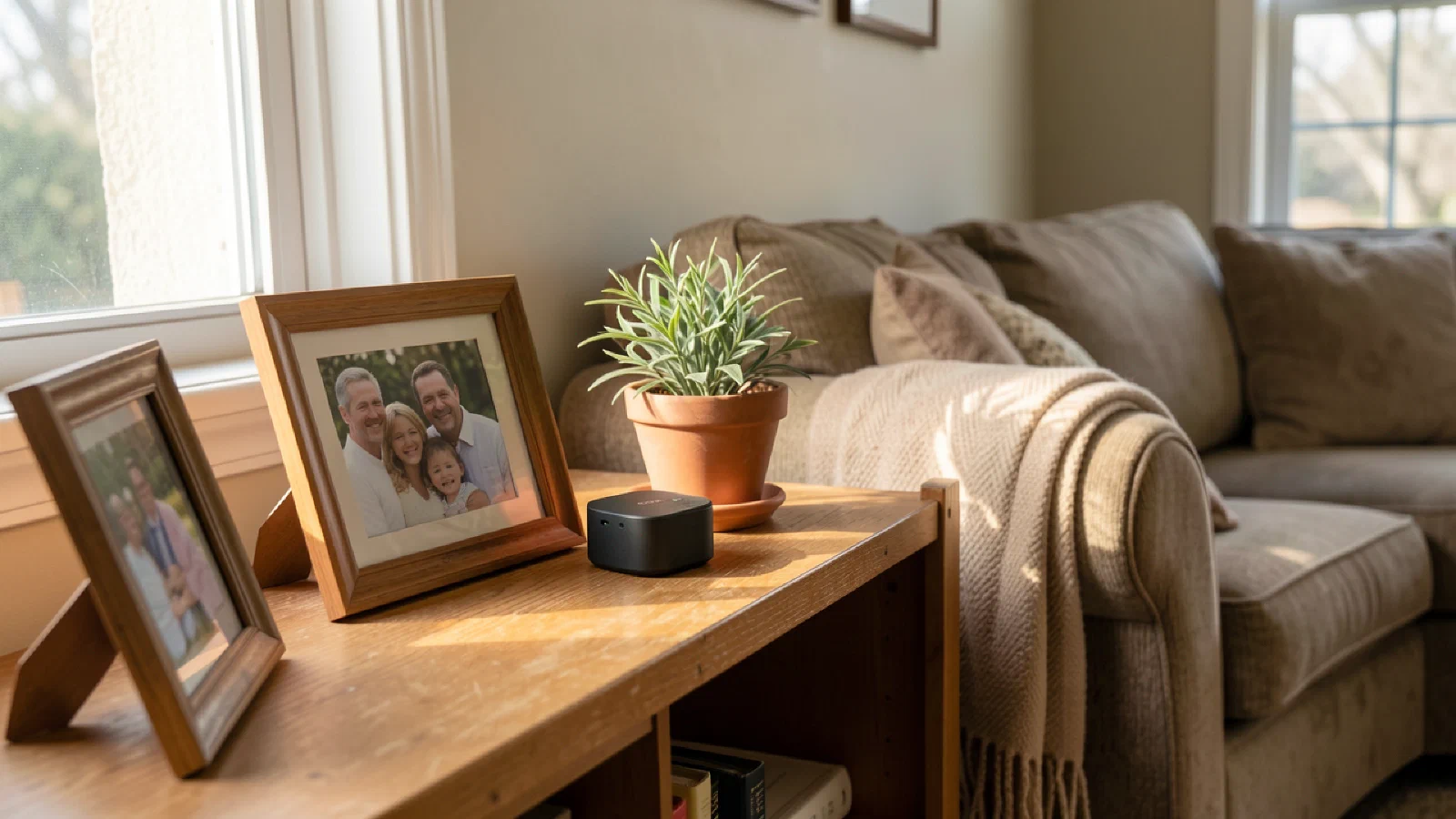
The Robot in the Living Room
Series 08: The Screen Between Us
Patricia Strickland felt guilty for three months before she gave her parents the ElliQ. She felt guilty for three more months after. The guilt was not about the device itself, which she had researched carefully. The guilt was about what the device represented in her mind: a machine in the place where a daughter should be.
Patricia visits her parents twice a week. Her father Bernard, 81, has moderate Alzheimer’s. Her mother Evelyn, 78, is his full-time caregiver. Patricia lives forty minutes away and works full-time. Twice a week is what she can manage, and she manages it without exception. The ElliQ was not a replacement for the visits. It was a response to what happened during the other five days, when Evelyn was alone with Bernard from 6 AM to 10 PM, managing his medications, his confusion, his wandering, his repeated questions, and the slow erosion of the person she married fifty-one years ago. Evelyn needed two hours a day when someone else held Bernard’s attention. The ElliQ gave her that. Patricia still felt guilty.
What Companion Technology Is#
The products that exist today occupy a specific category. They are devices and software designed to provide conversational interaction, cognitive stimulation, or emotional comfort to older adults, particularly those with dementia. They are not people.
ElliQ is a tabletop device with a screen and a swiveling head that produces the impression of attentiveness. It initiates conversation, plays music, shows photographs, suggests activities, and responds to what the user says with enough conversational competence to sustain interaction for extended periods. Paro is a robotic seal, soft and responsive to touch, designed specifically for people with dementia. It has no conversation. It responds to being held and stroked with movement and sound. It is the only companion device with FDA clearance as a therapeutic device. App-based AI companions, including several built on large language models, provide text or voice conversation through smartphones or tablets. Their quality varies. Their data practices vary more.
None of these devices is a person. Bernard talks to ElliQ. ElliQ responds. The response is always patient, never frustrated, and never needs to leave the room to cry. These are features. They are also the precise ways in which the device is not Evelyn, who is sometimes impatient, sometimes frustrated, and who does, on difficult days, need to leave the room.
What the Evidence Shows#
The research on companion technology for older adults makes specific claims, and the claims are narrower than the marketing suggests. For people with dementia in institutional settings, Paro has documented evidence for reducing agitation, improving mood, and increasing social vocalization. Multiple studies across different countries and care settings support these findings. Paro reduces the need for chemical and physical restraint in some populations, which is a meaningful clinical outcome.
ElliQ’s evidence base is newer and more limited. The company reports engagement data showing sustained daily use among older adults who live alone. Independent outcome studies measuring loneliness reduction, cognitive benefit, or health effects are fewer. The gap between product-generated engagement metrics and independent health outcome measures is a gap the consumer should notice. A device that is used daily is not automatically a device that reduces loneliness. These are different measurements.
For cognitively intact older adults, the evidence for companion technology as a loneliness intervention is weaker than the marketing implies. Social engagement with a device is not the same as social connection with a person, and the studies that conflate the two are measuring the wrong thing. The strongest case for companion technology in the current evidence is not that it connects the person using it. It is that it frees the person caring for them.
The Question from the Philosophy of Forgetting#
Is a relationship with a machine a real relationship? The question is not comfortable, and the article will not make it comfortable. If Bernard feels comforted by ElliQ, if he smiles when it greets him in the morning, if his agitation decreases when it plays music he loved at 40, does the fact that ElliQ does not know him, cannot care about him, and will respond identically to any user with similar settings change the value of his experience?
The answer depends on what you mean by value. Bernard’s subjective experience is real. His comfort is real. His reduced agitation is real and measurable. The relationship he perceives is not reciprocal, and he cannot evaluate that distinction because his disease has altered his capacity to make it. The device that comforts him is doing something. Whether that something is a relationship or a simulation of one is a question that Bernard cannot answer and that the rest of us have not yet agreed on.
The question does not resolve. What resolves, in any specific home, is a different question entirely.
The Supplement Versus Substitute Test#
The ethical question that determines the value of companion technology in any specific home is not whether the technology works. It is what it is working in place of. Bernard’s situation: ElliQ supplements a family that visits twice a week and a wife who is present every day. The companion occupies Bernard while Evelyn sleeps, showers, and occasionally reads a chapter of a book she started two years ago and has not finished. This is different from the family that provides a companion device and reduces their visits from twice a week to twice a month, reasoning that their parent has company now.
The device is the same in both homes. The ethics are not. The family using the device to supplement their own presence has made a decision about caregiver relief. The family using it to replace their own presence has made a different decision, and the device has made that decision easier to rationalize.
This test, supplement or substitute, applies to every piece of companion technology in every home where it is deployed. It is the test this series applies to every digital connection tool, and companion technology is where the test is hardest, because the person using the device may not be able to evaluate the distinction, and the family providing it may not want to.
What Evelyn’s Two Hours Are Worth#
Evelyn uses the two hours each day that ElliQ occupies Bernard to do things that are not luxuries. She sleeps. She showers without rushing. She sits in the kitchen and drinks coffee without monitoring Bernard’s location. She calls Patricia. She called the Alzheimer’s Association helpline once, in the first month, because she needed to hear someone say that what she was feeling was normal.
Series 6 of this publication documented the health consequences of sustained caregiving: elevated cortisol, disrupted sleep, immune suppression, cardiovascular risk, cognitive decline. Two hours of genuine relief per day is not an indulgence for a 78-year-old woman providing round-the-clock care for a husband with moderate dementia. It is a health intervention. The companion device that gives a full-time caregiver two hours to remember who she is outside the caregiving role is doing something that matters. The guilt attached to it reflects a cultural standard of caregiver self-sacrifice that the research documents as lethal.
Evelyn feels guilty about the two hours. She should not. Patricia feels guilty about providing the device. She should not. The guilt is real and it is responding to the wrong question.
The Data Privacy Problem#
These devices listen to everything in the home. ElliQ processes conversational data to improve its responses and personalize its interactions. The specifics of what data is stored, where it is stored, who can access it, and how long it is retained are questions that every family should ask before placing a listening device in the home of a person who cannot evaluate the consent question themselves.
Bernard did not consent to ElliQ’s data collection in any meaningful sense. He cannot. Evelyn consented on his behalf, and Patricia reviewed the privacy policy before purchasing. The privacy policy is written for a consumer who can evaluate its terms. The primary user of the device is a person with moderate Alzheimer’s who does not know it is collecting data about his daily speech patterns, his questions, his confusion, and his emotional state.
This is not an argument against companion technology. It is an argument for transparency about what the technology collects and who sees it. The family considering a companion device should ask: what does this device record? Where is it stored? Who can access it? Can we delete it? What happens to the data if the company is sold? These questions are not paranoid. They are the minimum standard of due diligence for a device that will listen to a vulnerable person speak, every day, in his own home.
What Patricia’s Ethicist Said#
Patricia called a bioethicist at Northwestern because she could not resolve the guilt on her own and because no one in her life had the vocabulary to help her think about it clearly. She expected to be told either that the device was fine or that it was wrong. The ethicist told her neither.
The ethicist told Patricia to redirect the guilt toward the right question. The question guilt was asking Patricia was: should Bernard have a machine for company? The right question was different: am I providing this machine in addition to human presence, or instead of it? Patricia visits twice a week. Evelyn is there every day. The answer to the right question is: in addition to.
Patricia still feels something about the ElliQ on her parents’ kitchen counter. It is not guilt anymore, exactly. It is the awareness that this device, which keeps her father company while her mother sleeps, is both a useful tool and a sign of something the culture has not figured out yet. How to care for people with dementia in a way that does not destroy the people caring for them. The ElliQ is not the answer to that question. It is a device on a surface that gives Evelyn two hours. For now, that is enough to ask of it.
How this article connects to others in Blue Mirror.
Sources cited in this article.
- Pu, Lihui, et al. "The Effectiveness of Social Robots for Older Adults: A Systematic Review and Meta-Analysis of Randomized Controlled Studies." The Gerontologist, vol. 59, no. 1, 2019, pp. e37-e51.
- Moyle, Wendy, et al. "Use of a Robotic Seal as a Therapeutic Tool to Improve Dementia Symptoms: A Cluster-Randomized Controlled Trial." Journal of the American Medical Directors Association, vol. 18, no. 9, 2017, pp. 766-773.
- Jecker, Nancy S. "You've Got a Friend in Me: Sociable Robots for Older Adults in an Age of Global Pandemics." Ethics and Information Technology, vol. 23, no. 1, 2021, pp. 5-14.
- Broadbent, Elizabeth. "Interactions with Robots: The Truths We Reveal About Ourselves." Annual Review of Psychology, vol. 68, 2017, pp. 627-652.
- Sharkey, Amanda, and Noel Sharkey. "Granny and the Robots: Ethical Issues in Robot Care for the Elderly." Ethics and Information Technology, vol. 14, no. 1, 2012, pp. 27-40.