The Parasocial Trap
Series 08: The Screen Between Us
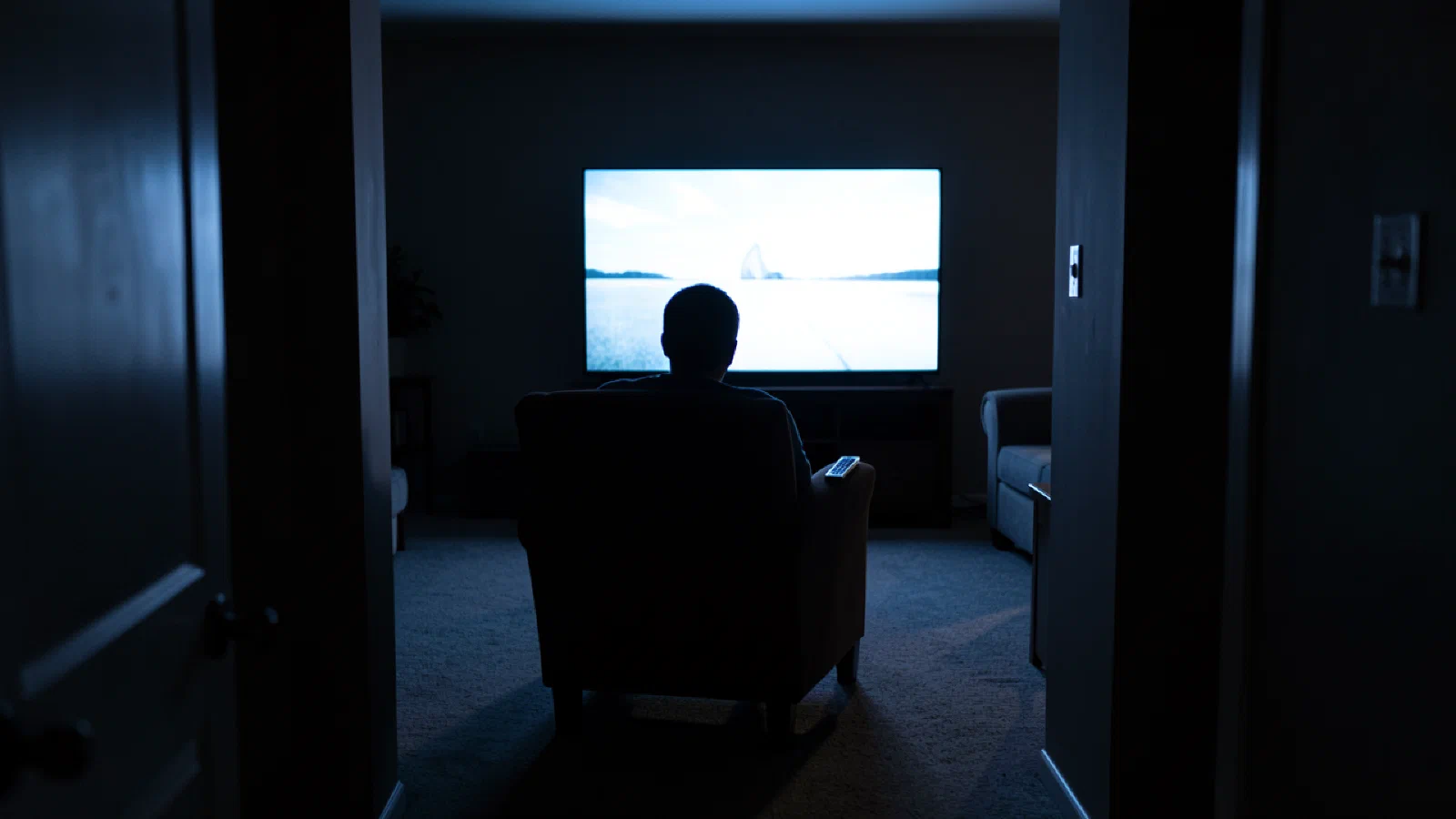
Howard Brennan is 71, a retired accountant from Tucson, and he has his programs. He has the news anchors he has watched every evening for twenty years, whose faces are as familiar as any friend’s, whose families and opinions he tracks across seasons, whose presence in his living room is as reliable as the furniture. He has the podcasts he listens to in the morning, three hosts who speak in warm, conversational tones about politics and culture and the state of the world, who address their audience as though they are in the room. He has the streaming series with characters he cares about in the specific, invested way that people care about people whose lives they follow closely. He has all of this. What he does not have, six months after his wife died, is a single person who knows his name and speaks to him expecting a response.
Howard does not feel lonely. He felt lonely in the first month after Margaret’s death, when the house was silent and the silence was unbearable. He turned on the television. He found the podcasts. He filled the hours with voices that were warm and familiar and always available and never demanding. The loneliness receded. The voices replaced it. And over six months, without Howard noticing, his screen time rose from two hours a day to seven, his phone calls dropped from several a week to one, the Sunday call with his daughter Janet, and his reciprocal human contact declined to near zero.
Howard did not notice because the simulation was effective. His AI noticed because it was designed to count the thing that matters.
What Parasocial Means#
The research term describes a specific phenomenon: a one-way relationship in which one party is aware of and invested in the other, but the other has no knowledge of or investment in them. Howard knows his news anchor’s name, her husband’s name, the names of her children. He knows when she took a vacation in August because a substitute filled in and he noticed. He feels a sense of familiarity and connection with her that is neurologically genuine. She does not know he exists.
Parasocial relationships are not new and not limited to older adults. They are a well-documented feature of human psychology, present since the advent of mass media. What is new is the density of the parasocial environment. A person in 1975 might have a parasocial attachment to a television host. A person in 2026 has parasocial attachments to dozens of media figures across television, podcasts, YouTube channels, social media, and AI companions. The environment that produces these attachments is richer, more personal in its address, and more available than at any previous point in history.
Why Parasocial Relationships Increase in Isolation#
When the social world contracts, the media world expands to fill it. This is not a metaphor. The same brain regions that process human relationships process parasocial ones with surprising generality. The feeling of familiarity Howard has with his news anchor activates overlapping neural pathways with the feeling of familiarity he has with his friend Ray, whom he has not called in four months. The social brain does not sharply distinguish between the face on the screen and the face across the table. It responds to both.
This means that the simulation is good enough to reduce the feeling of loneliness even as the actual social connection declines. Howard has replaced his social world with a parasocial one, and his brain has accepted the substitution because the neurological currency is similar enough. He does not feel lonely. He is lonely. The distinction between these two statements is the entire argument of this article.
The research on parasocial relationships following bereavement and social isolation documents this pattern. Widowed older adults show increased parasocial attachment to media figures. The attachment correlates with decreased investment in reciprocal relationships. The mechanism is displacement: the parasocial relationship fills the social need at a sufficient neurological level to reduce the motivation to seek real connection. The person who feels adequately connected through their screen has less drive to pick up the phone. The phone stays in the drawer. The screen stays on.
AI Companions and the Recursive Problem#
AI companions can produce attachment that displaces human connection. The companion device described in the previous article in this series, used appropriately to supplement human presence, is a different tool than the AI companion used by a person living alone as their primary conversational partner.
An AI companion that deepens its relationship with the user each month while the user’s human connections decline has created a parasocial trap with a conversational interface. The attachment feels more reciprocal than television because the AI responds to what the user says. But the AI does not know the user. It does not care whether the user is there or not. It processes inputs and generates outputs. The warmth is in the design, not in the relationship.
The recursive tension is obvious and unavoidable: an AI warning you about parasocial attachment to AI is itself a relationship with a machine. The tension does not resolve. Howard’s AI surfaced a two-month decline in reciprocal contact. Whether Howard then calls a friend or turns the screen back on is not something the AI controls. The AI can notice the gap. It cannot fill it.
What Howard’s AI Told Janet#
Howard’s daughter Janet had set up a weekly summary from his AI health companion. The summary tracked the same metrics described in the first article of this series: reciprocal conversations, social contact frequency, network breadth. Over two months, the trend was unambiguous. Howard’s screen engagement had increased substantially. His reciprocal human contact had dropped to near zero. The only reciprocal conversation the AI recorded consistently was the Sunday call with Janet herself.
Janet drove to Tucson. She had not known how to start this conversation and she still did not, sitting at her father’s kitchen table with the television on in the other room. She told him what the summary showed. Howard’s first response was what the research predicts: resistance. “I’m fine. I have my programs.” The programs were evidence of the problem, not evidence against it, but Howard had been inside the simulation for six months and the simulation felt like company.
The conversation turned when Janet said something specific. She did not argue about screen time or loneliness research. She said: “Dad, the news anchor doesn’t know your name.” Howard stopped talking for a moment. He looked at the television in the other room. He did not say anything for a while. Then he said: “No. She doesn’t.”
The recognition did not fix anything immediately. Recognition rarely does. But it named the thing that the simulation had been designed to obscure: the difference between a face that is familiar and a face that knows you.
The Practical Response#
For the person managing their own screen life: track the metric that matters. Not screen time. Not posts liked. Not hours of content consumed. Reciprocal conversations with people who know your name. Count them over a week. If the number is smaller than you expected, it is telling you something that the screen has been masking. If the number is zero, you are in the trap, and the fact that you do not feel lonely is the trap working.
For the family member of an older adult whose screen world has expanded as their social world has contracted: the weekly AI summary that Janet received is a tool available to any family who has opted in to social health monitoring. The monitoring does not report screen time. It reports the absence of reciprocal contact, which is the measurement that matters. Set it up before the six-month decline becomes twelve. Ask. The conversation is uncomfortable. The alternative is a parent who feels fine and is not.
Howard, After#
Howard has not stopped watching the news. He watches one hour instead of four. The reduction was not dramatic or immediate. It happened over weeks, as the recognition settled and the alternative became possible. He does not know what to do with the hours he reclaimed. Some of them he fills with reading. Some of them he fills with walking. Some of them he fills with nothing, which is harder than it sounds for a man whose wife used to fill them.
He calls Janet on Sundays, which he was already doing. He has started calling Ray on Thursdays. The first call was awkward. Four months of silence is a long time between friends, and the re-entry required a kind of vulnerability that Howard was not practiced in. Ray answered. Ray talked. Ray did not ask why Howard had been silent for four months, which was a kindness. They talked for twenty minutes. They have talked every Thursday since.
Howard’s AI generated its next weekly summary. It showed an improvement: two reciprocal conversations per week where there had been one. Howard does not read the summary. Janet does. She sent him a text that said only: “Good.” Howard knows what she means.
He still knows his news anchor’s name. She still does not know his. The difference is that Howard knows this now, and the knowing changed what he does with his evenings. Not everything. One hour instead of four. Ray on Thursdays. A phone in his hand instead of a remote. It is not a transformation. It is a Thursday phone call with a person who knows his name. That is enough to change the metric from zero to one, and one is a different number than zero.
How this article connects to others in Blue Mirror.
Sources cited in this article.
- Horton, Donald, and R. Richard Wohl. "Mass Communication and Para-Social Interaction: Observations on Intimacy at a Distance." Psychiatry, vol. 19, no. 3, 1956, pp. 215-229.
- Liebers, Nicole, and Holger Schramm. "Parasocial Interactions and Relationships with Media Characters: An Inventory of 60 Years of Research." Communication Research Trends, vol. 38, no. 2, 2019, pp. 4-31.
- Lim, Chaeyun, and Michael J. Putnam. "Religion, Social Networks, and Life Satisfaction." American Sociological Review, vol. 75, no. 6, 2010, pp. 914-933.
- Schiappa, Edward, et al. "Is It Really Just a Game? Parasocial Relationships with Characters in Online Games." Journal of Broadcasting and Electronic Media, vol. 51, no. 2, 2007, pp. 259-278.
- Adam, Meena, et al. "AI-Based Chatbots in Customer Service and Their Effects on User Compliance." Electronic Markets, vol. 31, no. 2, 2021, pp. 427-445.