Caregiving Stole My Friends
Series 08: The Screen Between Us
Annette Dufresne is 62 and has not left her house for more than two hours at a time in fourteen months. Her mother Cecile, 88, has late-stage Alzheimer’s. They share a house in Baton Rouge. When Cecile was diagnosed three years ago, Annette sent the same text to twelve people in her life: “Mom has Alzheimer’s. I wanted you to know.”
Three people responded. Two maintained contact for more than a month. One is still here. Diane, her friend of twenty-two years, calls every Thursday at 7 PM for whatever time Annette has available. Some Thursdays that is forty-five minutes. Some Thursdays it is eight. Diane does not ask for more than what is available. She asks for what is available, and she shows up for it, every week, without exception.
Annette does not blame the nine people who did not respond. She does not blame the two who responded and then faded. She understands it. Caregiving conversation is heavy. The updates are difficult to hear. The appropriate response is unclear. Most people do not disappear because they do not care. They disappear because they do not know what to do with what they are being told, and the distance grows, and the silence becomes its own explanation, and then it has been eight months and the re-entry feels impossible. Annette understands all of this. Understanding it does not make Thursday any less important.
Why Friends Disappear#
The mechanics of caregiver social isolation are structural, not personal. Time is the first constraint. Annette’s day begins at 6 AM with Cecile’s medications and morning care and ends at 10 PM when Cecile is settled for the night, though the night itself is not reliable. The hours between are organized around Cecile’s needs: meals, toileting, medication, redirection when the confusion becomes agitation, the physical management of a woman who weighs 130 pounds and sometimes does not understand why she is being moved.
Energy is the second constraint. What remains after a day of caregiving is not social energy. It is the residue of sustained vigilance, a state that Series 6 documented as neurologically distinct from ordinary fatigue. The caregiver who finishes a fourteen-hour day does not have the capacity for reciprocal conversation, which requires attention, emotional availability, and the willingness to be present in someone else’s experience. Annette has used all of that on Cecile. What remains for Thursday is a narrower bandwidth, and Diane has learned to work within it.
The house is the third constraint. Annette cannot leave Cecile alone. Respite care is available in Baton Rouge but expensive, difficult to schedule, and requires Cecile to accept a stranger in her home, which on bad days she will not. Annette’s social world has contracted to the dimensions of her house. The friends who remain in her life are the ones who can reach her inside those dimensions.
The subject matter is the fourth. Caregiving conversation is not easy to receive. Annette’s life involves bodily functions, cognitive decline, insurance denials, and the slow disappearance of her mother’s personality. Most friends do not know how to respond to this material. The ones who try often say things that are well-intended and unhelpful: “I don’t know how you do it.” “You’re so strong.” “Let me know if you need anything.” These phrases close the conversation rather than open it. They express admiration from a distance. They do not produce connection.
None of this is the friends’ fault entirely. None of it is Annette’s. It is structural, and the structure is the house and the hours and the weight of what happens inside them.
What Diane Does Right#
Diane calls at 7 PM on Thursday. She does not say “call me when you have time.” She does not say “let me know when things settle down.” Things do not settle down. Annette does not have time. Diane calls at a specific hour on a specific day, every week, and takes whatever time is available.
Diane asks questions that require short answers. “How was today, one to ten?” “Did the aide come?” “What did you eat for dinner?” She does not require reciprocal disclosure. Some Thursdays Annette talks. Some Thursdays Annette listens while Diane talks about her own life, which is a gift, because hearing about a life that is not organized around Alzheimer’s is a form of oxygen that Annette does not know how to ask for. Diane sometimes just talks so that Annette can listen without performing.
Diane does not say “I don’t know how you do it.” She says “I’m here.” These are different sentences. The first closes a conversation by placing the caregiver on a pedestal. The second opens one by placing the friend in the room.
A Guide for the Diane in Someone’s Life#
If you are the friend of a caregiver and you want to stay, here is what the research and the experience suggest. Call on a set day and time, every week, without exception. Do not wait to be called. The caregiver will not call you. Not because she does not want to. Because the energy required to initiate a social contact, to decide who to call, when to call, what to say, is energy she does not have. You remove that burden by calling at the same time every week.
Ask short questions. Accept short answers. Do not require the caregiver to be interesting, insightful, or emotionally available. Some weeks she will be. Some weeks she will say four sentences and hang up because her mother is calling from the other room. Take the four sentences. They matter.
Talk about your own life. The caregiver’s world has contracted to the dimensions of caregiving. Your world is the window she has. A story about your weekend, your dog, your daughter’s school play is not trivial to her. It is the reminder that the world outside the house continues, and that she is still connected to it, and that someone is willing to bring it to her because she cannot go to it.
Do not say “let me know if you need anything.” She will not let you know. She does not know what she needs, and she does not have the bandwidth to figure it out and then ask for it. If you can do something specific, do it. If you cannot, be present. Presence is enough.
The 2 AM Voice Message#
Annette left a voice message for Diane at 2 AM on a Wednesday in March. Cecile had been agitated for four hours. Annette had managed it alone. By 2 AM, Cecile was asleep and Annette was sitting on the kitchen floor with her back against the cabinet, and she needed to say out loud what had just happened to someone who would hear it.
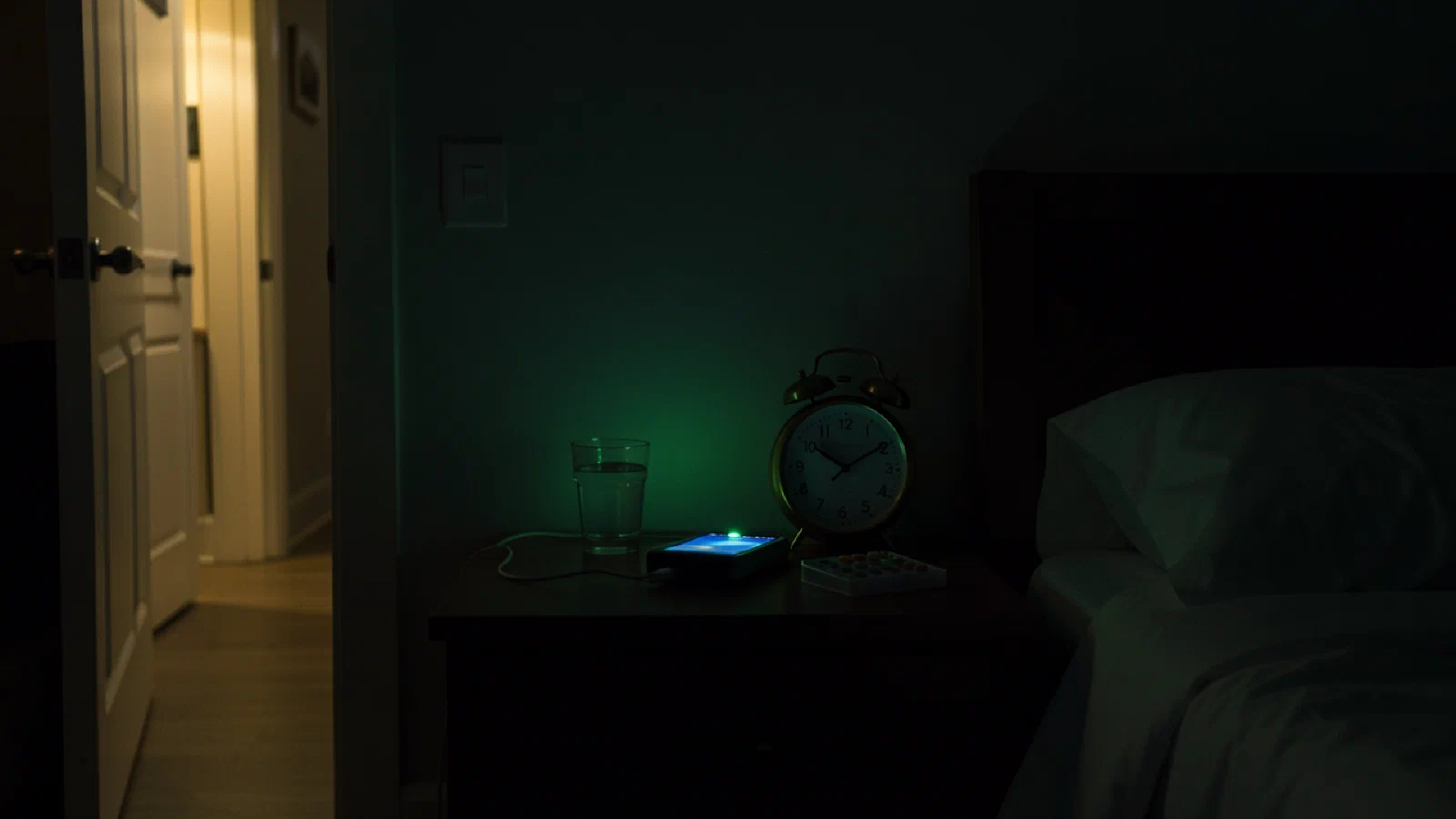
She did not call. Diane was asleep. She recorded a two-minute voice message on her phone and sent it. She said what happened. She said she was tired. She said she did not know how much longer she could do this. She said she was going to bed. Diane heard the message at 6 AM and recorded a response before Annette was awake. The response was three minutes long. Annette listened to it at 7 AM while she prepared Cecile’s breakfast. She did not respond to it. She did not need to. The exchange was complete.
Asynchronous communication is not a limitation for caregivers. It is the format that fits their lives. The voice message that does not require simultaneous availability, that can be sent at 2 AM and received at 6 AM, that carries the sound of a person’s actual voice and the specific texture of what they are feeling, is a tool designed for the exact constraints Annette lives inside. The friend who understands this and responds in kind is participating in a conversation that the schedule of their respective days would never allow in real time.
The Online Group#
Annette joined an online support group for adult children caring for parents with late-stage Alzheimer’s. The group has ninety-four members. It is moderated by a woman whose mother died of the disease two years ago. Annette posts two or three times a week, usually late at night, usually about something specific: a behavior she does not know how to manage, a feeling she does not know how to name, a question about medications or equipment or the look on her mother’s face when the recognition flickers and then goes.
The people in this group understand in a way that Diane, for all her faithfulness, cannot fully understand. Diane has not lived it. The people in the group have. They respond with the specificity that only shared experience makes possible: yes, that happens. Yes, it is terrifying. Yes, the look you are describing is a real thing, and here is what it meant in my mother’s case, and here is what I did, and here is what I wish I had done instead.
The group gives Annette something that Diane’s Thursday call cannot. Diane gives Annette something the group cannot. Both are real. Both are necessary. Neither is sufficient alone.
What Technology Cannot Fix#
Annette knows the difference between Diane’s Thursday call and having friends who could drop by, take over for an hour, bring dinner without being asked. She is not confused about the categories. The voice message at 2 AM and the online group and the Thursday call are not the same as a person at her kitchen table. They are what is available to a woman who cannot leave her house, and she is working with what is available.
Fourteen minutes on a Thursday evening is not equivalent to a social life. A support group of ninety-four people online is not equivalent to a neighborhood of friends who understand. What is available is enough to sustain a person through the week, which is not the same as enough. Annette knows this distinction. She lives inside it.
Thursday at 7 PM#
Cecile is asleep. Annette is in the kitchen. Diane calls. They have fifteen minutes tonight, maybe less if Cecile wakes. Annette does not say what she is really feeling about this week. She does not have the energy to assemble it into sentences. She says enough. She says Cecile had a bad Wednesday. She says the aide canceled. She says she finished a book, which is a sentence that means something larger than it says. Diane hears enough to know.
The call lasts fourteen minutes. Cecile does not wake. Annette hangs up and sits for a moment before she starts the evening routine. The fourteen minutes are not a cure for what caregiving has done to her social world. They are the floor that holds her through to Friday. That is what the Thursday call is for.
How this article connects to others in Blue Mirror.
Sources cited in this article.
- Greenwood, Nan, et al. "A Qualitative Study of Older Informal Carers' Experiences and Perceptions of Their Caring Role." Maturitas, vol. 68, no. 4, 2011, pp. 338-343.
- Brodaty, Henry, and Marika Donkin. "Family Caregivers of People with Dementia." Dialogues in Clinical Neuroscience, vol. 11, no. 2, 2009, pp. 217-228.
- Llanque, Sarah M., and Mary Enriquez. "Interventions for Hispanic Caregivers of Patients with Dementia: A Review of the Literature." American Journal of Alzheimer's Disease and Other Dementias, vol. 27, no. 1, 2012, pp. 23-32.
- Dam, Alieske K.M.C., et al. "A Systematic Review of Social Support Interventions for Caregivers of People with Dementia: Are They Doing What They Promise?" Maturitas, vol. 85, 2016, pp. 117-130.