The Tuesday Call Becomes the Wednesday Visit
Series 07: The Body in the Room
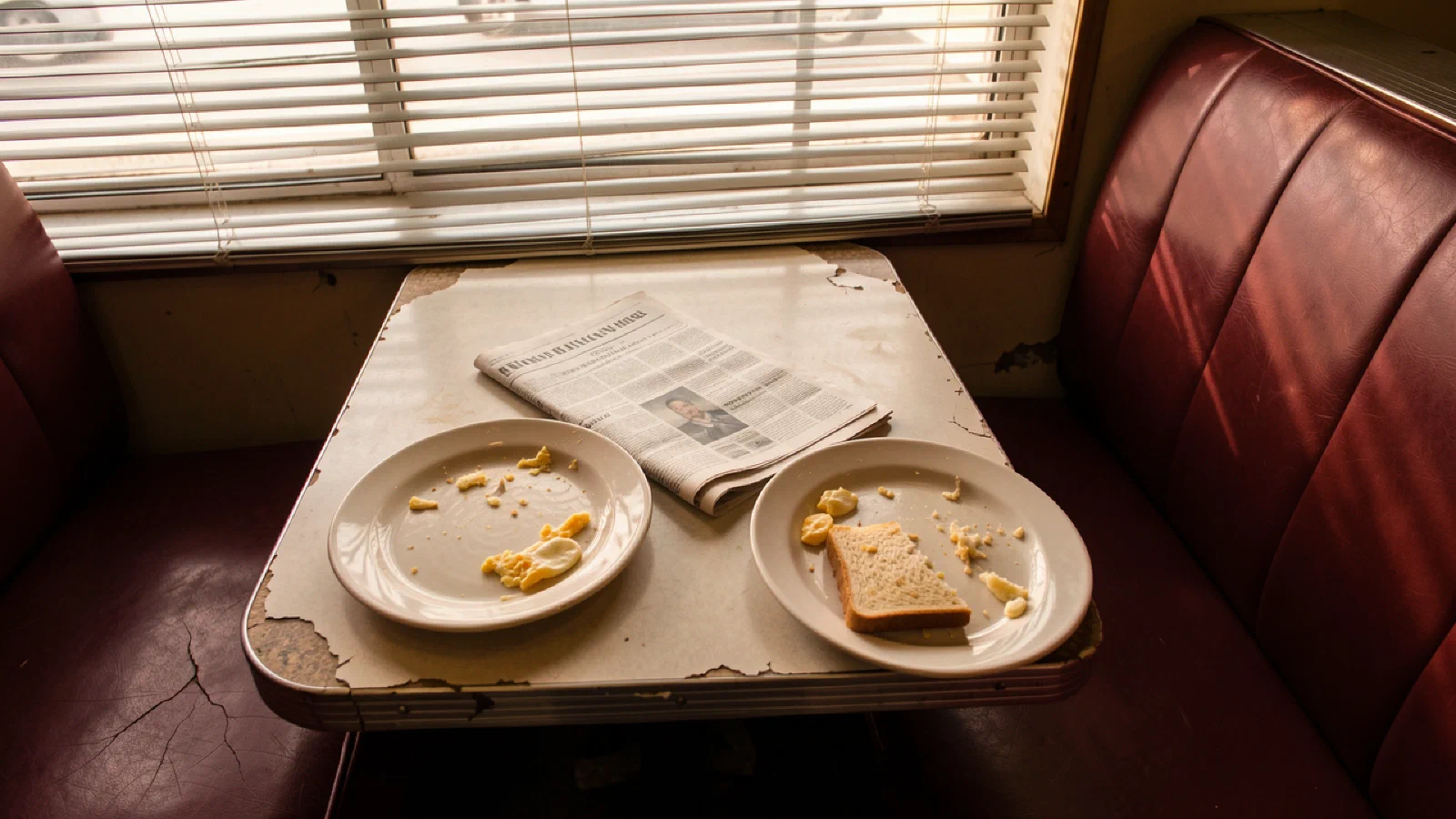
Ed Kaminski is 74, a retired electrician from suburban Columbus, Ohio. He is sitting in a booth at a diner on a Wednesday at noon. Across from him is Al Petrowski, 71, his neighbor of nineteen years. Ed has the western omelet and coffee. Al has the patty melt and Diet Coke. This is their twelfth Wednesday.
They are talking about the Bengals and Ed’s gutters and Al’s granddaughter’s soccer tournament in Akron next month. They are not talking about loneliness. They are not talking about connection or social health or grief. They are talking about the Bengals, which have disappointed Al since 1988, and about the gutter situation, which Ed keeps postponing. This is what the twelfth Wednesday looks like from the outside.
From the inside, Ed knows this: for four months after his wife Marie’s death, the only human voice he heard in any given week was the checkout clerk at the Kroger on Broad Street. He did not notice this was happening until his daughter set up the Tuesday call, and then he counted backward, and the number was four months.
What the Tuesday Call Was#
Ed’s daughter lives in Portland. She noticed he was not answering texts in any reliable way and was not calling back with any regularity. She proposed a standing call: every Tuesday at 7 PM. She would call. He would answer. They would talk for however long it took.
The Tuesday call was not a substitute for Wednesday lunch. It was the step before Wednesday lunch was possible.
Before the Tuesday call, Ed had not maintained a regular social contact of any kind in four months. The habit of engagement, like any habit interrupted long enough, had weakened. His daughter’s call rebuilt it. It gave him a scheduled social event he could anticipate, and a relationship that was current rather than lapsed, which meant it could grow. By month two of the Tuesday calls, he and his daughter had a conversational history again. By month three, when the topic of Al came up, Ed had something to say. Al’s wife had died two years before Marie. Ed had sent a casserole and a card. He had not been in contact since.
His daughter said: “You could call Al.”
Ed said: “I could.”
He did not call Al for three more months.
The Neuroscience of a Body in the Room#
The Tuesday call helped. It did not do what the Wednesday lunch does.
Face-to-face contact activates social neural systems that voice-only contact does not reach. When two people are in the same physical space, mirror neurons fire in response to the other person’s expressions and movements: the body reads another body in ways that have no telephone equivalent. Eye contact triggers oxytocin release; shared physical presence activates threat-appraisal circuits in ways that reduce social anxiety rather than sustain it, because the brain receives the evidence that the anticipated encounter is safe. The social brain, in other words, learns from physical contact in ways it cannot learn from a call.
This is not an argument against phone calls. The Tuesday call mattered. But it explains why Ed’s quality of wellbeing shifted again when the Wednesday lunch became a weekly event, in a way it had not shifted from the Tuesday call alone.
The 2023 advisory from the U.S. Surgeon General documented what researchers had been establishing for decades: social isolation carries health risks comparable to smoking fifteen cigarettes a day. The mechanism is not simply the absence of pleasant interaction. The absence of physical social contact alters immune function, inflammatory response, sleep architecture, and cardiovascular regulation. The body that lacks regular proximity to other bodies does not function as well as the body that has it.
The Three Months Between#
Ed did not avoid Al because he did not want to see him. He avoided the call because the call required him to become, temporarily, a version of himself he was not sure he still was.
This is the specific shape of social withdrawal after prolonged isolation: the longer it extends, the more the prospect of re-entry feels like a performance that might fail. Ed had not been anywhere intentionally social in eight months. He had not made a social phone call, including the kind he was being asked to make to Al, in four months before his daughter set up the Tuesday call. His house was not in shape for a visitor. He did not know what to say to Al about Marie, or about his own situation, or about the two years since the casserole. He was afraid, in the specific way social isolation produces fear, of being seen as he was now rather than as he had been.
This is not a character flaw. Neurologically, sustained isolation recalibrates the social brain’s threat-appraisal systems in a predictable direction: social situations that were once comfortable begin to register as requiring more effort and carrying more risk than they did before the isolation. The person who has been isolated for months is not choosing isolation because they prefer it. They are responding to a social brain that has adapted, unhelpfully, to isolation’s continuation.
The fix is not willpower. It is graduated re-exposure, each step small enough to succeed.
The Graduated Strategy#
Ed’s three-stage path from the Tuesday call to the Wednesday lunch is, it turns out, exactly what social reconnection research recommends.
Stage one is structured regular contact of any kind: the Tuesday call, the standing appointment, the text thread that requires a response. The function of stage one is to re-establish a relationship as ongoing rather than lapsed, rebuild the social habit of consistent engagement, and create conversational history from which a next step can grow. The medium matters less than the regularity. A phone call every Tuesday for eight weeks produces something that a phone call every six weeks does not: a relationship that feels current and alive.
Stage two is a single low-stakes in-person meeting with an obvious exit. Not dinner. Not a party. Coffee at a diner, 45 minutes, both parties able to leave without awkwardness. Ed’s first meeting with Al was coffee on a Saturday morning in September. He almost canceled it the night before. He went. The meeting lasted 38 minutes. It was slightly awkward in the first five minutes and entirely comfortable from minute six through minute thirty-eight. When it ended, Ed wanted to stay longer. Al said: “We should do this again.” Ed said: “We should.”
Stage three is a regular commitment that develops its own momentum. The Wednesday lunch was not proposed as a commitment. It was proposed as “again,” and again happened to fall on a Wednesday, and the second again fell on a Wednesday too, and by the fifth Wednesday it was simply Wednesday, which is what it still is.
Each stage feels, before it happens, harder than it actually is. This is consistent across the research on graduated social re-entry. The anticipatory difficulty is greater than the actual difficulty in almost every case. Ed knew this only in retrospect, which is the only way most people learn it.
What Technology Can Help With#
Ed’s daughter found Al’s phone number for him, because she looked it up and he could not be bothered to look it up himself, and this was the specific form of friction that would have extended the three-month gap by another two months. This is a legitimate use of the logistics capacity that Series 2 of this publication covers: the AI agent that can find a neighbor’s phone number, schedule a meeting, coordinate transportation for someone who no longer drives, or identify other potential Wednesday lunch candidates within two miles.
BlueMirror.world, in the next one to two years, will support community matching based on proximity, shared interests, and activity capacity, providing something like “there are seven people within walking distance of your address who are also widowers over 70 who have not had a social engagement in the past month.” This will matter for people who do not have a neighbor of nineteen years named Al already living across the street.
Transportation is the second logistical barrier: the person who can no longer drive cannot get to the diner without arranging a ride, and arranging a ride requires navigating a system that is often more complicated than it needs to be. Volunteer driver networks through faith communities and village networks exist now. App-based transportation services require smartphone literacy that cannot be assumed. This gap is real, and the technology that is genuinely close will close it for most people within two years.
What technology cannot do: make the call to Al. Ed did that. His daughter prompted him, repeatedly, over three months. But when he picked up the phone on a Tuesday afternoon in September and called a number he had not dialed in two years, he did it himself. The logistics were trivial. The decision was not.
Ed and Al, Wednesday#
They have been talking for forty minutes. The Bengals conversation has resolved itself (Al has low hopes; Ed has lower hopes; this is a shared position they enjoy occupying together). The gutter situation remains unresolved. Ed has agreed to at least look at YouTube videos about gutter maintenance before paying someone to come out. Al has agreed to help him look at them next weekend.
Ed picks up the check. Al picks up the tip. This has been the arrangement since the third Wednesday, established without discussion, arrived at by the logic of two men who understand reciprocity as a practice rather than an agreement.
Neither of them will say anything to the other about what the Wednesday lunch is. It is lunch. Its therapeutic function is invisible to both of them, which is exactly how it should work. The Wednesday lunch does not announce itself as social infrastructure or as a health intervention or as the conclusion of a three-stage reconnection strategy. It announces itself as the western omelet and the patty melt and the gutters and the Bengals and Al saying “same time next week” on his way out the door.
Ed drives home. He has a Tuesday call tonight. He will tell his daughter about the gutter situation.
How this article connects to others in Blue Mirror.
Sources cited in this article.
- Holt-Lunstad, Julianne, Timothy B. Smith, Mark Baker, Tyler Harris, and David Stephenson. "Loneliness and Social Isolation as Risk Factors for Mortality: A Meta-Analytic Review." Perspectives on Psychological Science, vol. 10, no. 2, 2015, pp. 227–237.
- U.S. Department of Health and Human Services. "Our Epidemic of Loneliness and Isolation: The U.S. Surgeon General's Advisory on the Healing Effects of Social Connection and Community." Office of the Surgeon General, 2023.
- Cacioppo, John T., and William Patrick. Loneliness: Human Nature and the Need for Social Connection. W. W. Norton, 2008.
- Uvnäs-Moberg, Kerstin. "Oxytocin May Mediate the Benefits of Positive Social Interaction and Emotions." Psychoneuroendocrinology, vol. 23, no. 8, 1998, pp. 819–835.
- Masi, Christopher M., Hsi-Yuan Chen, Louise C. Hawkley, and John T. Cacioppo. "A Meta-Analysis of Interventions to Reduce Loneliness." Personality and Social Psychology Review, vol. 15, no. 3, 2011, pp. 219–266.