The Third Place After 65
Series 07: The Body in the Room
Gerald Fontaine is 70, a retired high school history teacher from St. Louis. He tried four places before he found the one.
The first was the senior center six blocks from his house. He went once. The name was the problem. Gerald Fontaine, who spent thirty-one years teaching AP European History to teenagers who did not want to be in his classroom and ended up grateful they were, does not think of himself as a senior. He is 70. He has a walker on bad days and reading glasses all the time and a mild case of essential tremor in his left hand. He is not ready to sit in a room named for what he is becoming.
The second was a coffee shop. Too loud, too transient, too oriented toward people who were going to leave in twenty minutes. He was there three times before he realized there was nobody to come back to. The same barista, sometimes, but not the same people.
The third was the gym. The gym required him to have a reason to be there beyond being there. He exercised. He left.
The fourth was the park. The park depended on weather and offered benches designed for passing through, not staying. In February, the park was not useful.
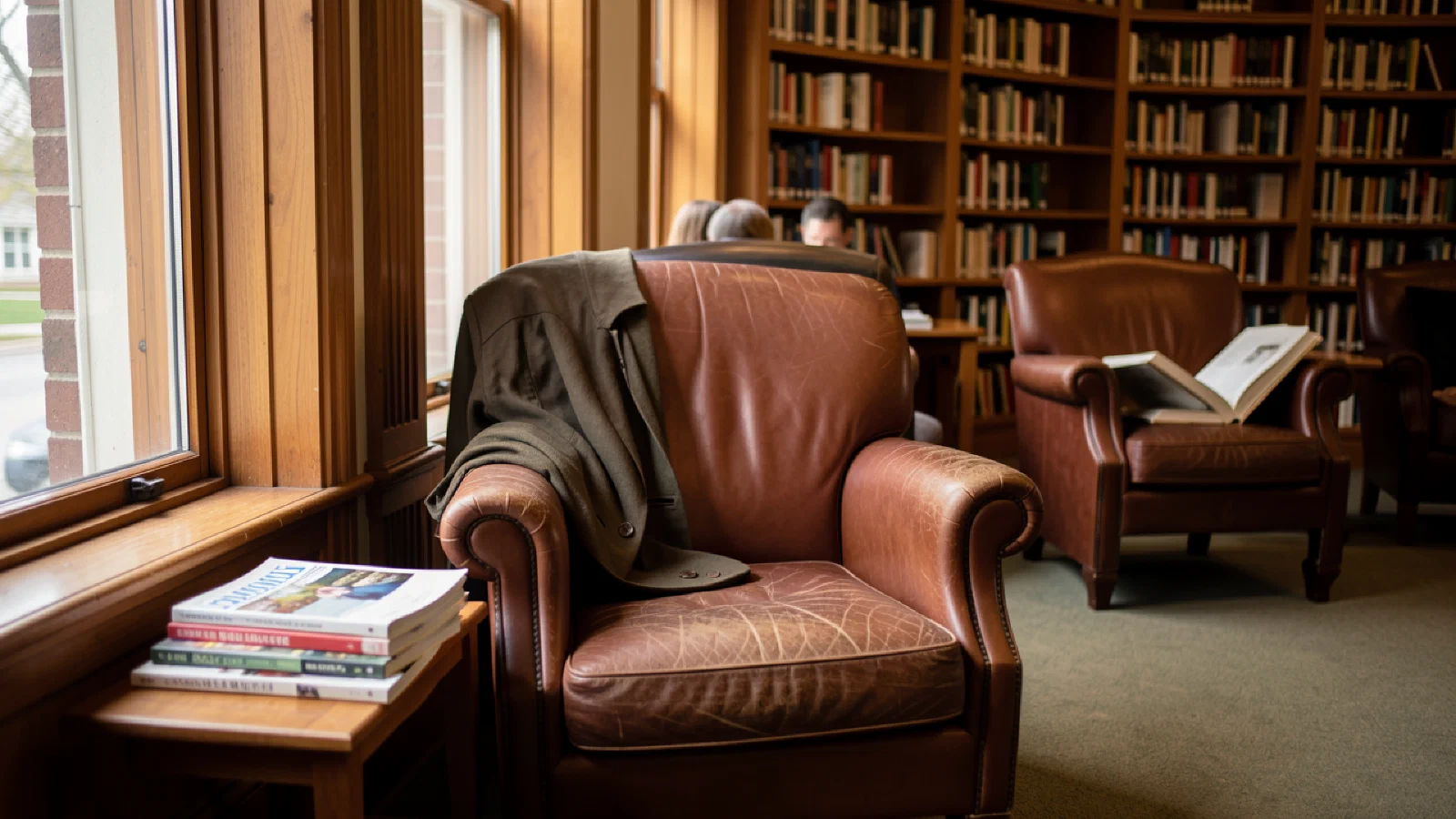
The fifth was the library branch four blocks from his house. He arrived on a Tuesday morning at 10 AM and has been back every Tuesday and Thursday since. He sits in the reading room. He opens the same three periodicals. The librarians know his name. He is there now.
What a Third Place Is#
The sociologist Ray Oldenburg spent most of his career arguing that American community life requires three places: the first place (home), the second place (work), and the third place, a gathering space that is neither. The coffee shop, the tavern, the barbershop, the park bench, the library reading room. Oldenburg’s definition has specific requirements: the third place is accessible, accommodating of extended stay, free or inexpensive, welcoming of regulars, and capable of producing what he called “conversation as the primary activity.”
Work has always provided the second place. Retirement removes it without replacing it. For many older adults, the loss of the second place is what makes the first place feel like a trap. Without somewhere to go that is not home, home becomes smaller, not cozier.
The third place that works for older adults is not necessarily the one that works for 35-year-olds. It needs accessible bathrooms. It needs seating designed for staying rather than turning over. It needs acoustic conditions that allow conversation without exhaustion. It needs staff who are stable rather than rotating, because recognition by the staff of a place is a form of belonging, and belonging is the function the third place serves.
The Library#
Gerald’s library branch is not what most people think of when they think of a library. It is not quiet in the cathedral sense. There is a children’s section with a noise level calibrated to children. There is a computer area with its own ambient sound. The reading room, where Gerald sits, is quieter than a coffee shop and better acoustically managed than most restaurants, and nobody expects Gerald to buy anything or leave by a certain time.
The case for the library as the best third place available to most American older adults is stronger than the social connection literature has acknowledged. Entry is free. Seating is designed for extended occupation, not table turnover. The climate is controlled. The programming ranges from simple (periodicals, books, access to the internet) to organized (author talks, community discussion groups, genealogy classes, civic engagement forums). The staff are present, consistent, and professionally oriented toward helping people find what they are looking for, which is different from the service orientation at a coffee shop, where the staff’s job is to take your order and make your drink.
The library does not ask Gerald why he is there. It does not require him to spend money to remain. It does not design the seating to make him uncomfortable after ninety minutes. The librarians know him by name by his third visit. By his eighth visit, the librarian at the reference desk said “See you Thursday, Mr. Fontaine,” and Gerald said “See you Thursday,” and this exchange lasted four seconds and was part of what keeps him healthy, in a way that a four-second exchange at a coffee shop would not be, because at the coffee shop there is no “Thursday.” There is only “next.”
The Senior Center Problem#
The senior center is the institution American communities built to address older adult social isolation, and it has a structural problem that most senior centers have not solved: the name.
“Senior center” as a label creates a sorting mechanism that repels exactly the population that might benefit most from connection in early-to-middle older age. The person who is 67 and managing minor arthritis and some cognitive slowing does not walk into a building with that name and see themselves. They see who they are afraid of becoming. The person who is 82 and has a walker and moderate cognitive impairment does walk into that building and feel correctly placed.
This self-selection produces populations at opposite ends of the need spectrum in the same facility, and it signals to everyone in the middle that the center is for the far end, not for them. Some senior centers have addressed this by renaming (community centers, wellness centers, lifelong learning centers), by programming for active adults in their 60s and early 70s, and by co-locating with fitness facilities and community education programs. These work, where they exist. They exist in a minority of communities.
The person looking for a third place should not wait for the senior center in their community to solve this problem. The senior center may be excellent or it may not be, but it is not the only option, and for many people in their late 60s and early 70s, it is not the right option.
Faith Communities#
The research on faith community participation and older adult health is more consistent across more decades and more study designs than almost any other social variable in aging. Active participation in a faith community is protective of mental health, physical health, longevity, and cognitive function in ways that remain significant even after controlling for health behaviors, socioeconomic status, and health status at baseline.
The mechanism is not the religious content. Non-religious older adults who participate in faith communities as cultural communities (the UU congregation, the secular humanist group, the Jewish cultural organization that does not require belief) show similar protective effects to religiously observant participants. The mechanism is the structure that faith communities provide: regular scheduled contact, on a weekly rhythm that does not depend on individuals to initiate; reciprocal care norms (the community will bring meals, visit the sick, assist the grieving, as a matter of shared expectation); multigenerational presence (the faith community is one of the few American institutions that reliably mixes age groups); and shared ritual that activates procedural memory and emotional continuity in ways that are particularly protective as cognitive change proceeds.
Gerald stopped attending church after his divorce in 2019. He has not returned. This is his business. The research on what he is missing is not the church’s argument to make; it is information that belongs to him. He has the library, and the library is doing real work. He may also have some consideration to do about whether the library and the church together would do more work than either alone.
What Else Exists#
Walking groups exist in most communities and are among the most effective third places for people with adequate mobility, because they combine physical activity (with its independent health effects), nature exposure (with its independent effects), and social contact in a format that is free, weather-dependent, and not dependent on a physical venue’s hours. The barriers: finding one that exists in a specific neighborhood, and the mobility requirement that excludes people who walk slowly or unreliably.
Community education programs, particularly Osher Lifelong Learning Institutes affiliated with universities and the continuing education programs at community colleges, provide structured intellectual engagement with peers across a wide age range. These are among the best-designed institutions in American aging for the 65-to-80 population that senior centers often miss. The barrier: cost, which ranges from modest to significant depending on the program.
Men’s Sheds, addressed more fully in Article 07.06 of this series, provide structured activity-based third places specifically designed for the male social connection pattern that article explains.
Parks with benches designed for long occupation, coffee shops with acoustic conditions that support conversation, fitness programs designed for older bodies without making older bodies their brand: all of these work, variably, in different communities and for different people.
What Makes a Gathering Space Work#
Gerald can tell you, now, exactly why the library works and the coffee shop did not. He had to work backward from the answer to figure out the question.
The library provides seating designed for occupation rather than turnover. The coffee shop chair that becomes uncomfortable after thirty minutes is designed to become uncomfortable after thirty minutes; the revenue model of the coffee shop requires that people leave. The library chair is not. Gerald can sit for two hours and leave when he is ready.
The library’s acoustic design supports presence without requiring conversation. Gerald does not need to talk to be there. He can read, and he is not alone while he reads. This is what Oldenburg meant by a place where you can be present without agenda: the agenda is just being there, and being there is enough.
The staff are consistent. Gerald has been going to the same branch twice a week for eight months. He knows three of the librarians by first name. They know him by last name, which is the right register for a retired high school teacher in his first year of regular library patronage. These relationships are not friendships. They are something more durable than transient acquaintance and less demanding than friendship, and for someone rebuilding the habit of regular social presence, they are exactly sufficient.
No purchase is required. This is not a trivial feature. The third place that requires ongoing expenditure has a limit on how long it can be used without social pressure. Gerald could not afford a daily coffee shop habit. He can afford the library indefinitely.
Gerald, Tuesday#
He arrives at 10:08 AM, slightly later than usual because he stopped to pick up his prescription at the pharmacy on the way. He hangs his coat on the peg at the end of the reading room and settles into the chair by the second window. He opens the Atlantic first, then the Smithsonian, then the Economist, which he reads less thoroughly than the others but likes having in his hands.
At 11:20, another regular, a woman Gerald does not know by name but recognizes from Thursdays, settles into the chair two down from his. They nod. They read.
At noon, he gets up, puts on his coat, returns the periodicals to their rack, and walks to the reference desk. The librarian, whose name is Renata, looks up from her monitor. She says: “See you Thursday, Mr. Fontaine.” Gerald says: “See you Thursday.” He walks out into a November afternoon that is colder than he expected and pulls his collar up and starts the four blocks home.
The exchange with Renata lasted four seconds. It will occur again Thursday. The fact that it will occur again Thursday is a form of social infrastructure, small and specific and not nothing.
How this article connects to others in Blue Mirror.
Sources cited in this article.
- Oldenburg, Ray. The Great Good Place: Cafes, Coffee Shops, Community Centers, Beauty Parlors, General Stores, Bars, Hangouts, and How They Get You Through the Day. Paragon House, 1989.
- Ellaway, Anne, and Sally Macintyre. "Social Participation, Geographical Area, and Health." Environment and Behavior, vol. 27, no. 5, 1995, pp. 653–663.
- Koenig, Harold G., Donna K. King, and Verna Benner Carson. Handbook of Religion and Health. 2nd ed., Oxford University Press, 2012.
- Cruwys, Tegan, S. Alexander Haslam, Genevieve A. Dingle, Matthew J. Haslam, and Jolanda Jetten. "Depression and Social Identity: An Integrative Review." Personality and Social Psychology Review, vol. 18, no. 3, 2014, pp. 215–238.
- Fried, Linda P., Michelle C. Carlson, Marc Freedman, Kevin D. Frick, Thomas A. Glass, Joel Hill, Sylvia McGill, George W. Rebok, Teresa Seeman, James Tielsch, Barbara A. Wasik, and Scott Zeger. "A Social Model for Health Promotion for an Aging Population: Initial Evidence on the Experience Corps Model." Journal of Urban Health, vol. 81, no. 1, 2004, pp. 64–78.