The Table You Stopped Setting
Series 07: The Body in the Room
Frances Alderman has not had anyone in her home in fourteen months. She is 77, a retired school principal from Sacramento, and she has a good reason for this, and the reason is not what she says it is.
What she says: the house is not ready. The living room needs straightening. She needs to make something worth serving. She has not been feeling like herself lately. She is tired.
What she does not say: the bathroom off the hallway has grab bars now, the chrome ones that look like something from a hospital. There is a fall mat in the kitchen, the kind with the raised edges. Her late husband Gerald’s medical equipment, a transport wheelchair and a portable oxygen concentrator he stopped needing six weeks before he died, is still in the corner of the living room. She cannot bring herself to remove it. She cannot display it without explanation. She has not found the explanation.
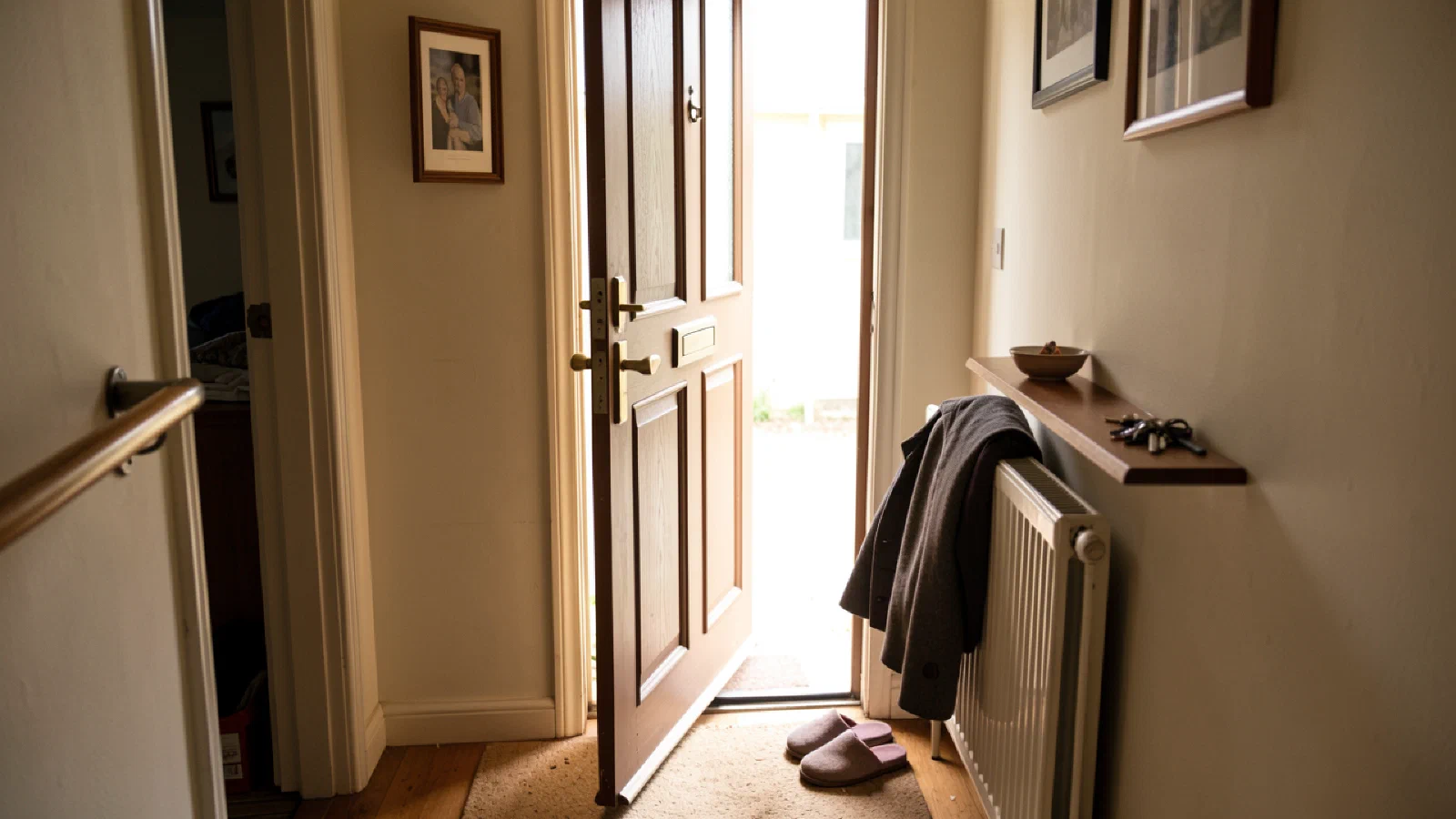
Frances’s neighbor Dot brings soup on a Tuesday afternoon in October, after Frances’s knee surgery. Dot does not call ahead. She appears at the door with a container of minestrone, still warm, and she says, “I brought soup and I want to see the knee.” Frances opens the door.
What Stops Hosting#
Frances’s four reasons for not having anyone in are not unusual. They are, according to occupational therapists and social workers who work with older adults, representative of why hosting stops across most of the households where it stops.
The first reason is the changed house. The fall modifications, the equipment, the adjustments that the body required and the home accommodated, now make visible what was private. A guest who uses the bathroom sees the grab bars. A guest who glances toward the corner sees Gerald’s wheelchair. These things tell a story about loss and limitation that Frances has not chosen to narrate to anyone, and the way to avoid narrating it is to not invite anyone to whom it would require narrating.
The second reason is cooking. Frances hosted Sunday dinners for twenty-two years. Sunday dinner for eight people requires a full day and the physical stamina she no longer has for a full day in the kitchen. This is a real constraint, and it has become, in her mind, synonymous with hosting itself, as if the only legitimate form of hospitality is the form she can no longer execute.
The third reason is the bathroom. Article 07.04 of this series addresses incontinence and mobility as social barriers more fully, because they are more fully a barrier for many people than most social connection literature acknowledges. For Frances, the embarrassment is specific and different: she is afraid a guest will be uncomfortable using a bathroom with grab bars, and she cannot imagine explaining that a guest who needs them will find them helpful, not alarming.
The fourth reason is energy. And the fifth is shame. The shame is the center of all the rest.
The Kitchen Table#
There is a body of research on hosting and health in older adults that most older adults do not know exists. Reciprocal in-home contact, meaning visits in which a person sometimes hosts and is sometimes a guest, is one of the most consistently health-protective social behaviors in the aging literature. Adults who maintain in-home reciprocal contact into their 70s and 80s show better immune function, slower cognitive decline, lower rates of depression, and longer independent living than those who maintain contact only outside the home or stop maintaining contact at all.
The kitchen table is not a metaphor in this publication. It is literally the most important piece of furniture for social health in a person’s house. The research does not show that the living room produces these effects, or the back deck, or a restaurant four miles away. The kitchen table produces them because of what sitting at a kitchen table means: the person has come inside, has accepted the intimacy of the home, has entered the space where the other person actually lives.
Frances knows none of this. She knows what it felt like when Dot sat in her kitchen for two hours on a Tuesday afternoon and talked about her daughter’s divorce and her own plans to visit her brother in Phoenix. She knows what it felt like when Dot’s car pulled away from the curb. She did not want her to go.
The Standard That Needs Lowering#
Frances has been operating under a standard of hospitality that was set when she had different physical capacity, a different kitchen arrangement, a living room that did not have a wheelchair in the corner, and a husband who could carry things from the counter to the table.
A visit does not require what a Sunday dinner requires. A visit requires a chair and enough coffee for two. This is not a consolation prize. It is what most visits, including the good ones, have always required.
Dot sat in Frances’s kitchen for two hours. She did not ask about the equipment in the corner. She did not say anything about the grab bars, though she certainly noticed them. She sat where Frances pointed and drank coffee and talked about her daughter and asked Frances about the knee and stayed until Frances’s energy flagged in a way that both of them noticed, and then she said she needed to get home to feed the cat and she got her coat and she left. The kitchen did not need to be extraordinary. It needed to be open.
The specific lowerings that matter:
One: the meal does not need to be homemade. Takeout spread on the kitchen counter has the same social function as a cooked meal served at the table, with a fraction of the energy expenditure. The ritual of eating together is the point. The preparation is incidental.
Two: the house does not need to be ready. It needs to be the house it is. Dot has a house. Dot’s house has things in it that tell stories. Everyone’s house tells stories. The story Frances’s house tells is that she lived here with Gerald and Gerald got sick and Gerald died and she has continued to live here alone and the kitchen still works and the coffee is still good.
Three: one guest is hosting. A dinner party for six is not hosting. It is a production. Frances is capable of hosting. She is not capable of the production, and the production was never the point.
The Shame Barrier#
The reason most social connection literature does not address the shame barrier directly is that shame is difficult to discuss without either minimizing it or pathologizing it.
Frances stopped hosting because her home no longer looks like the home she was proud of, and letting someone in means letting them see what has happened. What has happened is that Gerald got sick and died, and Frances’s body has required accommodations, and the living room has a wheelchair in the corner. These are not shameful facts. They are the facts of a 77-year-old woman who survived the loss of her husband and is still living in her home and still making coffee and still capable of sitting in a kitchen with a neighbor for two hours.
The guest who is invited into this house is not being invited to evaluate the evidence of decline. They are being invited for coffee. The grab bars in the bathroom are irrelevant to the coffee. The wheelchair in the corner is irrelevant to the coffee. If a guest uses the bathroom, they will see grab bars that someone installed for a very good reason, and they will be grateful, because almost everyone Frances’s age has a good reason to be grateful for a grab bar.
Frances will not believe this the first time she reads it. She will believe it the fourteenth time Dot has come for coffee without mentioning the equipment in the corner.
What Technology Can Help With#
The logistics of hosting, specifically the meal, are now significantly reducible by technology that exists today.
Grocery delivery services remove the shopping trip from the preparation. Meal delivery services remove the cooking. An AI agent of the kind described in Series 2 of this publication can coordinate grocery ordering, schedule delivery timing around a guest’s arrival, and handle the follow-up logistics without requiring Frances to manage a phone call, a website, and a timing problem simultaneously.
The specific form of hosting that becomes most accessible when cooking is removed from the equation: the takeout dinner party, in which Frances orders Indian food or pizza or whatever she and her guest prefer, and sets it on the counter, and they eat from containers at the kitchen table. This format has advantages that the cooked dinner party does not. No cleanup beyond throwing away containers. No performance of a skill that requires physical capacity Frances is managing. Full attention to the guest rather than split attention between the conversation and the stove.
Within one to two years, AI home agents of the kind described in Series 3 will be able to coordinate hosting logistics end to end: ordering food, confirming delivery timing, setting a reminder when the guest is expected to arrive, handling follow-up scheduling for the next visit. This will reduce the logistical burden of hosting to roughly the effort of sending a text invitation.
What technology cannot provide: the decision to open the door. When Dot knocked, Frances opened the door. That was the hosting.
Frances, Next Week#
She calls Dot on Thursday. She says: “Could you come for coffee next week? Not a big thing. Just coffee.”
Dot says: “Tuesday works. I’ll bring the cookies.”
Frances does not clean the living room before Tuesday. She cleans the kitchen counter, which takes seven minutes. She puts the good mugs on the counter and makes a full pot. She sits in the kitchen and waits.
Dot arrives at ten. She brings shortbread. She does not say anything about the equipment in the corner. She says, “The knee looks better,” and Frances says, “It is,” and they drink coffee and Dot eats three shortbreads and Frances eats one and a half and they talk for ninety minutes about Dot’s Phoenix trip and Frances’s daughter in Denver and the neighbor two doors down who is having the big renovation done.
When Dot leaves, Frances is tired and the kitchen still smells like coffee. She washes the mugs. She puts them back on the counter instead of in the cabinet. The table was set after all.
How this article connects to others in Blue Mirror.
Sources cited in this article.
- Holt-Lunstad, Julianne, Timothy B. Smith, and J. Bradley Layton. "Social Relationships and Mortality Risk: A Meta-Analytic Review." PLOS Medicine, vol. 7, no. 7, 2010, e1000316.
- Shankar, Aparna, Anne McMunn, James Banks, and Andrew Steptoe. "Loneliness, Social Isolation, and Behavioral and Biological Health Indicators in Older Adults." Health Psychology, vol. 30, no. 4, 2011, pp. 377–385.
- Cornwell, Erin York, and Linda J. Waite. "Social Disconnectedness, Perceived Isolation, and Health Among Older Adults." Journal of Health and Social Behavior, vol. 50, no. 1, 2009, pp. 31–48.
- Thoits, Peggy A. "Mechanisms Linking Social Ties and Support to Physical and Mental Health." Journal of Health and Social Behavior, vol. 52, no. 2, 2011, pp. 145–161.