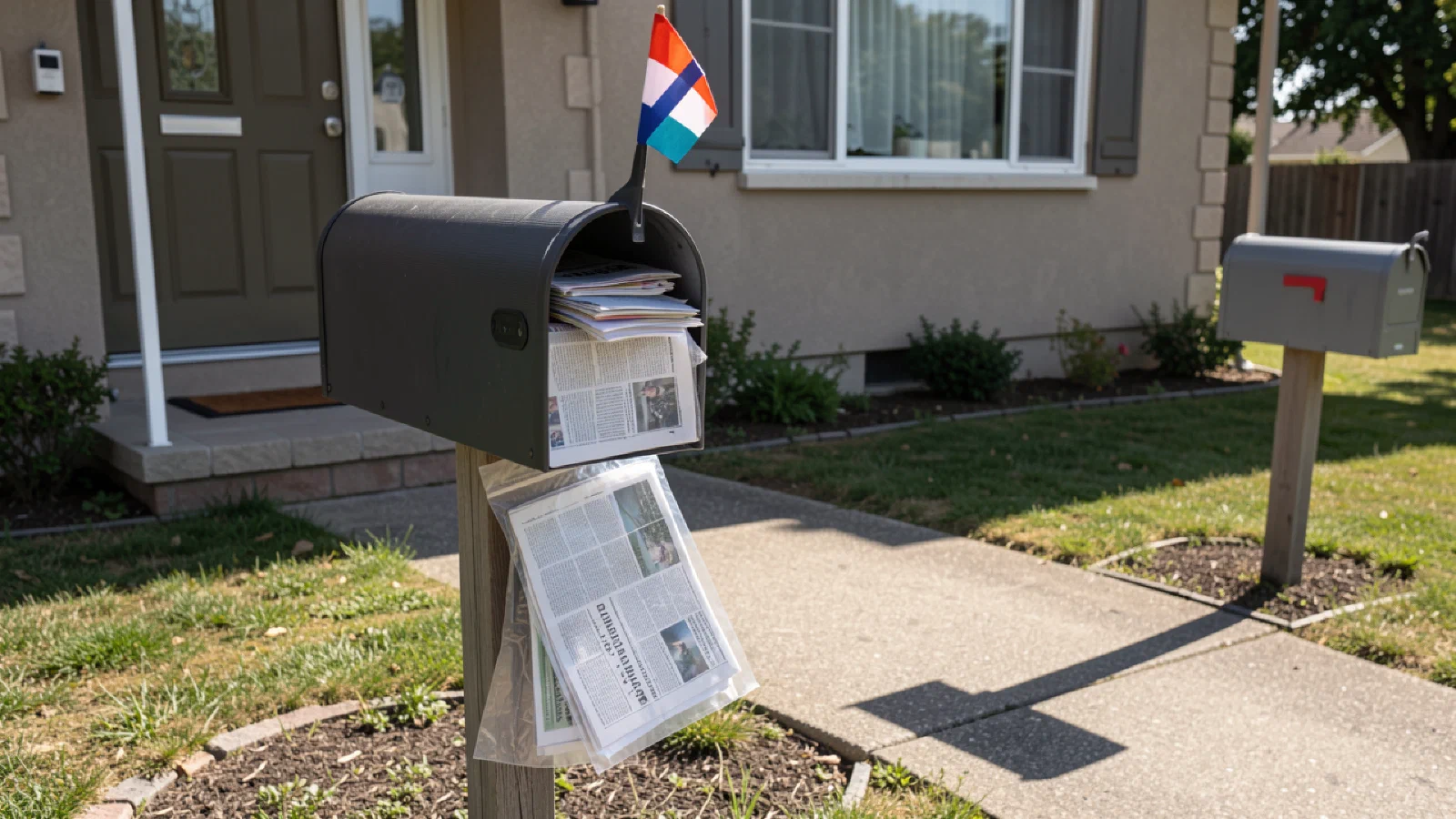
The Check-In Question
Series 07: The Body in the Room
On a Thursday morning in April, Patricia Sims noticed that the mail in Helen Marsh’s box had not been collected in two days. Patricia lives four doors down. She had no reason to expect a problem. Helen, 81, was sharp and independent and not the kind of woman who needed checking on. Patricia rang the doorbell anyway.
Helen had fallen in her kitchen on Wednesday evening. She was on the floor for fifteen hours. Patricia called the non-emergency police line at 11 AM. Helen was taken to St. Luke’s, treated for a hip contusion and mild dehydration, and released four days later. She recovered. She is home now.
The following January, Walter Gibbs, who lives two doors from where Helen lives, did not collect his mail for three days. His neighbor Diane noticed. Diane had moved in two years before and did not know Walter well. She was not sure it was her place to intervene. She did not want to intrude. She decided to give it another day.
Walter, 77, had a stroke on a Sunday afternoon. He was found by his mail carrier on Tuesday morning. He survived. He did not recover fully enough to return to his house. He is in a skilled nursing facility now, in a room he did not choose, in a facility he did not plan for.
Same street. Same year.
The Check-In Question#
The question is not: “Who do you call in an emergency?”
Everyone has an answer to that question. The answer is a name on a hospital form, a daughter in Phoenix, a son in the suburbs who would drive over immediately if something happened. The emergency contact system exists. It activates after the event.
The question is different: Who will notice if you miss a day? Who is in your life regularly enough to know what your pattern is, and whose relationship with you includes the permission to say something when the pattern breaks?
Patricia noticed because she and Helen had coffee every other Thursday, which meant Patricia knew that Helen always collected her mail in the morning. Two missed days, no coffee confirmation, no answer at the door: the pattern was broken. Patricia did not need a protocol to act. She needed to know the pattern and to feel that noticing it was her business.
Diane noticed Walter’s mail and did not know his pattern. She did not know if this was a problem or a vacation or a habit she had not observed before. She did not know whether a knock on his door would be welcome or presumptuous. She did not know him well enough to know what she was looking at. She gave it another day. The another day was the day after the stroke.
Why It Is Not the Technology#
Helen has a medical alert button. She wears it on a lanyard. It has worked twice in the past three years: once when she fell in the garage, once when she had a dizzy spell on the back steps. Both times, she pressed it herself, within seconds of the event, while she was still mobile enough to activate it.
On Wednesday evening in April, she fell in the kitchen and hit her head on the edge of the counter. She was conscious throughout the fifteen hours she was on the floor. She could not reach the button, which had come off the lanyard in the fall and was four feet from her hand. She did not lose consciousness and she never stopped being able to speak. She could not get up.
Medical alert systems require the person to activate them. They are designed for the person who falls and can press the button. They are not designed for the person who cannot reach the button, or for the person whose decline is not a single event but a slow change across three weeks of decreased appetite and increased confusion and fewer lights on in the evening. The technology detects the incident. It does not watch the pattern.
Remote monitoring sensors of the kind described in Series 3 of this publication can detect motion, track patterns of daily activity, and flag anomalies for review by a family member or care coordinator. These systems are closer than they were two years ago and will be more widely available within the next year or two. They address the pattern problem in ways that alert buttons do not. Helen’s daughter in Denver could have received a notification that her mother had not moved through the kitchen since Wednesday evening.
But the sensor requires installation, subscription, and a family member who is watching the alert. It addresses the pattern through technology. Patricia addressed the pattern through coffee. The neighbor who knows the pattern, and who has been told explicitly that noticing is her business, is available in ways the sensor is not: she does not require installation or a subscription. She requires only the relationship and the permission.
The Agreement#
What made Patricia act and Diane hesitate was not personality. It was whether each of them had been told, explicitly, that noticing was their role.
Patricia and Helen had not had a formal conversation about this. They had not sat down and established a mutual check-in protocol. But their every-other-Thursday coffee had produced, over four years, the equivalent of an implicit agreement: each of them knew the other’s patterns, and the patterns were close enough and regular enough that a break would register. Patricia felt, when she saw the mail on Thursday morning, that calling was her responsibility. She was not sure she was right. She called anyway.
Diane did not have that implicit agreement with Walter because they did not have the relationship that produces it. She had the observation, but not the permission. The missing permission was not something she could manufacture from the observation alone. It is the thing that the explicit conversation produces and the implicit relationship may or may not produce.
The explicit conversation is short. It does not need to be solemn or formal or frightening. It needs to include one sentence: “If you don’t hear from me for two days, call.” That is the whole infrastructure. Most people have not said it to anyone.
How to Build It#
The check-in relationship requires identifying the person and having the conversation.
The person is not a family member, necessarily. A family member in Phoenix is an emergency contact, not a check-in person. The check-in person is someone in your physical life, in regular contact, who can notice the mail and the lights and the Thursday morning coffee and the pattern that breaks. A neighbor. A friend who calls every Tuesday. A faith community member who sits in the same pew. Someone at the library who expects to see you on Thursdays.
The conversation is not complicated. “I want to ask you something. If you try to reach me and you can’t, or if something seems off, I want you to feel like it’s okay to call. And if I don’t hear from you, I’ll do the same.” That is enough. The conversation takes three minutes. Most people put it off for years and then something happens that makes it too late to put off, or that makes it too late, period.
The explicit agreement changes something specific: it removes the hesitation. Diane had an observation and a hesitation. Patricia had an observation and no hesitation, because the relationship had established, implicitly over four years of Thursday coffee, that Helen’s wellbeing was also Patricia’s business. The explicit sentence makes the implicit understanding durable. It does not depend on the relationship having reached a specific depth. It creates the permission directly.
The Pattern, Not the Event#
Helen’s mail. Walter’s mail. The outward signs are the same. The difference is in what the observer knows.
Patricia knew that Helen’s mail came out of the box every morning by 9:30, without exception, and had done so for four years. Two mornings without it was not ambiguous data. It was a clear break in a known pattern. Walter’s mail was three days unread, which was also a break in a pattern, but Diane did not know Walter’s pattern. She knew the mail was there. She did not know whether its presence was unusual.
The check-in person watches for the pattern, not the event. The pattern includes: the morning mail, the Tuesday call that usually comes by noon, the Thursday coffee, the light in the kitchen that is usually on by 6 PM. It includes the more subtle versions: she used to answer texts the same day; now it’s been five days. He used to wave from the garden; the garden has been untended for three weeks. The change that is not alarming in itself is the change that matters, and the only person equipped to notice it is the person who knows what normal looks like.
This is what the medical alert system cannot provide. The system knows the event. The neighbor knows the deviation from normal.
Mutuality#
The check-in relationship is not a burden one person carries for another. It works in both directions.
Patricia checks on Helen. Helen, in any condition to do so, checks on Patricia. The relationship is not symmetrical in capacity, and nobody pretends it is: Patricia is 71 and Helen is 81, and the statistical probability that Patricia will need to act on the check-in before Helen does is lower, but not zero, and they both know it. Helen knows Patricia’s pattern. When Patricia’s sister was hospitalized in November and Patricia did not come to their Thursday coffee and did not call, Helen phoned at 2 PM. Patricia answered and explained. Helen said: “I thought something must have happened.” The something that happened was manageable. But Helen noticed.
The mutual structure is also what makes the explicit conversation possible to have without it feeling like a request for help, which many people cannot make. The sentence “If you don’t hear from me for two days, call” is not a request for a favor. It is a proposal for a reciprocal arrangement. Most people can make that.
Walter’s Street, Now#
After Walter went to the facility in February, Patricia talked to two other neighbors on the street. She did not make a project of it. She brought it up at the neighborhood association meeting, briefly, without the names. She said: “I want to know if we’re all okay with checking on each other. I want to say explicitly that if I don’t see someone when I expect to, I’m going to knock.”
Two of the neighbors said yes. One of them, a man named Ron who is 74 and lives alone, said: “I would like that.” He did not say more than that.
Patricia has had coffee with Ron once. She knows that he drives to the pharmacy on Monday mornings and takes his walk in the afternoons and has his daughter over on the second Sunday of every month. She knows what to look for if something is wrong.
She has not needed to look for it yet. But three houses on the same street now have an explicit agreement: the mail sitting is not just mail, and the light not coming on is not just a light, and the pattern breaking is everyone’s business and no one’s intrusion.
This is the most important social infrastructure for aging available. It is not technology. It is not a program. It is a conversation, and the sentence at its center, and two people who said it.
How this article connects to others in Blue Mirror.