The Architecture of Showing Up
Series 07: The Body in the Room
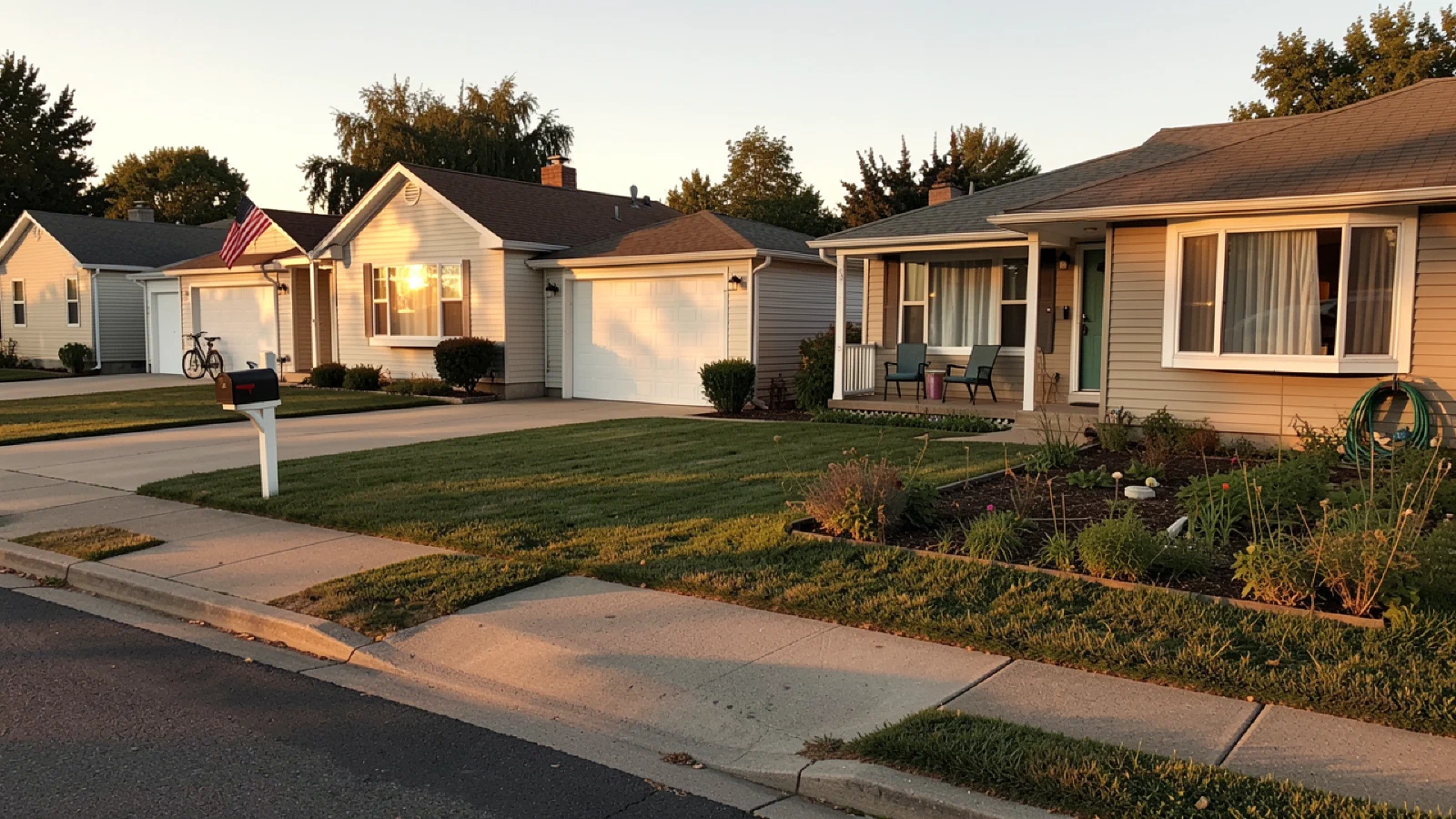
A researcher who studies aging and social health looks at eight houses on a suburban street in a mid-sized American city. She can tell you, from the data she has on those eight households, which residents are chronically lonely, which are adequately connected, and which are thriving socially.
The houses look the same from the outside. Inside, the difference is not wealth, and it is not health, and it is not personality. It is architecture. Who built the social infrastructure, when they built it, and whether they maintained it when maintaining it became harder than it used to be.
This series has covered six of the most important elements of that architecture: the graduated path from isolation back to in-person contact; the home as social venue; the third place; the specific physical barriers that cause people to quietly disappear; the shared meal; and the specific shape of male social isolation. Together they make a single case for design, at the individual level and at the community level, because the community that does not design for social connection produces isolation as reliably as the house without grab bars produces falls.
The Evidence Hierarchy for Physical Connection#
Not all forms of social contact are equally protective, and the differences matter for how an individual allocates limited time and energy.
The research is clear on what sits at the top: structured reciprocal contact. The Wednesday lunch with Ed and Al. The regular visit. The alternating dinner rotation between two households. The key features are regularity (not occasional but scheduled), reciprocity (both parties give and receive), and physical presence (a body in the room, not a voice on a phone). This combination produces the strongest and most consistent health effects in the aging literature: lower rates of depression, lower rates of cognitive decline, lower inflammatory markers, better immune function, and longer independent living.
Community membership comes second. Active participation in a faith community, a Men’s Shed, a walking group, a cooking club, or a community education program produces documented protective effects that are significant but, on average, somewhat smaller in magnitude than regular reciprocal contact. The mechanism: regular scheduled exposure to other people in a defined context, which provides the consistency and predictability that social cognition requires.
Shared meals occupy a specific place in the hierarchy because they combine physical presence with the additional commensality effects documented in Article 07.05: synchronized physiological activity, oxytocin release, and the ritual structure that food sharing creates in human social life across every culture. A shared meal at a kitchen table between two neighbors is not just a social visit; it is a social visit in the format that human social bonding evolved to use.
Casual third-place presence, the library reading room, the park bench, the coffee shop occupied by familiar faces, ranks fourth. The effects are real and should not be minimized: Gerald Fontaine’s four-second exchange with Renata at the reference desk is doing social work. But it does not substitute for the Wednesday lunch any more than the Tuesday call substitutes for the Wednesday lunch. The hierarchy is not moral; it is functional. The architecture needs an anchor, and the anchor is the structured reciprocal contact.
The Home as Infrastructure#
Frances Alderman’s kitchen table is the most important piece of social infrastructure in her house. She did not know this during the fourteen months she kept the door closed.
Article 07.02 of this series made the case for home hosting as a health behavior, not a domestic performance. The research supports a claim the caregiving and social connection literature has been reluctant to make directly: people who maintain reciprocal in-home contact into their 70s and 80s age better, across multiple metrics, than people who do not. The home that stops hosting is not a private decision with private consequences. It is a health decision with health consequences that take years to become visible.
The barriers to hosting that Frances navigated, the changed house, the cooking burden, the bathroom embarrassment, the energy cost, the shame of being seen in decline, are real and specific and mostly solvable. The cooking barrier is the most straightforwardly solvable: grocery delivery, meal delivery, meal kits, takeout, and AI agents that coordinate food ordering have collectively removed the preparation requirement from the hosting equation. The energy barrier is managed by right-sizing the event. The shame barrier requires something that technology cannot provide: the recognition that the house that shows what has happened is not a confession but a home.
The Barriers the Architecture Must Address#
The barriers described in Article 07.04 are worth restating here in the aggregate, because in aggregate they constitute a systems failure rather than a collection of individual medical problems.
Incontinence affects roughly half of older adults. It is the primary reason older adults stop leaving their homes, according to continence care research. It does not appear in social connection literature. The products that address it work and are available. The apps that map bathroom locations exist and function. These solutions have not reached the people who need them because no professional or institution in the current system is responsible for connecting a continence concern to a social participation outcome.
Hearing loss affects roughly two-thirds of adults over 70. It is one of the most common reasons older adults withdraw from group social settings. Over-the-counter hearing aids have been available since 2022 at prices dramatically lower than prescription devices. The people who most need them remain among the least likely to know about them or use them.
Transportation loss is one of the most consistent precipitants of social isolation in older adults. Ride-sharing services require smartphone literacy and comfort that cannot be assumed across the age group. Community transportation programs exist in some communities and not others, with no national standard.
These are not individual problems. They are a system that has distributed responsibility for the social participation of older adults across so many institutions, none of which has it as a primary mandate, that in practice no institution has it at all. The occupational therapist is the professional best positioned to assess and address the full set of physical barriers to social participation. Most older adults navigating these barriers have never seen one for this purpose.
The Community Design Question#
The researcher looking at eight houses on a suburban street can name, after a few hours reviewing the data, which residents are thriving. She cannot look at the street’s physical design and predict this. The houses are set back from the street by deep front yards. The sidewalks are wide but mostly empty. The nearest coffee shop is 1.4 miles away; the nearest library branch is 0.8 miles. There is no destination within comfortable walking distance for someone with a rollator or unreliable balance. There is no café or community room in the neighborhood. There is no gathering place that is neither home nor destination.
The communities that produce social connection in aging adults have these features: walkable third places within comfortable distance of residential zones; mixed-use development that puts people on sidewalks rather than in cars; libraries positioned centrally rather than on the outskirts of service areas; facilities that are multi-generational by design rather than age-segregated by default; communal spaces, courtyards, front porches, covered walkways, designed for presence without agenda.
This is not a utopian prescription. It is a description of the built environment that European aging research has associated with longer active life, lower institutionalization rates, and better outcomes on most health measures for older adults. It is a community design choice, not a technology solution, and most American communities have not made it.
Social prescribing, a practice well-established in the UK and growing in the United States, represents a modest step in this direction: primary care providers refer patients with social isolation concerns to community social resources the way they refer to physical therapy, and community health workers follow up on those referrals. The evidence base is growing. The practice is spreading slowly, constrained by the absence of standardized referral pathways and by primary care systems that have twelve minutes per patient.
What Technology Can and Cannot Do#
Technology’s role in Pillar III social connection is specific: it removes friction. It does not create connection.
Transportation apps identify available rides. Community matching platforms identify potential connection partners. AI agents coordinate grocery delivery for hosting. Hearing aids reduce the acoustic barriers that make group conversations exhausting. Bathroom-mapping apps provide certainty that reduces incontinence fear. Remote captioning provides a channel for people with severe hearing loss to participate in group conversations. These are real contributions to real problems.
What technology cannot do: provide the social brain’s response to a body in the same room. The mirror neuron activation that happens when Ed watches Al take a sip of his coffee does not happen on a video call. The oxytocin release that occurs in physical proximity does not occur between two people reading the same text on their respective phones. The synchrony that commensality produces cannot be replicated by two people eating at the same time in different rooms. The social brain requires a body, and no technology that currently exists or is plausibly close to existing provides what a body provides.
This is not an argument against technology. It is an argument about what technology is for in this domain: the reduction of friction between people who might otherwise be in the same room, and who are not because transportation or logistics or acoustic conditions or bathroom uncertainty got in the way. Fix the friction. The connection that happens when the friction is removed is human.
The Personal Architecture#
For the reader who cannot wait for community redesign, for the person sitting with this series in a house on a street that was not designed for this, here is the individual architecture.
One structured reciprocal contact, regular and maintained. The Wednesday lunch. The alternating neighbor dinner. The standing coffee invitation that happens whether or not you cleaned the living room. This is the anchor. The architecture does not work reliably without it.
One community membership. A faith community. A walking group. A Men’s Shed. A cooking club. A library-based discussion group. The specific venue matters less than the regularity: this is the place you go on a schedule that does not depend on you generating the initiative each time.
One shared meal in a context where sitting at a table with someone is the primary function, not the incidental one. Not a restaurant that turns tables. A kitchen.
One check-in relationship. Article 07.C1 covers what that relationship requires and how to build it. Its inclusion in the architecture is not optional.
The architecture does not need to be elaborate. It needs to be intentional and maintained. The person who built it before the loss of the work community, before the death of the spouse, before the decade that reduced the network by attrition, will have something to maintain. The person who is rebuilding it after those losses can build from where they are. Ed Kaminski rebuilt from four months of silence. Frances Alderman rebuilt from fourteen months of a closed door. Dennis Hargrove rebuilt from a Saturday morning’s indictment and a cabinet that needed sanding.
Who on the Street Is Thriving#
The researcher looking at the eight houses goes home and writes her notes. She knows which residents have the architecture and which do not. She knows that the ones who have it built most of it before they needed it most urgently, which gave them time to maintain it through the changes that aging brings. She knows that the ones who are thriving now are not necessarily the healthiest or the wealthiest or the most socially gifted. They are the ones who, at some point, built a Wednesday lunch and kept it.
From the outside, the houses look the same. The architecture inside is the difference. It is a design choice, not a fortune.
How this article connects to others in Blue Mirror.
Sources cited in this article.
- U.S. Department of Health and Human Services. "Our Epidemic of Loneliness and Isolation: The U.S. Surgeon General's Advisory on the Healing Effects of Social Connection and Community." Office of the Surgeon General, 2023.
- Holt-Lunstad, Julianne, Timothy B. Smith, Mark Baker, Tyler Harris, and David Stephenson. "Loneliness and Social Isolation as Risk Factors for Mortality: A Meta-Analytic Review." Perspectives on Psychological Science, vol. 10, no. 2, 2015, pp. 227–237.
- Oldenburg, Ray. The Great Good Place: Cafes, Coffee Shops, Community Centers, Beauty Parlors, General Stores, Bars, Hangouts, and How They Get You Through the Day. Paragon House, 1989.
- Berkman, Lisa F., and Syme, S. Leonard. "Social Networks, Host Resistance, and Mortality: A Nine-Year Follow-Up Study of Alameda County Residents." American Journal of Epidemiology, vol. 109, no. 2, 1979, pp. 186–204.
- Masi, Christopher M., Hsi-Yuan Chen, Louise C. Hawkley, and John T. Cacioppo. "A Meta-Analysis of Interventions to Reduce Loneliness." Personality and Social Psychology Review, vol. 15, no. 3, 2011, pp. 219–266.
- Jenkinson, Caroline E., Andy P. Dickens, Kate Jones, Jo Thompson-Coon, Rod S. Taylor, Morwenna Rogers, Clare L. Bambra, Iain Lang, and Suzanne H. Richards. "Is Volunteering a Public Health Intervention? A Systematic Review and Meta-Analysis of the Health and Survival of Volunteers." BMC Public Health, vol. 13, 2013, article 773.