Shared Meals and What They Carry
Series 07: The Body in the Room
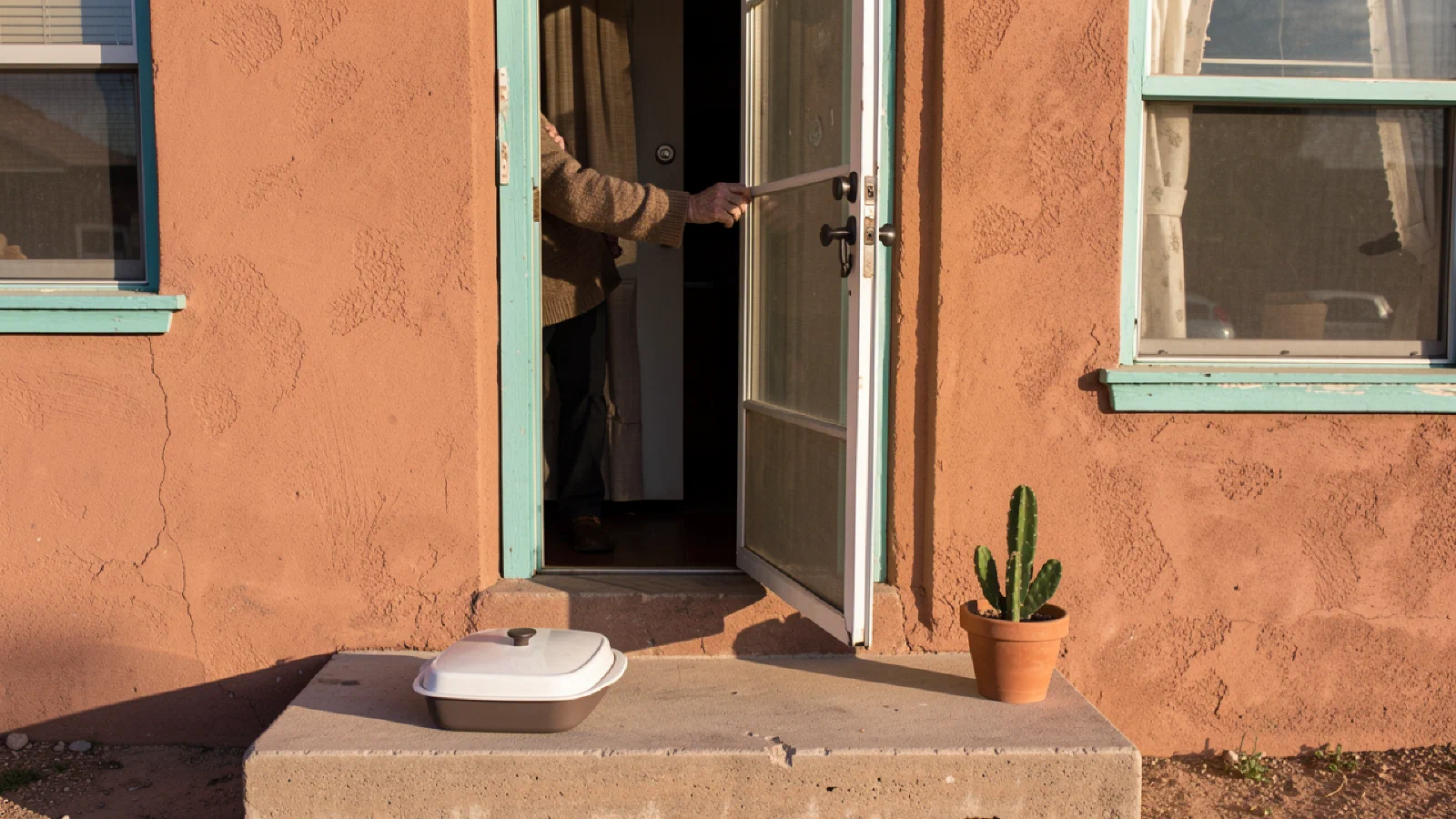
Vincent Albanese is 68, a retired plumber from Albuquerque who started volunteering for Meals on Wheels three years ago because he needed something to do with his Tuesdays and Thursdays. He delivers to sixteen households on each route. He is in and out of most stops in four minutes. A few take longer.
Louise Adkins is 84. She has not been to a grocery store in two years. Her daughter lives in Phoenix and calls on Sundays. Her neighbor waves from the driveway but they have not been inside each other’s homes since 2021. When Vincent knocks on Tuesday, Louise is dressed and waiting. She asks him how his knee has been. He asks how hers has been. They have an established answer to this question: his is better; hers is not. They have covered the Albuquerque weather, his daughter’s new baby, and the casserole situation (Louise has opinions about the casseroles; Vincent has learned which weeks not to warn her in advance).
They have a four-minute conversation on Tuesdays and Thursdays. Louise has told Vincent things she has not told her daughter.
Somewhere around his fortieth delivery, three months into the volunteer work, Vincent understood that he was not delivering nutrition.
What Commensality Is#
The act of eating together has a name that most people have not encountered: commensality. The term derives from the Latin for “at the same table,” and it describes something the research has been establishing for decades, which is that shared meals produce social and physiological effects that eating alone does not.
Synchronized eating, two or more people consuming food at the same time in the same space, produces synchronized metabolic activity, which in turn strengthens the social bonding mechanism that physiological synchrony supports. Shared meals in social settings trigger oxytocin release through the combination of physical proximity, reciprocal behavior (someone offered; someone accepted), and the ritual structure of the meal itself. These effects occur even in attenuated form: a delivery driver who asks how you are, waits for the full answer, and engages with what you say is activating, in a limited but real way, the social mechanism that a shared meal at the same table activates more fully.
This is not a reason to substitute the delivery for the meal. It is a reason to understand that the delivery is not nothing, and that the four minutes Vincent spends in Louise’s doorway are doing something that the casserole alone does not do.
The Research on Congregate Meals#
The clearest evidence for the health effects of eating together comes from studies comparing home-delivered meals to congregate meal programs, in which older adults receive the same food but eat it together at a community site rather than alone at home.
The findings are consistent across multiple study designs: participants in congregate meal programs have better nutritional outcomes than recipients of home-delivered meals alone, and the difference is not fully explained by the food. Nutritional status does improve when meals are delivered to homebound older adults. But nutritional status improves more, and improvements are more sustained, when the same people eat the same food with other people. The social contact during the meal produces independent health effects that the nutrition alone does not produce.
The effects extend beyond nutrition. Congregate meal participants show lower rates of depression, better cognitive test performance, lower rates of reported loneliness, and higher rates of social engagement in other areas of their lives, compared to home-delivered-only recipients with similar demographic profiles. The meal is the anchor. The connection that happens during the meal radiates outward.
Meals on Wheels: What the Data Shows and Does Not Show#
Meals on Wheels America serves roughly 2.4 million older adults annually across the United States. It is the largest nutrition program for seniors in the country. The nutritional benefit is well-documented: participants have better dietary quality and more reliable food access than comparable non-participants. The program demonstrably addresses food insecurity in a population where food insecurity has serious health consequences.
The social contact benefit is real and understudied. The research on driver-recipient interaction within Meals on Wheels is limited. The program’s outcomes data tracks nutrition, health status, and program reach. It does not systematically track what Louise has told Vincent that she has not told her daughter, or what the four-minute conversation produces in terms of wellbeing, social confidence, or the sense that someone who is not a family member is paying attention.
Meals on Wheels America has piloted structured social engagement protocols for drivers in some regions, training volunteers to extend visits and ask specific check-in questions. These protocols are not standardized across the national network. Vincent’s four minutes with Louise are not part of any protocol. They are what Vincent decided, sometime around his fortieth delivery, that he was actually there to do.
The program cannot require this of every volunteer. It can, and should, train volunteers to understand that the four minutes matter, that the conversation is not incidental to the delivery but is part of what the delivery accomplishes, and that a volunteer who is uncomfortable with extended interaction is, for homebound recipients, delivering less than the program’s full potential.
The Cultural Dimension#
Food is not only a delivery mechanism for nutrients. It is how every American community defines belonging.
The Sunday table in an Italian-American household is a ritual of family membership, maintained across generations, that communicates who you are and where you are from in ways that extend beyond the pasta. The after-service meal in a Black church congregation is a weekly renewal of community belonging, an extension of the worship into the ordinary act of eating. The specific foods of an immigrant household, the tamales at Christmas, the dumplings at New Year, the specific versions of specific dishes that cannot be replicated outside the specific kitchen where they were learned, carry identity that is irreplaceable and that is lost when the household that made them is no longer reachable.
When an isolated older adult loses access to shared meals, they are not losing only nutrition and social contact. They are losing the most specific form of community identity they have. Louise grew up in a household in East Albuquerque where her mother made red chile from dried pods her grandmother grew in a garden that no longer exists. Louise cannot make the chile anymore. Nobody in her immediate world makes it the way her mother made it. This is a loss that Meals on Wheels does not address and cannot address. It is a loss that matters alongside the nutritional benefit the program provides.
Cooking Clubs and Neighbor Dinners#
The most effective form of shared meal for social health is also the simplest and the least institutionally supported: two households, one meal, the table set for two or four.
Cooking clubs and neighbor dinner rotations exist wherever someone has organized them, which is not most places, and which requires an initiator. The barrier is not logistics. It is the first question: “Would you like to come for dinner Thursday?” The question requires one person to offer, which requires confidence that the offer will be accepted, which requires a relationship sturdy enough to make the confidence warranted, which requires enough prior connection to build the relationship.
A simple framework that removes most of the friction: two households, alternating preparation, one meal every two weeks. Person A cooks (or orders in, or buys prepared food) on the first Thursday. Person B takes the second Thursday. The responsibility is light because it is shared. The commitment is light because it is biweekly. The outcome is significant because it is reciprocal and regular and takes place at a table.
Meal kit delivery services make the cooking component accessible to people who have limited physical capacity for full meal preparation. A meal kit that arrives with measured ingredients and a specific recipe requires substantially less physical capacity than sourcing and planning a meal from scratch. This is not an advertisement for any specific service; it is an acknowledgment that the barrier to cooking for a guest has fallen over the past five years for people with adequate internet access and a credit card.
BlueMirror.world, within one to two years, will support neighbor meal matching: identifying households within a building or block that have expressed interest in shared meals and facilitating introductions. This is a service the technology can provide that the neighborhood cannot easily provide on its own.
What Vincent Knows#
Vincent knows which of his sixteen recipients are doing well by whether they want to talk when he arrives. Louise is doing well. She is alert and opinionated and she remembered last week to ask about his daughter’s baby’s name, which he had mentioned in passing three weeks prior.
He knows which ones are not doing well by the same measure. There is a man on his Thursday route, a widower of 81 whose wife died in November, who answers the door, takes the meal, says “Thank you,” and closes the door. Vincent rings the bell, accepts the answer, and leaves. He has tried twice to extend the exchange. Both times the man closed the door.
He does not know what to do about this. He is not trained for it. He is a retired plumber who has found, to his surprise, that the most important tool he brought to this volunteer work is the willingness to stand in the doorway long enough for the other person to decide whether they want to keep talking. Louise always does. The man on Thursday never does. Vincent does not know whether his presence matters to the man on Thursday. He rings the bell anyway.
The four minutes he spends with Louise are not in any protocol. They are in him, and they keep her alive in ways that the casserole alone does not, and Louise knows this, and Vincent knows this, and neither of them would describe it that way.
How this article connects to others in Blue Mirror.
Sources cited in this article.
- Thomas, Paul A. "Trajectories of Social Engagement and Limitations in Late Life." Journal of Health and Social Behavior, vol. 52, no. 4, 2011, pp. 430–443.
- Dunbar, Robin I. M., Jacques Launay, Rafael Wlodarski, Cole Robertson, Eiluned Pearce, James Carney, and Pádraig Mac Carron. "Functional Benefits of (Modest) Alcohol Consumption." Adaptive Human Behavior and Physiology, vol. 3, no. 2, 2017, pp. 118–133.
- Frongillo, Edward A., Shu Wen Ng, and Parke E. Wilde. "Conceptualization and Measurement of Food Insecurity among Older Adults." Current Aging Science, vol. 4, no. 3, 2011, pp. 209–217.
- Berkman, Lisa F., T. Glass, I. Brissette, and T. E. Seeman. "From Social Integration to Health: Durkheim in the New Millennium." Social Science and Medicine, vol. 51, no. 6, 2000, pp. 843–857.
- Meals on Wheels America. "The State of Senior Hunger in America." Meals on Wheels America, 2023.
- Carolan Wojtassek, Michelle, and Patricia Baird. "The Social Dimensions of Meals on Wheels: Driver Contact and Recipient Wellbeing." Journal of Nutrition in Gerontology and Geriatrics, vol. 36, no. 2-3, 2017, pp. 121–134.