Men and Loneliness After 65
Series 07: The Body in the Room
Carol Hargrove said it in July, on a Saturday morning when Dennis was on his fourth cup of coffee and his second hour of watching the backyard. She had been thinking it for two years and she had kept it back, and then she said it: “I cannot be your only person.”
Dennis Hargrove is 68, a retired civil engineer from Indianapolis. He did not argue with Carol. He did not say she was wrong or that he had other people. He had no argument because he understood, immediately and completely, that she was right and that he had no idea what to do about it.
He had not made a new friend as an adult since 1987, when he met a colleague named Frank at the I-65 project outside Greenwood, and they played golf together every other Saturday until Frank moved to Phoenix in 2009. His social architecture for forty years was built entirely on two foundations: work and Carol. Work ended in 2021. Carol is still there, sitting across from him on a Saturday morning, telling him she cannot be everything. He had not noticed, or had noticed and not understood the significance, that when the first foundation went, she became the entire structure.
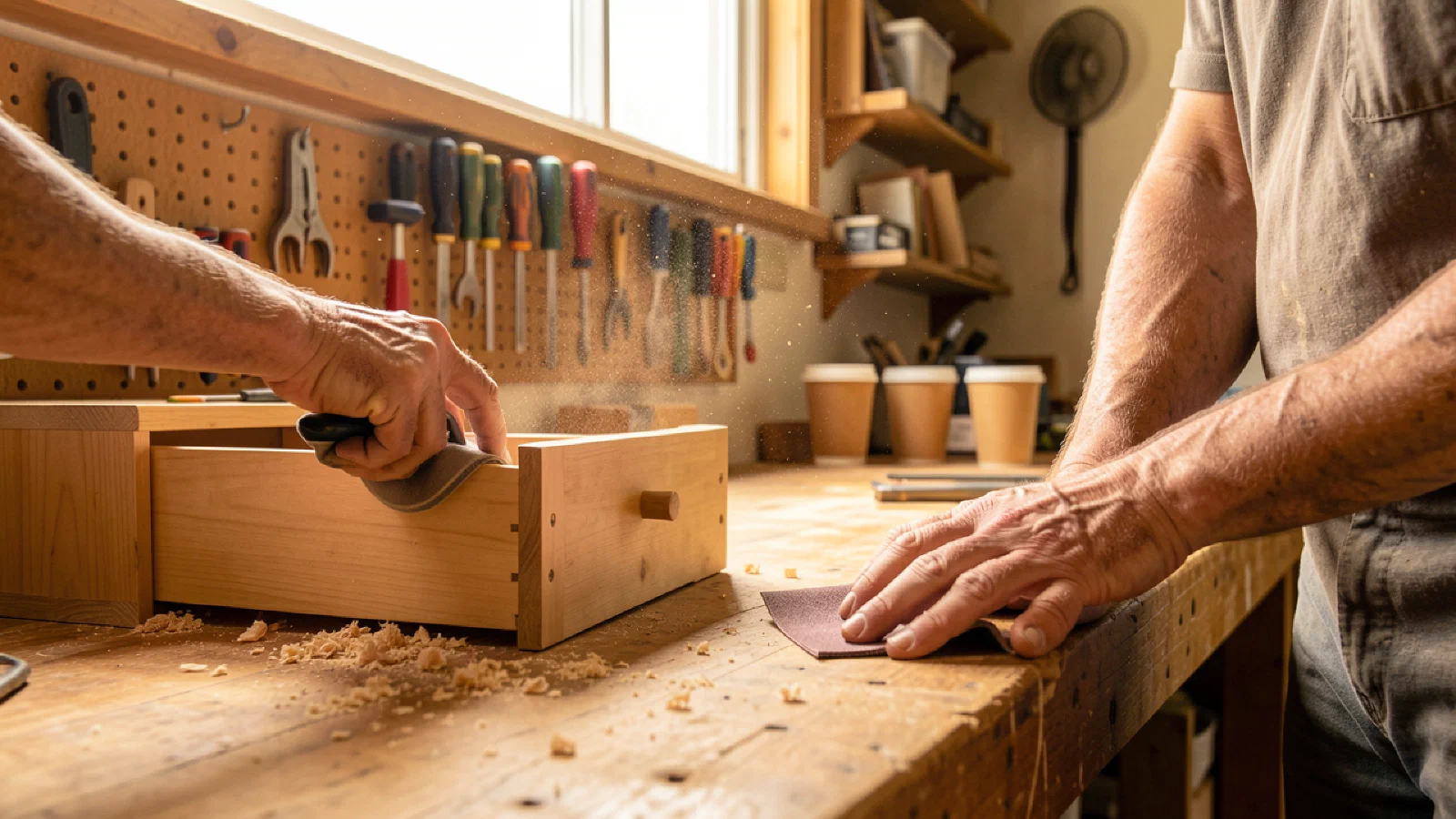
We meet Dennis four months later, in a Men’s Shed in the Broad Ripple neighborhood, sanding a cabinet he volunteered to repair for the neighborhood library.
Why Men’s Networks Collapse Faster#
Women’s friendships, on average, are built to survive the removal of the context in which they formed. The research on social network structure across genders is consistent: women’s friendships more often involve direct emotional disclosure, regular contact that is not dependent on a shared activity, and relationship maintenance behaviors (calls, visits, messages) that sustain the friendship when the original shared context disappears. The friendship that formed in college continues through different cities and different life phases because the women in it actively maintain it.
Men’s friendships, on average, are built differently. They are more often activity-dependent and side-by-side in structure: two men who golf together, two men who commute together, two men who are in the same work group and eat lunch in the same break room. The friendship exists in the context and is not fully separable from it. When the golf course becomes unavailable, when the commute ends, when the work group disperses, the friendship does not automatically continue. It requires a different kind of initiative than either party has practiced: the phone call not organized around getting to the tee time, the lunch not organized around the shared errand of being in the office. The initiative required feels, for men who did not practice it, unfamiliar in a way that makes it easy to defer.
This is not an emotional failure. It is an architectural one. Dennis’s friendship with Frank did not end because either of them stopped caring. It ended because the scaffold they built the friendship on (the golf game) was removed by geography and replaced by nothing. Dennis did not know how to replace it. Frank probably didn’t either. They exchanged Christmas cards for a few years and then did not.
The Specific Shape of Male Loneliness#
Male loneliness after retirement presents differently from the standard clinical picture, which is why it is frequently missed by the healthcare providers who are looking for it.
The Surgeon General’s advisory and the research base it draws on use language like “loneliness,” “social isolation,” and “lack of meaningful connection.” Men who are experiencing exactly those conditions often describe them differently. They say they are bored. They say they do not have enough to do. They say they are “not busy enough,” that retirement is “not what they expected,” that they “need a project.” The language of restlessness and purposelessness is doing the work that the language of loneliness would do if men were more likely to use it.
A primary care provider who screens for loneliness by asking “Do you feel lonely?” will miss the man who says, truthfully, that he does not feel lonely but cannot explain why the days have no shape and the house feels different when Carol is at book club. The screen is not wrong; the concept is the right one. The presenting symptom is not the word.
Dennis did not tell Carol he was lonely. He did not tell himself he was lonely. He would have described his situation, if asked in July, as: “Retirement is an adjustment. I need a project.” This is exactly right, and it is a description of loneliness.
What Does Not Work#
Programs and interventions designed for male social isolation that ask men to talk about their feelings, without providing a structure, a location, and an activity for the conversation, fail consistently. This is documented across multiple Men’s Sheds evaluations, Veterans Services programs, and social prescribing pilots. The format that works for some populations, the support group, the talking circle, the facilitated emotional sharing, is the format that keeps away men who need connection most urgently.
The reason is not that men are incapable of emotional expression. It is that many men were socialized in environments that did not build the skills for cold-start emotional disclosure, and the program that requires those skills as the entry cost cannot reach the people who lack them. This is a design problem, not a character problem.
General-population social groups that assume emotional availability as baseline also struggle to engage the men who most need them. The program that invites “come share your experience of aging” is not the program Dennis was going to join. The program that invites “come fix this cabinet” is the program he joined.
What Does Work: Structure and Side-by-Side#
The Men’s Shed model originated in Australia in the late 1990s and has grown to thousands of locations in Australia, the United Kingdom, Ireland, and, increasingly, the United States. A Men’s Shed is a shared physical space, typically a workshop, where men come to do things with their hands: woodworking, repair, fabrication, gardening, mechanical work. Conversation is not required. It happens because two people working side by side on a project talk, the way people have always talked when their hands are occupied and the silence becomes comfortable enough to fill.
The conversation that happens in a Men’s Shed is not therapy and is not designed to be. It is the conversation that happens when Frank and Dennis are two hours into the golf course and they have covered the shots on the front nine and the complaints about the greens keeper and the thing that happened at the company last Tuesday. The context gives the conversation shape. The activity gives the silence permission. The friendship that grows in this format is the male friendship pattern as it has always worked, which is why it works when general social programs do not.
The documented benefits of Men’s Sheds participation across UK and Australian evaluations are consistent: lower rates of depression and anxiety, improved sense of purpose, higher rates of social engagement outside the Shed, improved physical health behaviors, and higher rates of help-seeking for medical and mental health concerns. The last finding is particularly significant: men who participate in Sheds are more likely to see a doctor when something is wrong. The social connection and the purpose it provides appear to reduce the pride-based resistance to medical care that increases male health risk at every age.
What Else Works#
Men’s Sheds are not the only format that produces these effects; they are the most studied one. The common element across formats that work for men in this situation is the same: structure, a shared activity, side-by-side presence, conversation that is not the explicit goal.
Fitness-based community is a major underacknowledged category. The cycling club, the masters swimming league, the golf group, the Tuesday morning walking group, the fishing club: these are social infrastructure. Their mental health protective effects are consistent with the general evidence on social connection. They are not incidentally social activities; they are the primary social infrastructure for men who built their friendships around shared physical activity throughout their adult lives. The man who says he needs to get back to golf is not just saying he misses the sport. He is saying he misses the format his friendships used.
Volunteer organizations with meaningful projects and structured contact: skilled trade volunteer programs, habitat builds, veterans service organizations with active programs, civic organizations that still do things rather than just meet. The man who needs a project and a reason to be somewhere at 9 AM on a Tuesday morning can often find both in volunteer work, and the volunteer work provides what the retirement has removed: the structure, the purpose, and the people.
Intergenerational connection through skill-based mentorship (the BGO pairings described in Series 12 of this publication) provides a format in which the older man’s expertise is the value he brings, not the deficit he is managing. This matters. The Men’s Shed works partly because the men in it are capable of something. The friend Dennis has not met yet needs to experience Dennis as someone who knows how to do things. Dennis does. The context just needs to provide the venue.
Dennis at the Shed#
He did not know anyone when he walked in the first time. An older man named Ray showed him the space and pointed him to the bench where the library cabinet was waiting. Dennis looked at the cabinet for about five minutes before he understood what needed to happen to it. He started sanding.
The man at the next bench, whose name turned out to be Marcus, said something about the grain that Dennis did not entirely agree with, and Dennis said so, and Marcus explained his thinking, and Dennis said he saw the point but still thought the other direction was better, and they debated it for six minutes. Dennis sanded the way he thought was right. The cabinet came out well.
Over the next three Saturday mornings, Dennis and Marcus covered: woodworking (their shared subject); the Colts (Marcus’s team, with which Dennis has no particular association but strong opinions about offensive line management generally); Marcus’s late father who was a carpenter and whose tools Marcus inherited; and Dennis’s father, who was a machinist, and the drawer of tools from his father’s shop that Dennis has kept since 1994 and has never used.
Neither of them said anything about loneliness or retirement or what Carol said in July. They did not need to. The Shed was doing the work without either of them naming what the work was.
Carol, Three Months Later#
Dennis comes home from the Shed on Saturdays in time for lunch. A few weeks ago he texted Marcus about a hardware question mid-week, and Marcus texted back, and they have now established a low-grade text exchange about wood, and the Colts, and the project Marcus is building for his daughter’s kitchen.
Carol has not said anything to Dennis about the change she has noticed. She noticed it in September, when he came home from his second Shed morning easier than she had seen him in two years. She noticed it again in October when he offered to cook dinner on a Saturday and seemed interested in doing it rather than obligated. She does not have a name for what changed. She does not need one.
The Shed fixed something that Carol could see and Dennis would not have called a problem. This is often how it works: the thing that gets fixed is the thing neither party named. The fix was structural, not emotional. It required a workshop and a cabinet and a man named Marcus and six minutes of disagreement about wood grain direction.
Carol is no longer his only person. She has not said this to him. She does not need to.
How this article connects to others in Blue Mirror.
Sources cited in this article.
- U.S. Department of Health and Human Services. "Our Epidemic of Loneliness and Isolation: The U.S. Surgeon General's Advisory on the Healing Effects of Social Connection and Community." Office of the Surgeon General, 2023.
- Cordier, Reinie, and Roshan Leone. "Evaluation of a Community-Based Men's Shed Program." Australian Occupational Therapy Journal, vol. 60, no. 5, 2013, pp. 356–364.
- Milligan, Christine, Amanda Gatrell, and Anthony Bingley. "'Cultivating Health': Therapeutic Landscapes and Older People in Northern England." Social Science and Medicine, vol. 58, no. 9, 2004, pp. 1781–1793.
- Victor, Christina R., Sasha Scambler, John Bond, and Ann Bowling. "Being Alone in Later Life: Loneliness, Social Isolation, and Living Alone." Reviews in Clinical Gerontology, vol. 10, no. 4, 2000, pp. 407–417.
- Keogh, Brian, Geraldine McCarthy, and Tom Sargeant. "Loneliness and Social Isolation in Later Life: How Men Experience It." Journal of Clinical Nursing, vol. 25, no. 15-16, 2016, pp. 2162–2169.