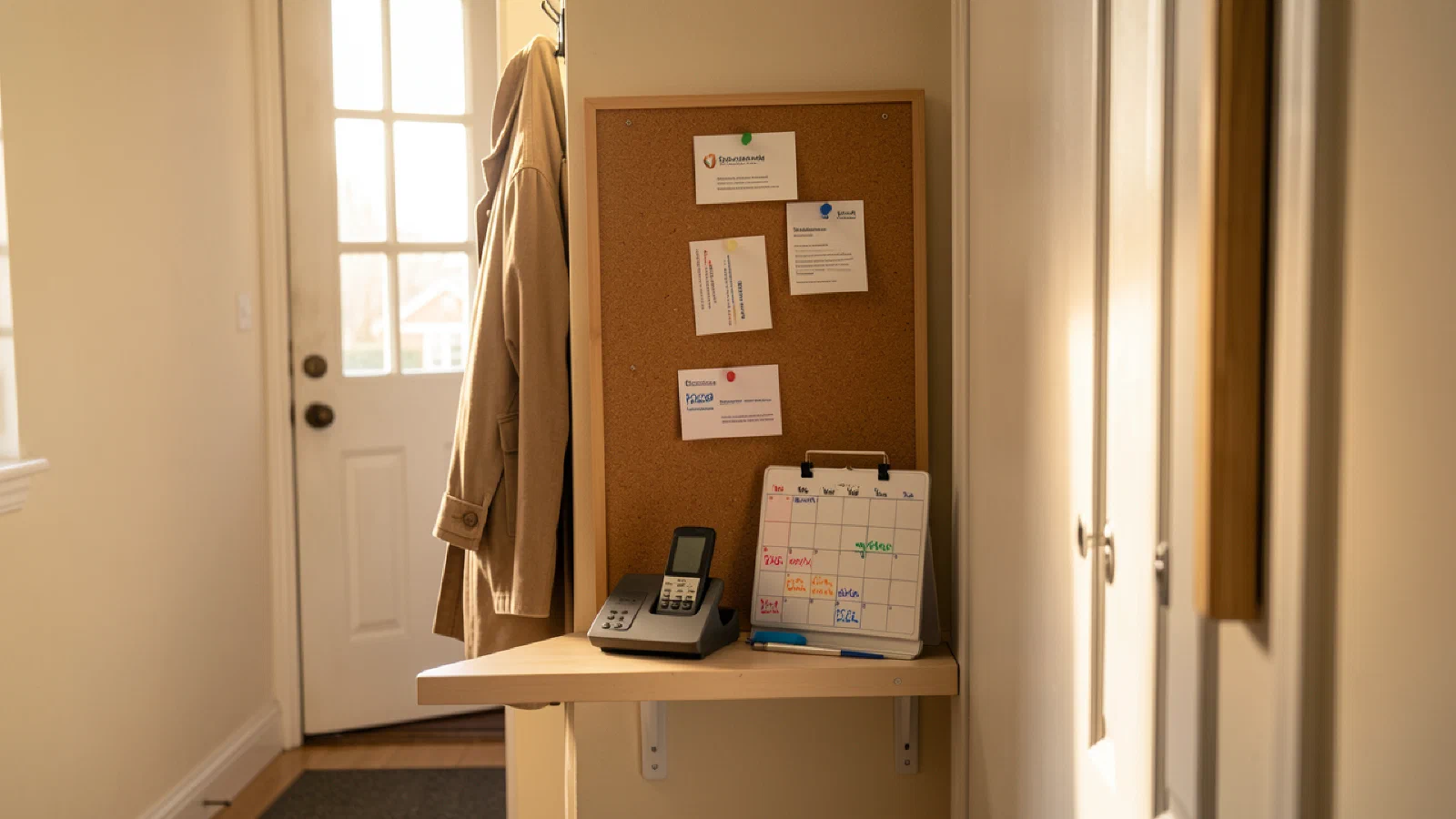
The Day You Stopped Being the Switchboard
Series 06: The Caregiver's Own Life
Robert Dietrich is 67, a retired contractor from Phoenix, and the first thing he does every morning is check three patient portals, a pharmacy app, and a text thread with his daughter in Seattle. His wife Sandra, 65, has early Alzheimer’s with concurrent heart failure and Type 2 diabetes. She sees a neurologist, a cardiologist, and an endocrinologist. None of them share records with the others. The home health aide texts Robert, not the neurologist. The pharmacy calls Robert, not Sandra. His daughter Megan needs weekly updates. Robert described his role this way: “I was playing telephone between people who don’t know each other’s names, about a person I love, and being the only one who holds the whole picture.”
He was not a caregiver. He was a switchboard. A human nervous system for a care system that had no nervous system of its own.
What a Switchboard Actually Does#
The cognitive load of care coordination for a person with multiple conditions is not a single task. It is a continuous state. Robert held in his head: Sandra’s fourteen medications and their schedules, interactions, and side effects. The neurologist’s instructions from six weeks ago that the cardiologist did not know about. The endocrinologist’s concern about a medication the neurologist had just increased. The home health aide’s observation from Tuesday that might be relevant to Thursday’s cardiology appointment but only if Robert remembered to mention it. The pharmacy’s question about a prior authorization that required a call to the insurance company that required a reference number that was on a form Robert had filed somewhere.
Research on caregiver cognitive overload, documented in depth in BGM’s “The Caregiver’s Brain” series, shows that this sustained information-holding produces measurable consequences. Caregivers managing complex care across multiple providers make more medication errors, report higher rates of missed or conflicting information between specialists, and show cognitive fatigue patterns similar to professionals in high-error-rate industries like air traffic control. The difference is that air traffic controllers work shifts and have institutional support systems designed to prevent overload. Caregivers work continuously and have no such system.
Robert made his first medication error in month fourteen. Sandra received a double dose of her blood thinner because the pharmacy had changed the pill strength without Robert’s knowledge, and Robert, working from the old dosage instructions, gave her two pills instead of one. Nothing happened. Something could have. The error was not Robert’s failure. It was a design failure of a system that uses a 67-year-old retired contractor as its primary information infrastructure.
What the Transformation Looks Like#
The AI care coordinator, when it works, does what Robert was doing, except it does not forget, does not get tired, and does not have to check three portals every morning.
All of Sandra’s medications are visible in a single view, with interaction checks running against the complete current list every time a provider changes anything. When the home health aide notes a behavioral change in her daily check-in, the AI flags it for the neurologist with the relevant context attached. When the endocrinologist adjusts Sandra’s insulin, the AI checks it against her cardiac medications and her neurological medications simultaneously. The appointment summaries Robert used to spend two hours preparing by hand are generated from the continuous care record. Robert reviews them. He corrects them when they miss context that only he has. But he is reviewing a draft, not building the document from memory.
The caregiver does not stop making decisions. The AI stops requiring them to carry the information. The distinction matters because it is the information-carrying, not the decision-making, that produces the cognitive overload, the errors, and the health consequences documented in the research.
What Exists Now, Honestly#
This transformation is not fully available today. The scenario described above represents what is genuinely close, within one to two years, as AI personal health systems extend to family caregiving contexts. What exists now is partial and fragmented.
Care coordination apps like CareZone and CaringBridge centralize some information and simplify family communication. Some large health systems using Epic or similar platforms offer care coordination tools within their network, but these tools break at the system boundary. Sandra’s neurologist and cardiologist happen to be in different health systems. Their records do not talk to each other through any existing tool. The gap between what Robert needs and what is currently available is real, and stating it plainly is more useful than pretending the solution exists when it does not.
Within one to two years, AI personal health assistants being developed for individual health management (covered in Series 01 of this publication) are being extended to family caregivers. The near-term deployment will give caregivers like Robert an AI that interfaces with Sandra’s health information across providers, holds the complete medication list, and flags conflicts and concerns. Within three to five years, the full integration described in this article, where the caregiver’s AI and the care recipient’s AI communicate to hold the complete picture together across a fragmented system, becomes practical. Robert’s morning routine changes from checking five apps to reviewing one summary.
What Changes When the Switchboard Stops#
Robert remembers the day the care coordinator took over the information management. Not because the technology was impressive. Because of what happened after.
“The first day in two years I was her husband instead of her project manager.” He sat with Sandra on the porch that afternoon while the aide was there. He did not check a portal. He did not prepare for Thursday’s appointment. He held her hand and talked about the trip they took to Sedona in 2014, and Sandra remembered the red rocks, and for twenty minutes neither of them was a patient or a caregiver. They were Robert and Sandra on the porch.
The relational cost of the switchboard role is rarely named. The wife or husband who has become a case manager for the person they love is performing a job that crowds out the relationship the job exists to protect. When someone else, or something else, holds the care information, the relationship has room to resurface. This is not a secondary benefit of care coordination technology. It is the primary one. The information management matters because errors matter. The liberation from the information management matters because the marriage matters.
The Caregiver’s AI, Too#
The same AI monitoring Sandra’s care is monitoring Robert. His sleep data shows fragmentation that has worsened over eighteen months. His resting heart rate has increased. His step count has declined. The caregiver whose own health is declining is not only suffering personally. He is a single point of failure in the care system. If Robert has a cardiac event, Sandra’s entire care infrastructure collapses.
Article 06.03 covers the caregiver’s own health in depth. The architectural point is straightforward: the AI care coordinator watching Sandra also watches Robert, not because Robert asked it to, but because a care system with one human load-bearing wall and no redundancy is a care system that will eventually fail. Monitoring the caregiver is not surveillance. It is the recognition that the person doing the caring is also a person with a body.
The dignity test from Series 05 applies here in a specific way. The AI monitoring Sandra must pass all five dignity questions: does it serve her, does it preserve her agency, does it treat her as still becoming, does it respect her documented preferences, does it account for how she experiences dignity now. The same test applies, with equal force, to the AI monitoring Robert. He did not ask to be watched. He needs to be asked. The tool that monitors a caregiver without the caregiver’s informed consent has failed the dignity test before it begins.
Robert, Three Months Later#
Robert still coordinates Sandra’s care. He still makes the decisions that matter: which specialist to trust when recommendations conflict, how to explain to Megan in Seattle that her mother’s cognition has declined again, whether the new medication’s side effects are worth the modest benefit. These decisions require judgment, knowledge of Sandra as a person, and the weight of love applied to impossible choices. No AI makes these decisions. No AI should.
But the information lives somewhere that is not his head. He does not forget what the pulmonologist said six weeks ago because the AI did not forget. He does not miss the interaction between the cardiac medication and the new antidepressant because the AI checked it before the prescription was filled. He holds fewer things. He holds Sandra’s hand more.
The switchboard is quieter. The husband is back.
How this article connects to others in Blue Mirror.
Sources cited in this article.
- Adelman, Ronald D., et al. "Caregiver Burden: A Clinical Review." JAMA, vol. 311, no. 10, 2014, pp. 1052-1060.
- National Academies of Sciences, Engineering, and Medicine. Families Caring for an Aging America. The National Academies Press, 2016.
- Wolff, Jennifer L., et al. "Family Caregivers of Older Adults, 1999-2015: Trends in Characteristics, Circumstances, and Role-Related Appraisal." The Gerontologist, vol. 56, no. 3, 2016, pp. 417-428.