What Music Knows
Series 05: Who You Are When You Forget
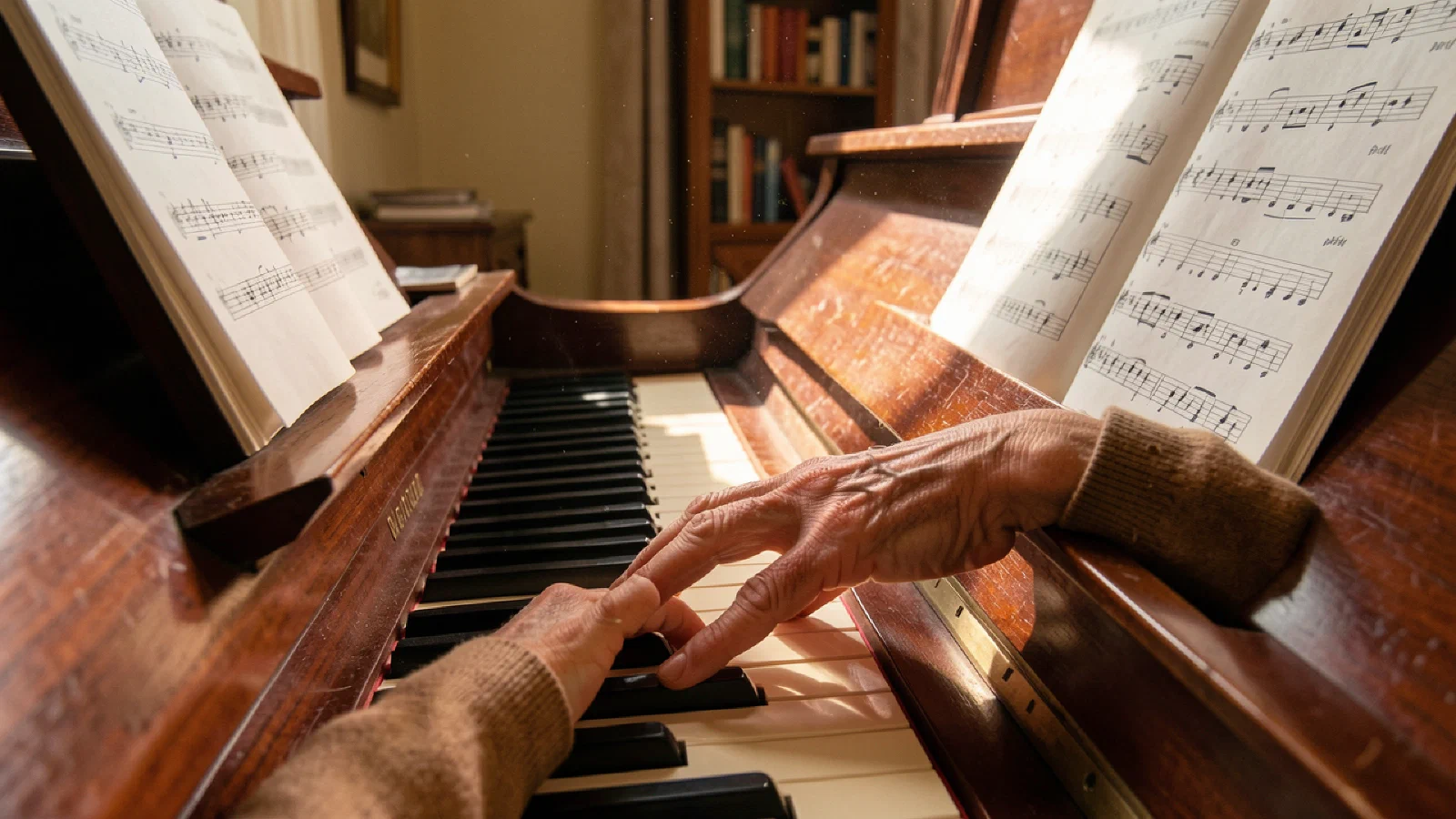
James Beaumont is 78, a retired jazz musician from New Orleans, and he has moderate Alzheimer’s. His wife Celestine plays him Coltrane every evening. “A Love Supreme,” the same record since 1965. James cannot reliably remember Celestine’s name. When the music starts, his left hand lifts from the armrest. His fingers move. Saxophone fingering, technically accurate, through all four parts of the suite. The phrasing is correct. The dynamics change where they should. The fingering reflects not just the notes but the interpretation, the way James played the piece, the specific choices a musician makes that distinguish performance from reproduction.
His neurologist, Dr. Sandra Park, shows this video in her lectures on the persistence of personhood. She tells her students: “That is not muscle memory performing a stored program. That is a musician. He is still there.”
Where Musical Memory Lives#
The neuroscience is specific. Musical memory is stored primarily in the cerebellum, supplementary motor area, and basal ganglia. These regions encode the procedural, motor, and timing aspects of music through thousands of repetitions. Alzheimer’s pathology, which begins in the entorhinal cortex and hippocampus and progresses through the temporal and parietal lobes, reaches these regions later in the disease than it reaches the structures responsible for episodic and semantic memory.
This is not a mystery. It is neuroanatomy. The same disease that has taken James’s reliable access to his wife’s name has not yet reached the neural substrate that holds sixty years of saxophone performance. The fingering is not a ghost of James performing in the absence of James. It is James performing, through the neural architecture that is still intact, in the medium that his disease has not yet closed.
Musical memory also spans emotional networks centered in the amygdala, which remains relatively preserved in Alzheimer’s, and semantic music networks in the temporal lobes that are affected but often retain enough function to support recognition of familiar songs well into moderate disease. The result is that music engages a coalition of brain regions, motor, emotional, semantic, and contextual, in a pattern that is more resistant to Alzheimer’s than any other cognitive function that has been studied.
What Music Can Do#
The evidence is strong for specific outcomes and should be presented without inflating it.
Emotional regulation. Music reduces agitation and anxiety in people with dementia. Multiple randomized controlled trials document this effect. The mechanism is dual: the music directly activates calming emotional responses through the amygdala, and the music redirects attention from the internal experience of confusion to an external stimulus that carries positive emotional associations. The effect is strongest for personally meaningful music and weaker for generic era-appropriate selections.
Retrieval of associated episodic memories. BML-05.09 covers this in depth. Music activates the same emotional and contextual networks as the original experience, providing a retrieval pathway that verbal prompts cannot open. Salvatore Ricci’s cassette tape in BML-05.06 is the specific case. The general principle: a song from a personally significant moment can pull the associated episodic memory into temporary accessibility.
Social engagement. Shared music sessions produce more interaction than any other activity type in memory care settings. More verbal output, more eye contact, more shared affect, more physical responsiveness. Group singing produces higher engagement than group listening, and both produce higher engagement than non-musical group activities. The social dimension of music is as important as the cognitive dimension.
Identity expression. James playing the fingering is not performing for an audience. He is being a musician. The music gives him the channel through which his identity as a musician can express itself when the channels of conversation, planning, and daily living have narrowed. The channel is still open. The identity comes through it. Dr. Park’s point to her students is precise: this is not residue. This is a person.
The MUSIC & MEMORY Program#
MUSIC & MEMORY is a certified program active in thousands of care facilities and expanding to home use. Its core intervention is the personalized playlist: a collection of songs selected for personal significance, loaded onto an iPod or similar device, and delivered through headphones. The program has a documented evidence base for behavioral and emotional outcomes in people with dementia and has produced some of the most widely shared videos of music’s effect on people with advanced cognitive change.
The key word is personalized. Not “music from the 1960s.” The specific songs associated with specific periods of this specific person’s life, selected through biographical interview. The song that played at the wedding. The song that was on the radio the summer of 1972. The song the family sang on car trips. Each song is a key tuned to a specific lock, and the biographical data from BML-05.07 is what tells you which keys to cut.
Facilities can request MUSIC & MEMORY certification through the program’s website. Home-based families can implement the same principle without the certification: build the personalized playlist, use any streaming service, deliver it through comfortable headphones, and observe the response. The headphones matter because they create an immersive sound environment that reduces competing stimuli. The personalization matters because a generic playlist is entertainment, not therapy.
Building the Playlist#
The practical method has three inputs.
Era mapping: identify the periods of the person’s life with the strongest emotional associations. Adolescence and young adulthood, roughly ages 15 to 30, are typically the richest source of emotionally significant music. This is the “reminiscence bump,” the period when the brain is most actively encoding new experiences and the music of that period is most deeply embedded.
Event associations: the specific songs connected to specific life events. The first dance at the wedding. The song playing on the radio during the road trip. The song that was popular the year the first child was born. These require biographical knowledge and are the most powerful retrieval keys because they connect to specific episodic memories rather than general era-appropriate associations.
Current emotional response: what produces a positive response now. A song from the person’s era that they never personally connected with will not produce the same effect as a song they loved. The person’s current response, observed during trial listens, is the final filter. Some songs that should work based on era and association do not produce a response. Some songs produce responses the family did not predict. The person’s behavior during the listening is the evidence. The family’s expectations are not.
Any streaming service can build the playlist. Label it clearly. Share it with anyone who provides care. The playlist should travel with the person to every care setting, every hospital visit, every transition. It is as important as the medication list, and easier to carry.
Music as Connection#
Celestine and James listening to Coltrane on a Tuesday evening is not Celestine providing comfort to a patient. It is Celestine and James listening to Coltrane together, as they have done since 1965. The activity has not changed. The cognitive context has changed. The relationship is still happening in the medium that is still open.
Playing a meaningful song with a person with dementia is not entertainment. It is a reunion. The shared song is a shared memory, held in a format that both people can still access. Celestine remembers 1965 through her episodic memory. James remembers 1965 through his musical and emotional memory. They are remembering the same thing through different neural architectures, and the music is the meeting place.
The family member who plays music for a person with dementia should understand this: the music is not a service you provide. It is a shared experience you participate in. Sit with the person. Listen to the music with them. Watch their face. Respond to what you see. The music creates a space where the relationship can still happen. Be in the space.
What Music Cannot Do#
Reverse neurodegeneration. Music does not slow Alzheimer’s progression. It does not restore neurons that have been lost. It does not modify the underlying disease pathology.
Restore memories that are genuinely lost. The retrieval windows that music opens are temporary. The associated episodic memories that surface during music may not surface again. The door opens and closes, and the music does not control the door.
Replace pharmacological or clinical treatment. Music therapy is complementary. It is not a substitute for medical management of the disease.
Produce consistent results. Some sessions produce dramatic responses. Some produce nothing. The same person may respond powerfully to the same song one day and show no response the next. The inconsistency is the biology, not the method. The family that expects consistency will be frustrated. The family that expects possibility will be equipped.
James, After the Record#
The record ends. James’s hand returns to the armrest. The fingers stop. Celestine sits with him in the silence. He does not know her name today. He knew the music. The knowledge was in his hands, in his motor cortex, in the neural substrate of sixty years of musicianship that the disease has not yet reached.
Celestine does not need him to know her name. She needs what the music gives them: forty-five minutes of being in the room with the person she married, the musician, the man whose hands still know what his mind has forgotten. The silence after the record is part of the evening. The silence is not empty. It is the space between one record and the next.
Tomorrow she will play it again. She will play it because she knows he will respond, and because the response is James, and because being in the room with James is the reason she plays the record. The music does not fix anything. It opens a door, and Celestine walks through it every evening, and James is there.
How this article connects to others in Blue Mirror.
Sources cited in this article.
- Jacobsen, Jörn-Henrik, et al. "Why Musical Memory Can Be Preserved in Advanced Alzheimer's Disease." Brain, vol. 138, no. 8, 2015, pp. 2438-2450.
- Särkämö, Teppo, et al. "Music, Emotion, and Dementia: Insight from Neuroscientific and Clinical Research." Music & Medicine, vol. 4, no. 3, 2012, pp. 153-162.
- Gerdner, Linda A. "Evidence-Based Guideline: Individualized Music for Persons with Dementia." Journal of Gerontological Nursing, vol. 36, no. 6, 2010, pp. 7-15.
- Rossato-Bennett, Michael. "Alive Inside: A Story of Music and Memory." Film, 2014.
- Baird, Amee, and William Forde Thompson. "The Impact of Music on the Self in Dementia." Journal of Alzheimer's Disease, vol. 61, no. 3, 2018, pp. 827-841.