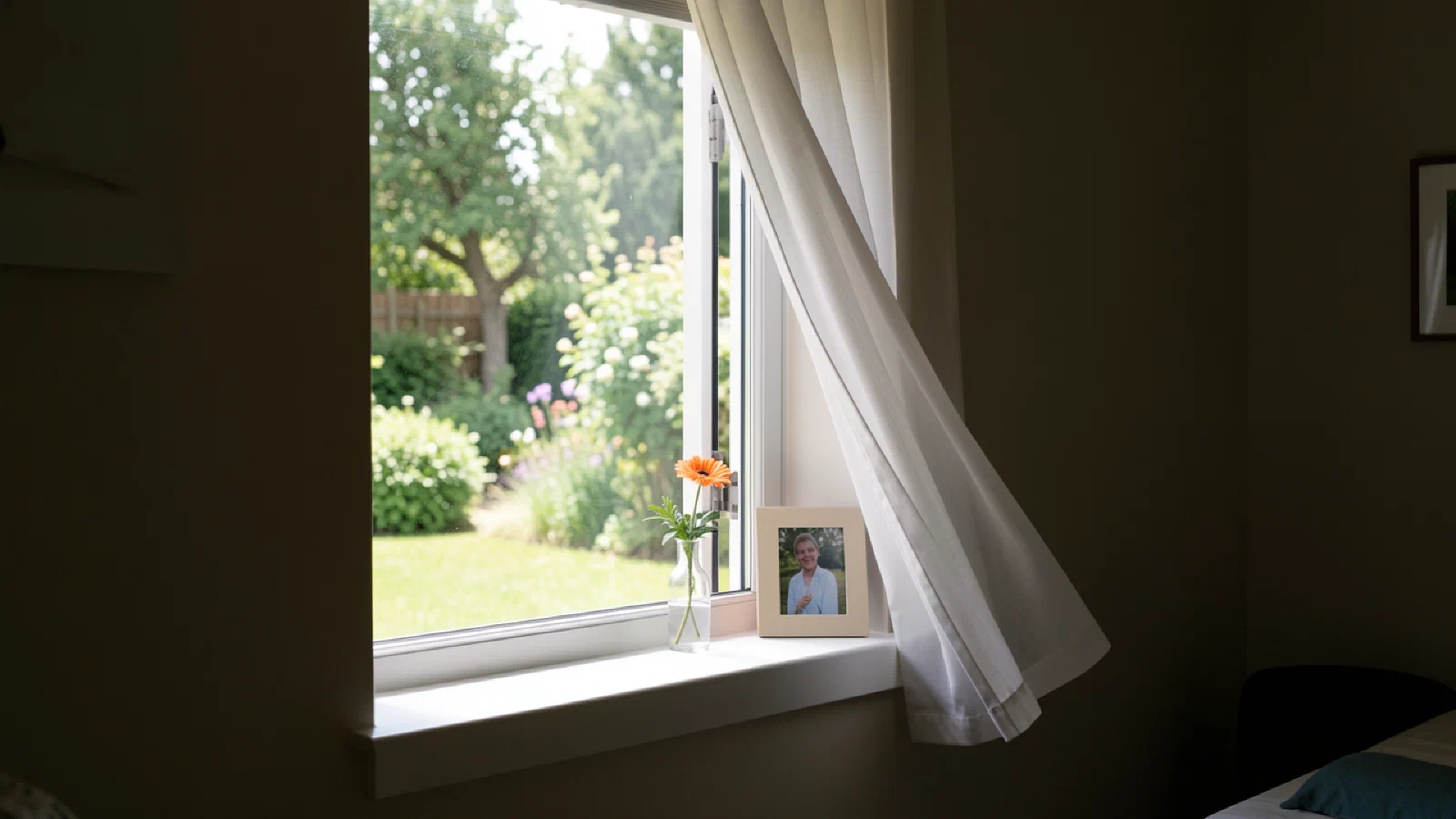
The Window Opens
Series 05: Who You Are When You Forget
Dr. Raymond Osei is 81, a retired cardiothoracic surgeon, and he has moderate Alzheimer’s. Every Wednesday at 2 PM, a second-year medical student named Priya Anand comes to his memory care room with his surgical instruments: a Kelly clamp, a needle driver, a set of retractors. She also brings his surgical case photographs from a career spanning thirty years.
For forty-five minutes, Dr. Osei teaches. He describes the anatomy with precision. He explains the decision-making process for specific surgical approaches. He corrects Priya’s instrument handling the way he corrected residents for three decades, with the same patience, the same insistence on the correct angle, the same expectation that the student will get it right on the next attempt. Priya says it is the best clinical education she receives all week.
One Wednesday, the window does not open. Dr. Osei sits quietly. He looks at the instruments without reaching for them. Priya sits quietly too. After forty minutes, she says: “Can I show you what I did this week?” He nods. She tells him about a case she observed. He listens. He does not respond with surgical expertise. He responds with attention, with the courtesy of a person who is being told something by someone who wants to tell it. That is enough.
What a Window Is#
A memory or sensory intervention that produces a period of clarity, fluency, or capability during which the person is not just experiencing a memory but is capable of something they are not capable of at other times. The window is not a cure. It is not a reversal. It is a change in what is accessible.
The concept is precise. Dr. Osei at 2 PM on a productive Wednesday has access to surgical knowledge, teaching capacity, and professional identity that Dr. Osei at 10 AM the same day may not have. The instruments, the photographs, the student’s presence, and the consistency of the Wednesday appointment all contribute to creating the conditions under which the window is most likely to open. The opening is not guaranteed. It is probabilistic. The conditions increase the probability without determining the outcome.
The window metaphor is deliberate. A window allows passage between inside and outside. It opens and closes. When it is open, the person is present in capacities that the disease has restricted but not destroyed. When it closes, the capacities return to their restricted state. The person who was teaching at 2:15 PM and cannot name the instruments at 3:00 PM is the same person. The difference is not in the person. It is in the access.
These Are Not Sentimental Moments#
The philosophical claim must be made directly: a retired surgeon who teaches a medical student during a window of clarity is exercising the same agency and serving the same purpose as a surgeon teaching in a residency program. The cognitive context is different. The window may not last. The knowledge transmitted is real. The student’s learning is real. The contribution is not diminished by the diagnosis any more than a lecture is diminished by the fact that the lecturer will eventually leave the room.
This is not a sentimental observation. It is a clinical and philosophical claim about what human dignity requires. Dignity requires that contribution be recognized as contribution regardless of the cognitive status of the contributor. Dr. Osei’s teaching on a Wednesday afternoon produces real educational value for a real medical student who will carry that knowledge into real patient care. The value does not require Dr. Osei to be cognitively intact at all other times. It requires him to be present during the window, and the window is enough.
What Creates the Windows#
Specific triggers reliably produce windows for specific preserved expertise categories.
Familiar tools for procedural experts. Harold’s toolbox in BML-05.08. Dr. Osei’s surgical instruments. The mechanic’s wrenches. The carpenter’s saw. The hands on the tools activate the motor memory, which cascades into the procedural knowledge, which cascades into the professional identity. The tools are the key.
Biographical photographs for people with strong visual-episodic histories. Dr. Osei’s surgical case photographs provide visual cues that activate professional memory networks. Photographs from specific periods, specific locations, specific accomplishments provide the visual retrieval pathway that general conversation cannot open.
Music for musicians, as BML-05.10 documents. Thomas Yuen’s Chopin is a window. James Beaumont’s saxophone fingering is a window. The music activates the integrated musical intelligence that produces not just recall but active engagement.
The sensory environment of the original work context. The smell of the workshop. The sounds of the professional setting. The spatial arrangement of the workspace. These environmental cues activate contextual memory that, for people whose professional identity was central, can open a window to professional capacity.
The biographical profile from BML-05.07 identifies which triggers are most likely to work for a specific person. The triggers are personal, not generic. A generic set of surgical instruments would not open the same window that Dr. Osei’s own instruments open. The personal specificity is the mechanism.
How to Structure the Session#
Design principles for window-based purpose sessions follow from the evidence.
Identify the preserved expertise and the associated trigger. The biographical profile provides both. The family member who knows what the person’s hands did for a living, what tools they used, what their professional identity was, holds the information needed to select the trigger.
Build a regular session. The regularity is part of the trigger. Wednesday at 2 PM has become part of Dr. Osei’s procedural memory. His body anticipates the Wednesday visit the way George Whitfield’s body anticipates 0530. The consistency of timing, location, and format converts the session from an event into a routine, and the routine is scaffolding for the window.
Bring a real audience with a real need. Priya is not performing a service. She is learning. The authenticity of her need is part of what opens the window. Dr. Osei’s identity as a teacher was forged across thirty years of residents who needed what he knew. Priya’s need activates the teaching identity through the same pathway the residents did. A person who asks questions because they want to know the answer produces a different response than a person who asks questions as an exercise.
Plan explicitly for the sessions when the window does not open. This is the design principle most programs miss. If the session’s value depends entirely on the window opening, then the sessions when it does not open are failures. If the session’s value includes the relationship between the two people in the room, then the quiet Wednesday when Priya tells Dr. Osei about her week is as real as the productive Wednesday when he teaches. The relationship exists whether or not the window opens. The relationship is part of what the program builds.
The Wednesday That Didn’t Work#
Dr. Osei sat quietly. He looked at the instruments. He did not reach for them. Priya waited. She is learning to wait the way clinicians learn to wait: not filling the silence, not prompting, not pushing. After forty minutes of comfortable silence, she shifted.
“Can I show you what I did this week?” He nodded. She described a procedure she had observed. She described the anatomy. She described the surgeon’s decision-making. She was, without meaning to, performing the role of the teaching student who presents a case for the attending physician’s assessment. Dr. Osei listened. He did not offer a surgical critique. He listened the way a person listens to someone who is telling them something important.
The window did not open. The relationship was in the room anyway. Priya sat with Dr. Osei for the full forty-five minutes. She left and came back the next Wednesday. She will keep coming back because the value of the program is not only in the teaching. It is in the fact that someone shows up, every week, with his instruments, and sits in his room, and treats him as a person whose knowledge matters. The showing up is the intervention. The teaching is the bonus.
The Connection to Pillar IV#
This is the logic of Series 11, the Sage Economy, applied to a population the world has decided is no longer available for contribution. On Wednesdays at 2 PM, a retired surgeon with moderate Alzheimer’s teaches a medical student something she cannot learn from anyone else. The teaching is real. The learning is real. The value produced is real.
If meaning is medicine, and the evidence from the purpose and meaning literature suggests that it is, then the window is both a clinical intervention and an act of respect. The clinical benefit: engagement of preserved expertise during the window activates neural networks that are strengthened by use. The respect: recognizing that a person with moderate Alzheimer’s still has something to give, and designing the conditions for the giving.
The Window Closes#
The instruments go back in the box. Dr. Osei sits quietly. The Wednesday visit is over. He is back to the moderate dementia, back to the room, back to the afternoon that will proceed without surgical instruments or a medical student asking questions.
The contribution remains. Priya’s notes from today’s session contain a technique for managing bleeding during a specific thoracic procedure that she has not found in any textbook. She will use it someday. She will remember where she learned it. The window closed. The teaching did not close with it.
The window is temporary. The contribution is permanent. That distinction is the argument for building the conditions under which the window can open, knowing it will close, and knowing that what passes through it before it closes has a life of its own.
How this article connects to others in Blue Mirror.
Sources cited in this article.
- Cohen-Mansfield, Jiska, et al. "Self-Identity in Older Persons Suffering from Dementia: Preliminary Results." Social Science & Medicine, vol. 51, no. 3, 2000, pp. 381-394.
- Boyle, Patricia A., et al. "Effect of a Purpose in Life on Risk of Incident Alzheimer Disease and Mild Cognitive Impairment in Community-Dwelling Older Persons." Archives of General Psychiatry, vol. 67, no. 3, 2010, pp. 304-310.
- George, Daniel R., and Peter J. Whitehouse. "The War (on Terror) on Alzheimer's." Dementia, vol. 13, no. 1, 2014, pp. 120-130.
- Mitchell, Gail J., and Ingunn Agnete Holkup. "Dwelling with the Stories of Persons with Dementia: Art and Science Approaches." Nursing Science Quarterly, vol. 16, no. 3, 2003, pp. 211-215.
- Camic, Paul M., et al. "Object Handling and Art Gallery Interventions for People with Dementia." Journal of Mental Health, vol. 23, no. 4, 2014, pp. 199-204.