The Senses as a Bridge
Series 05: Who You Are When You Forget
Raymond Costa is 72, and he is caring for his wife Patricia, 74, who has moderate Alzheimer’s. Patricia grew up in her grandmother’s kitchen in Lisbon. Cinnamon, burned toast, strong coffee. Those three smells were the air of that kitchen, and that kitchen was the safest place Patricia knew as a child.
Raymond discovered the trigger by accident. He burned toast one morning and Patricia, who had been agitated and withdrawn all week, came to the kitchen doorway. She looked around with a calm expression, looked past Raymond as though he were furniture, and said, in Portuguese, “Avó?” She was looking for her grandmother. She was eighty years and an ocean away from that kitchen. She was, briefly, entirely at peace.
Raymond burns toast every afternoon at 4 PM. He has been doing this for six months. Patricia comes to the kitchen doorway. She is looking for her grandmother. She does not find her grandmother. She finds peace, for a few minutes, in the smell of a kitchen that no longer exists. Raymond burns toast because it works, and because working is enough.
Why Smell Is Different#
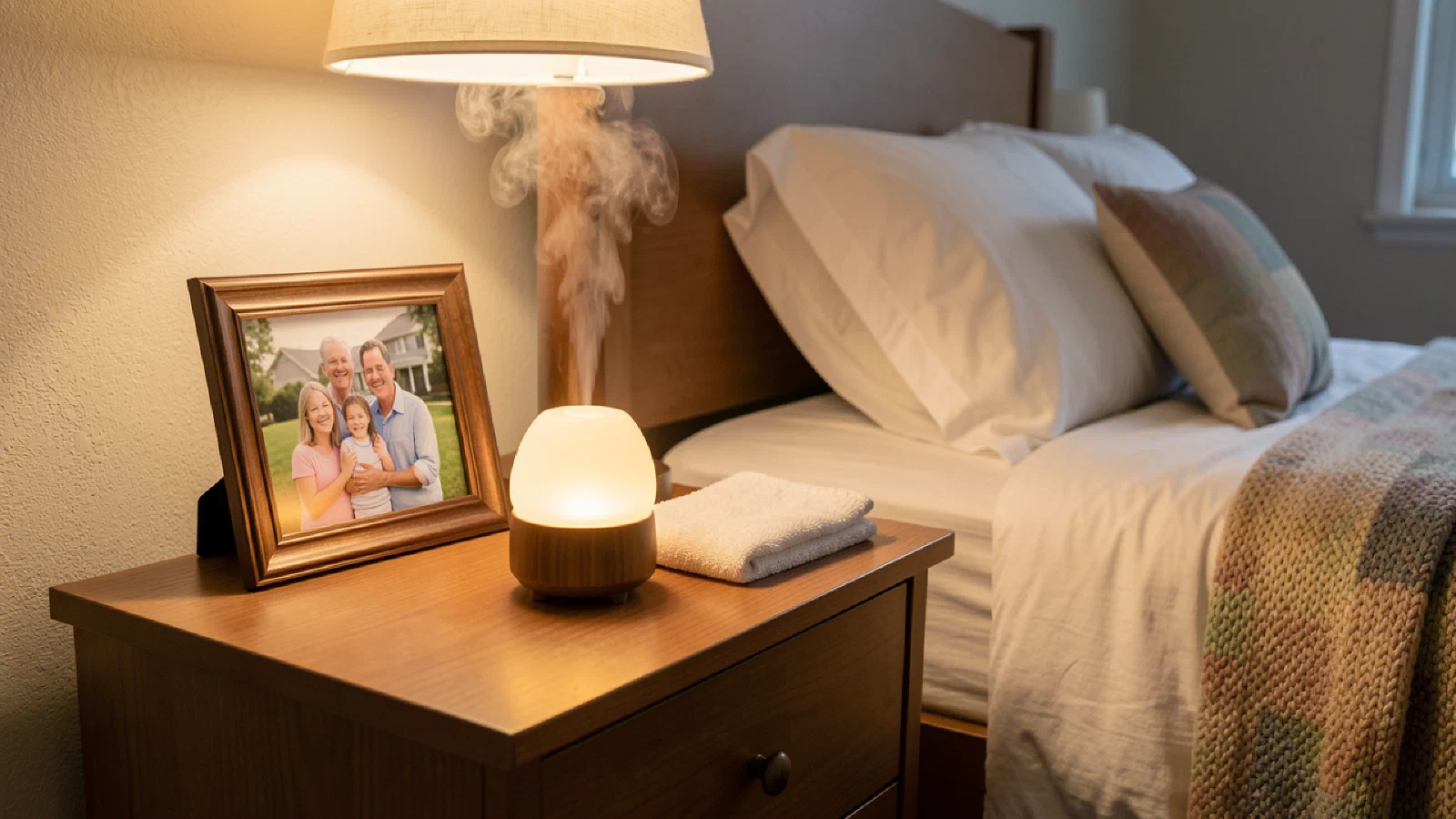
Olfactory processing is the only sensory pathway that bypasses the thalamus and connects directly to the hippocampus and amygdala. Every other sense, vision, hearing, touch, taste, is routed through the thalamus for processing before reaching memory and emotion centers. Smell goes direct. The olfactory bulb sends projections straight to the structures that encode emotional and episodic memory.
This is why a childhood smell can produce an emotional response in a person who cannot remember where they are. The smell does not require the person to recognize it, name it, or place it in a biographical context. The smell activates the emotional and contextual associations directly, without requiring the cognitive processing that dementia has impaired. Patricia does not need to think “this smells like my grandmother’s kitchen” for the emotional response to occur. The response happens before the thinking, through a neural pathway that operates below conscious recognition.
The neuroscience explains Raymond’s observation. Patricia’s response to burned toast is not a cognitive event. It is a subcortical event, fast, automatic, and connected to the deepest emotional encoding her brain holds. The fact that the encoding involves a kitchen in Lisbon sixty years ago is irrelevant to the neural mechanism. The pathway is intact. The memory is accessible through this pathway. The smell is the key.
The Practical Aromatherapy Question#
Clinical aromatherapy for dementia has a modest but consistent evidence base. Personally meaningful scents produce calming and orienting responses in people with moderate to advanced dementia. Lavender and lemon balm have the largest evidence base for general calming effects, but the personally significant scent outperforms the generic therapeutic scent consistently, because the personal scent activates autobiographical memory networks that generic scents do not.
What the evidence does not show is clinical-grade cognitive improvement from generic aromatherapy protocols. The essential oil diffuser in the common room of a memory care facility may produce a pleasant environment. It is not therapy unless the scents are matched to the individuals, and matching scents to individuals requires the biographical documentation from BML-05.07.
The distinction between a therapeutic protocol and a pleasant environment matters for families. A pleasant environment is worth creating. A therapeutic protocol is worth designing. They are different interventions with different requirements and different outcomes, and the family that understands the difference will design the protocol with the biographical specificity that makes it work.
Taste as Identity Carrier#
The dish someone cooked for forty years is not a meal. It is a sensory autobiography. The specific combination of flavors, textures, and aromas that constituted Sunday dinner for three decades is encoded in gustatory memory, olfactory memory, motor memory (the hands that made it), and the emotional memory of every Sunday dinner the dish accompanied.
The evidence base for taste-based reminiscence in dementia is limited but qualitatively consistent. Personally meaningful food produces engagement, conversation, and positive affect in people with moderate dementia. The mechanism is the same as for scent: the taste activates associations that verbal prompts cannot reach.
The practical application is simple. Identify the dishes with biographical significance from the documentation in BML-05.07. The recipe the person made every holiday. The meal from the childhood kitchen. The dish associated with a particular person or period. Cook them. Sit with the person while they eat. Do not ask whether they remember the dish. Watch their face. The recognition, if it comes, will be in the face before it is in the words.
Patricia’s grandmother’s cinnamon cake is a recipe Raymond learned from Patricia’s cousin. He bakes it on Sundays. Patricia eats it slowly. She has not said her grandmother’s name since that first morning with the burned toast. But the expression on her face when she eats the cake is the expression of a woman in a kitchen where she was safe, and the expression is enough.
Touch and Texture#
A specific fabric, a gardening tool, bread dough, the feel of a familiar object. Touch activates the somatosensory cortex and connects to the motor and emotional memory networks that BML-05.08 covers through objects. The contribution of touch beyond objects is the direct skin-to-skin or skin-to-material contact that does not require the cognitive step of object recognition.
The occupational therapy literature on tactile engagement in dementia documents high engagement, long session duration, and accessibility for people with very advanced dementia who have lost most language responsiveness. Weighted blankets, textured cushions, hand massage, and handling of familiar materials all produce measurable calming and engagement. The memory box from BML-05.08 is as much a tactile intervention as a visual one. The toolbox Harold held engaged his hands, and the engagement was in the touch as much as the recognition.
For the family member visiting a person with advanced dementia who has stopped responding to conversation and photographs and music: touch remains. Holding a hand, brushing hair, placing a familiar fabric across the lap. These are not gestures of comfort only. They are sensory interventions that activate neural pathways other modalities cannot reach, and they are available to every family member at every visit without any technology at all.
Sound Beyond Music#
BML-05.10 covers music as the most documented sensory bridge. Beyond music, specific non-musical sounds carry biographical significance that can produce responses analogous to the music effect.
The ambient sound of a workplace: the hum of machinery, the clink of tools, the specific acoustics of a space where the person spent decades. Church bells. Rain on a particular kind of roof. The sound of a screen door. The sounds of a childhood neighborhood.
Spatial audio recordings of meaningful acoustic environments are an emerging therapeutic tool. Recording the ambient sound of a meaningful place and playing it through headphones creates an immersive auditory environment that can orient a person with dementia to a familiar context without visual stimulation. The technology is straightforward: a smartphone recording of the ambient sound of the workshop, the garden, the kitchen during cooking, played through comfortable headphones. The application is biographical: the sound must be specific to the person’s history.
Building the Sensory Profile#
The sensory profile is the practical companion to the life story documentation in BML-05.07. The life story documents who the person is through narrative. The sensory profile documents who the person is through the body’s experience of the world.
The smells: what did the childhood kitchen smell like? What did the workplace smell like? What perfume or cologne did the person wear for decades? What seasonal smells carry emotional weight? Is there a specific cleaning product, a specific soap, a specific food smell that the person has known since childhood?
The tastes: what did the person cook most often? What dishes are associated with significant people or periods? What flavors are most connected to home? What does the person eat when they need comfort?
The textures: what did the person’s hands touch most often? What fabric did they prefer? What is the texture of their favorite chair, their preferred blanket, the surface they worked on for decades?
The sounds beyond music: what sounds were constant in the home? What sounds are associated with the workplace, the neighborhood, the church, the outdoors?
This requires biographical knowledge and family memory. It is worth collecting before the person can no longer confirm what is correct. The family member who knows that burned toast is the key to Patricia’s grandmother’s kitchen in Lisbon holds information that no clinical assessment will ever produce. The information is in the family. It needs to be documented, organized, and made available to anyone who provides care.
Raymond, 4 PM#
Patricia comes to the kitchen doorway. She is looking for her grandmother. She does not find her grandmother. She finds the smell of burned toast and cinnamon and strong coffee, because Raymond has made all three. The kitchen in Cincinnati is not the kitchen in Lisbon, but the air is similar, and Patricia’s amygdala does not distinguish between the two. She stands in the doorway. Her face is calm. She is, briefly, entirely at peace.
Raymond stands at the counter, watching. He does not try to talk to her about Lisbon. He does not ask if she remembers. He lets the smell do what the smell does, which is open a door to a place where Patricia was safe, through a neural pathway that her disease has not closed. The moment lasts five minutes. Then Patricia turns and walks to the living room and sits in her chair. The peace fades. The agitation returns later in the evening, as it always does.
Raymond burns toast every afternoon at 4 PM, because five minutes of peace is five minutes of peace, and because the thing his wife’s brain responds to is not a pill or a device or a therapy session. It is the smell of a kitchen where she was loved. That is a small thing. It is an exactly adequate thing. And it is what Raymond can give her, every day, at the cost of a piece of bread.
How this article connects to others in Blue Mirror.
Sources cited in this article.
- Herz, Rachel S. "The Role of Odor-Evoked Memory in Psychological and Physiological Health." Brain Sciences, vol. 6, no. 3, 2016, p. 22.
- Glachet, Ophélie, and Mohamad El Haj. "Emotional and Phenomenological Properties of Odor-Evoked Autobiographical Memories in Alzheimer's Disease." Brain Sciences, vol. 9, no. 12, 2019, p. 339.
- Ballard, Clive G., et al. "Aromatherapy as a Safe and Effective Treatment for the Management of Agitation in Severe Dementia." Journal of Clinical Psychiatry, vol. 63, no. 7, 2002, pp. 553-558.
- Burns, Alistair, et al. "Sensory Stimulation in Dementia." BMJ, vol. 325, no. 7376, 2002, pp. 1312-1313.
- Lopes, Tânia Sofia, et al. "Sensory Stimulation Programs in Dementia Care: A Systematic Review of Methods and Effectiveness." Dementia, vol. 15, no. 5, 2016, pp. 859-888.