The Scaffold That Travels
Series 05: Who You Are When You Forget
Arthur Mendez is 71, a retired high school Spanish teacher from Albuquerque, and he walks to the coffee shop every morning. He has done this for twelve years. Same route, same destination, same order when he arrives. His daughter Elena set up his phone three months ago after his early-stage dementia diagnosis: large-font GPS with audio turn-by-turn at every intersection, contacts with photographs for calling, and a voice memo from Arthur to himself that plays when he hesitates at the corner of 5th and Central. The memo says: “You are going to Café Luna. Turn right here. You know this walk.”
Elena is watching the GPS dot on her phone at 7:58 AM. The barista at Café Luna knows to call Elena if Arthur has not arrived by 9:15. He arrives at 9:07. He orders his usual. He sits at his usual table. The walk is still his.
The Design Distinction#
The GPS tracker in Eduardo Chaves’s shoe (BML-04.11) and the GPS that guides Arthur to Café Luna are the same technology pointed in different directions. Eduardo’s tracker is surveillance designed to locate him after he is lost. Arthur’s GPS is guidance designed to prevent him from getting lost. The tracker follows. The guide leads. One is deployed after the person’s agency has been exceeded. The other is deployed to extend the person’s agency before it is exceeded.
The distinction is both ethical and practical. A scaffold that exists only in the home confines agency to the home. A scaffold that travels extends agency to the places the person has always gone, preserving not just the capacity to move through the world but the specific routes and destinations that constitute a life lived outside four walls.
Arthur does not need to be at Café Luna for medical reasons. He needs to be at Café Luna because he has been going to Café Luna for twelve years, because the barista knows him, because the table by the window is his table, and because a man who walks to the coffee shop every morning is living a different life than a man who stays home because the walk is too risky.
The Wallet Card#
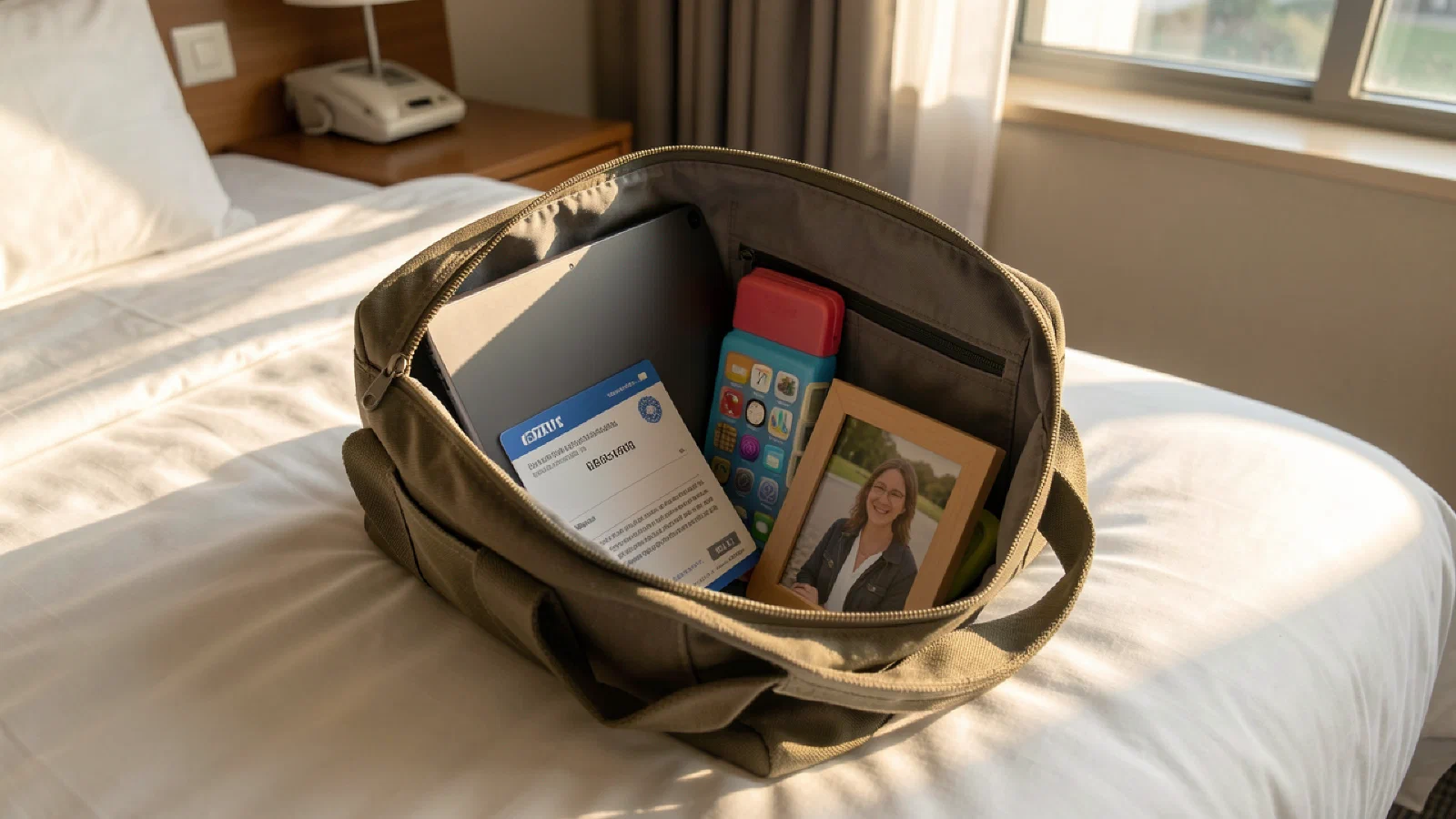
The simplest scaffold for the person who still goes places costs nothing and should be in every wallet of every person with a cognitive diagnosis. A card with their name, their address, the name and phone number of their nearest emergency contact, their medical condition, and a sentence: “I have a memory condition. Please help me call my family.”
Most wallets do not contain this card. The reasons are the reasons that govern so much of early-stage dementia care: the person does not want to acknowledge the diagnosis, the family has not thought of it, nobody told them to do it. The card is a scaffold that requires no technology, no training, and no ongoing maintenance. It works in every environment. It works when the phone is dead. It works when the person cannot remember their own address but can hand someone a card.
Arthur has one. Elena laminated it. It is behind his driver’s license, which he no longer uses but which he carries because he has carried it for fifty years and the wallet feels wrong without it.
The Phone as Scaffold#
Elena spent an afternoon configuring Arthur’s phone. The configuration is specific and deliberate.
The home screen has four large icons: Phone, Maps, Camera, and Home (a shortcut that calls Elena). Everything else is hidden. The visual simplicity reduces the decision load to four options, and Arthur’s procedural memory has learned which icon does what because there are only four to learn.
The GPS is set for audio turn-by-turn with voice navigation at every intersection, not just when a turn is required. “Continue straight on Central Avenue” is reassurance, not instruction. It confirms that Arthur is on the right path, which prevents the hesitation that escalates into confusion.
The contacts show photographs, not names. Arthur may not reliably connect the name “Elena” to his daughter, but he recognizes her face. The photograph is the retrieval pathway the name cannot provide.
The voice memo is the most important piece. Arthur recorded it himself, three months ago, when Elena explained what it was for. He said: “You are going to Café Luna. Turn right here. You know this walk.” When the phone detects that Arthur has stopped moving at the corner of 5th and Central for more than thirty seconds, it plays the memo. Arthur hears his own voice. He trusts his own voice. He turns right.
Scaffolding an Outing#
The caregiver-facing preparation for a scaffolded outing is not a list of restrictions. It is a list of preparations that make the outing possible.
Familiar routes only. Arthur walks to Café Luna because he has walked to Café Luna for twelve years. A new route requires executive function for navigation. A familiar route requires only procedural memory. The scaffold extends the familiar. It does not introduce the unfamiliar.
Time limits calibrated to the person’s capacity. Arthur’s walk takes about an hour, door to door. Elena knows this because she timed it for two weeks before the scaffolding was installed. If the GPS dot has not returned home within ninety minutes, Elena calls. The ninety-minute window gives Arthur his walk and gives Elena a clear action trigger.
A backup contact at the destination. The barista at Café Luna knows Arthur, knows Elena’s number, and knows to call if Arthur seems confused, distressed, or has not arrived by 9:15. This is not surveillance. It is community infrastructure. The barista is part of the scaffold.
Family location awareness. Elena uses a family location app to see Arthur’s GPS position. Arthur knows she can see where he is. He consented to this when he was diagnosed, as part of a broader conversation about what safety measures he would accept and which he would not. He accepted the location sharing. He declined a wrist tracker. His preferences governed the design.
The Barista Network#
The informal scaffold of people who know the person is as important as any device in the system. The barista who calls if Arthur does not arrive. The neighbor two doors down who knows Arthur’s walk and will call Elena if she sees him going the wrong direction. The pharmacist who knows the family and will help Arthur call home if he comes in confused.
This is not technology. It is community infrastructure, and for a person with early-stage dementia it is often the most reliable layer of the scaffold. Devices fail. Batteries die. GPS signals bounce off buildings. The barista does not need a battery. The neighbor does not lose signal.
Building the network is the caregiver’s work. It requires identifying the people along the person’s routes who see them regularly, telling those people about the diagnosis with the person’s consent, giving them a contact number, and asking them to call if something seems wrong. Most people say yes. Most people are willing to be part of the scaffold when someone asks. Most people are never asked.
The Dignity Test Applied#
Elena did not restrict Arthur’s walk. She built the conditions under which the walk could continue safely. The alternative, the one Arthur’s brother advocated, was to stop the walk entirely. It was too risky, the brother said. Arthur could get lost. He could wander into traffic. He could fall.
All of those risks are real. The GPS, the voice memo, the barista, the neighbor, the wallet card, and Elena’s phone do not eliminate those risks. They reduce them to a level that Arthur and Elena agreed was acceptable, because the walk itself is not optional for Arthur. The walk is the thing that makes the morning the morning. It is identity. It is routine. It is twelve years of a life lived outside the house. The brother’s proposal would have eliminated the risk by eliminating the walk, and in doing so would have eliminated something that no amount of safety can replace.
BML-05.04 makes the dignity test explicit. Here it is applied in motion: does this intervention extend the person’s agency, or does it contract it? Elena’s scaffolding extended Arthur’s agency to include a walk he has taken for twelve years. Her brother’s proposal contracted Arthur’s agency to the house. Both thought they were protecting the same person. They were answering different questions.
9:15 AM#
Arthur is at his table. The coffee is the same order he has placed for twelve years. The barista did not need to call Elena. The GPS dot arrived at 9:07 and has not moved since. Elena has gone back to her morning.
The walk is still Arthur’s. Not because the dementia does not exist, and not because the scaffolding eliminated the risk, but because someone spent an afternoon building the conditions under which the walk could remain possible. The phone, the memo, the barista, the neighbor, the wallet card. A network assembled from simple pieces that returns something no amount of safety thinking can replace: a man at his table, on a Tuesday morning, in the life he built.
How this article connects to others in Blue Mirror.
Sources cited in this article.
- Bantry White, Emer, and Paul Montgomery. "Supporting People with Dementia to Walkabout Safely Outdoors: Development of a Evidence-Based Multifaceted Intervention." BMC Geriatrics, vol. 15, no. 1, 2015, pp. 1-12.
- Pot, Anne Margriet, et al. "Improving Safety of People with Dementia in the Community: A Multi-Component Approach." International Journal of Geriatric Psychiatry, vol. 27, no. 2, 2012, pp. 173-183.
- Hegde, Sudeep, and Ruth Ellenbogen. "Use of Smartphones in the Management of Dementia: A Scoping Review." International Journal of Environmental Research and Public Health, vol. 18, no. 4, 2021, p. 1919.
- Robinson, Louise, et al. "Keeping in Touch Everyday (KITE) Project: Developing Assistive Technologies with People with Dementia and Their Carers to Promote Independence." International Psychogeriatrics, vol. 21, no. 4, 2009, pp. 665-684.