The Person in the Room
Series 05: Who You Are When You Forget
You have a person you love who has a diagnosis. You have been reading this series because someone told you it was worth reading, or because you found it at 2 AM when the house was quiet and the question was too large for the silence. You have read about scaffolding and dignity and reminiscence and the memory that can be lost and found. You have read about music and scent and objects that the hands recognize when the mind does not. You have read about enhancement and preserved capacities and the windows that open and close. You have read about a retired surgeon who teaches on Wednesday afternoons and a grandmother who says “Good” when her own story is read back to her.
You are still not sure what to do on Tuesday.
This synthesis is addressed to you.
Seven Dimensions, One Project#
This series covered seven dimensions of the relationship between technology, memory, and personhood. They are not separate interventions. They are facets of a single project: keeping the person present, in every sense of that word, across every stage of cognitive change.
Scaffolding is compensation. Carl’s $194 system, George’s 0530 routine, Arthur’s walk to Café Luna. The scaffold closes the gap between what the person knows and what they can access, extending independence into territory the diagnosis would otherwise close. The scaffold does not fix the brain. It fixes the environment, so the brain can do what it still can.
Dignity is the ethical spine. Dr. Miriam Osei’s five questions. The test every intervention must pass before it belongs in the care plan: does this serve the person, or does it serve the family’s need to manage the person? The scaffolding in Morris’s own handwriting versus the sign that says REMEMBER. The GPS that guides Arthur home versus the tracker in Eduardo’s shoe. The difference is design intent, and the design intent is the ethical question.
Reminiscence is activation. Salvatore’s cassette tape. David’s forty hours of recording. Harold’s toolbox. The structured engagement with biographical material that activates preserved memories through sensory, motor, and emotional pathways that the disease has not closed. Reminiscence does not treat the disease. It treats the experience of the disease, and the experience is where the person lives.
Reconstruction is retrieval. Lorena’s lullaby. The moment when the door opens and one word comes through. The neuroscience says the memories are patterns, not files, and the patterns may still be there even when the retrieval pathway is locked. Music, scent, touch, and motor cues are keys. Some keys fit. Some doors open. The opening is not guaranteed. The conditions that make it more likely are worth creating.
Enhancement is building on what remains. Dr. Ahmadi’s walking shoes. Phillip’s dual-task training. The honest assessment of what works (exercise, sleep, specific training on preserved expertise) and what does not (most of the $8 billion nootropics market). Enhancement is a practice, not an event. It accumulates. It compounds. It requires the discipline to show up, and the honesty to know what the showing up can and cannot produce.
Connection is the relationship restored. Dorothy calling Kathleen after two years of silence. Walter and Edna’s Friday evening with the Sinatra. The scaffolded tablet that removes every barrier except the desire to connect. Social connection is not a luxury added after the medical needs are met. It is a neurological event that activates the most complex networks the brain operates. The person who is isolated is declining faster. The person who is connected is exercising capacities that isolation would atrophy.
Purpose is the turn. Dr. Osei teaching Priya on a Wednesday afternoon. Gloria reciting a poem for high school juniors. Maya’s three index cards and the grandmother who says “Good.” Purpose is the moment when the person with dementia stops being only a recipient and becomes a giver. The giving is real. The expertise is real. The value produced is real. And the experience of being needed, of holding knowledge that someone wants, of mattering to someone who is not obligated to care, is the experience that no medication, no scaffold, and no amount of excellent care can provide.
The Technology Across All Seven#
What exists now: functional tools across every dimension. Labeled cabinets and smart speakers for scaffolding. Values statements and advance directives for dignity documentation. Smartphone recording and StoryCorps for life story capture. Personalized playlists and the MUSIC & MEMORY program for music-based retrieval. Walking shoes and sleep hygiene for enhancement. Photo-contact tablets for connection scaffolding. The barista network and three index cards for purpose deployment. None of these requires a prescription. None requires institutional permission. All are available to any family with the knowledge to use them.
What is genuinely close, within one to two years: AI-assisted life story documentation platforms. Scaffolding systems integrated with cognitive monitoring from BML-04.02. AI-guided reminiscence prompts built from biographical profiles. Purpose session protocols organized by preserved expertise category. These tools will not replace the human presence that makes every dimension work. They will provide structure, personalization, and monitoring that most families do not have time to build themselves.
What requires structural change: care systems reoriented from deficit management to capacity deployment. Assessment tools that measure what the person can do, not only what they cannot. Reimbursement structures that recognize cognitive care coordination, reminiscence facilitation, and purpose deployment as healthcare rather than activities. The cultural permission to treat people with dementia as contributors. These changes are not technological. They are institutional, political, and philosophical. They are coming, but they are not coming fast.
The Dignity Test Applied to the Full Series#
Every intervention in this series, every technology, every approach, is held against the five questions from BML-05.04.
The scaffolding in the person’s own handwriting versus the sign that says REMEMBER. The reminiscence that asks what the person experienced versus the reminiscence that replays the family’s preferred version of the story. The monitoring system that allows the walk versus the system that locks the door. The purpose session deploying real expertise for a real audience versus the activity calendar asking the person to sort buttons. The connection scaffold that reopens a forty-year friendship versus the isolation that efficiency chose.
Each pair is the test applied. The first option in each pair treats the person as present. The second treats the person as managed. The technology is often identical. The intent is the difference. The intent is always the difference.
When Technology Preserves and When It Creates a Simulacrum#
The hardest question in this series, held for the synthesis: when does technology preserve identity and when does it create a more comfortable version of a person who is no longer there?
The boundary is not technology-based. It is intent-based. Technology that helps the present person be more fully themselves is inside this series. The scaffold that lets Morris find his coffee mugs. The playlist that lets James play saxophone in his armchair. The tablet that lets Dorothy call Kathleen. These serve the person who is here now.
Technology that performs a person for others’ comfort is outside this series. An AI that generates responses in the person’s voice after the person can no longer speak. A chatbot trained on biographical data to simulate the person for family members who miss them. A digital twin that answers as the person would have answered. These may serve the family’s grief. They do not serve the person. The person is not in the simulation. The person is in the room, in whatever capacity remains.
The distinction is the dignity test’s third question: does this treat the person as someone who is still here, or as someone who is already gone? Technology that serves the person who is still here, at whatever stage, with whatever capacities remain, is the technology this series endorses. Technology that replaces the person with a more convenient version has failed the test.
What the Exoskeleton Cannot Replace#
Human presence. Human touch. The person who sits with Dorothy when she calls Kathleen. The person who turns the pages Thomas does not need turned. The person who brings three index cards to a Saturday visit. The person who burns toast every afternoon at 4 PM.
The technology in this series augments human presence. It does not substitute for it. The scaffold without a person maintaining it is a set of labels and devices. The reminiscence without a person in the room is a playlist playing to an empty chair. The purpose session without a real audience is an exercise without meaning. Every dimension of this series begins and ends with a human being who shows up.
The exoskeleton is the structure. The person inside it is the reason the structure exists.
The Case for Starting Early#
Every dimension of this series has a better outcome when the work begins while the person can still participate in designing it. The life story documentation from BML-05.07 is richest when the person is fully articulate. The scaffolding design from BML-05.01 is most effective when the person can say what they need. The sensory profile from BML-05.11 is most accurate when the person can confirm which scents carry which memories. The values documentation from BML-05.04 is most trustworthy when the person writes it in their own words.
Building the exoskeleton together, while both hands are still available, is different from building it for someone who can no longer tell you what to build. The participation is not just practical. It is relational. The person who designs their own scaffold is exercising agency. The person whose scaffold is designed for them is receiving care. Both are valid. The first is available now and may not be available later.
For the person reading this who does not yet have a diagnosis: start. Record the conversations. Write the values statement. Build the sensory profile. Document the life story. Not because you expect to need it. Because timing is the one resource that cannot be recovered, and the work is a gift to the people who will need it and to the person you will be when they do.
Tuesday#
This synthesis does not tell you exactly what to do on Tuesday. What it tells you is the frame to bring.
The person is still in the room. In every sense of that phrase. Present in their preserved capacities, in what their body still knows how to do. Present in their emotional memory, in what they still feel. Present in what they can still give, in the expertise that the window sometimes opens onto. Present in the relationship that cognitive change has not destroyed but only changed.
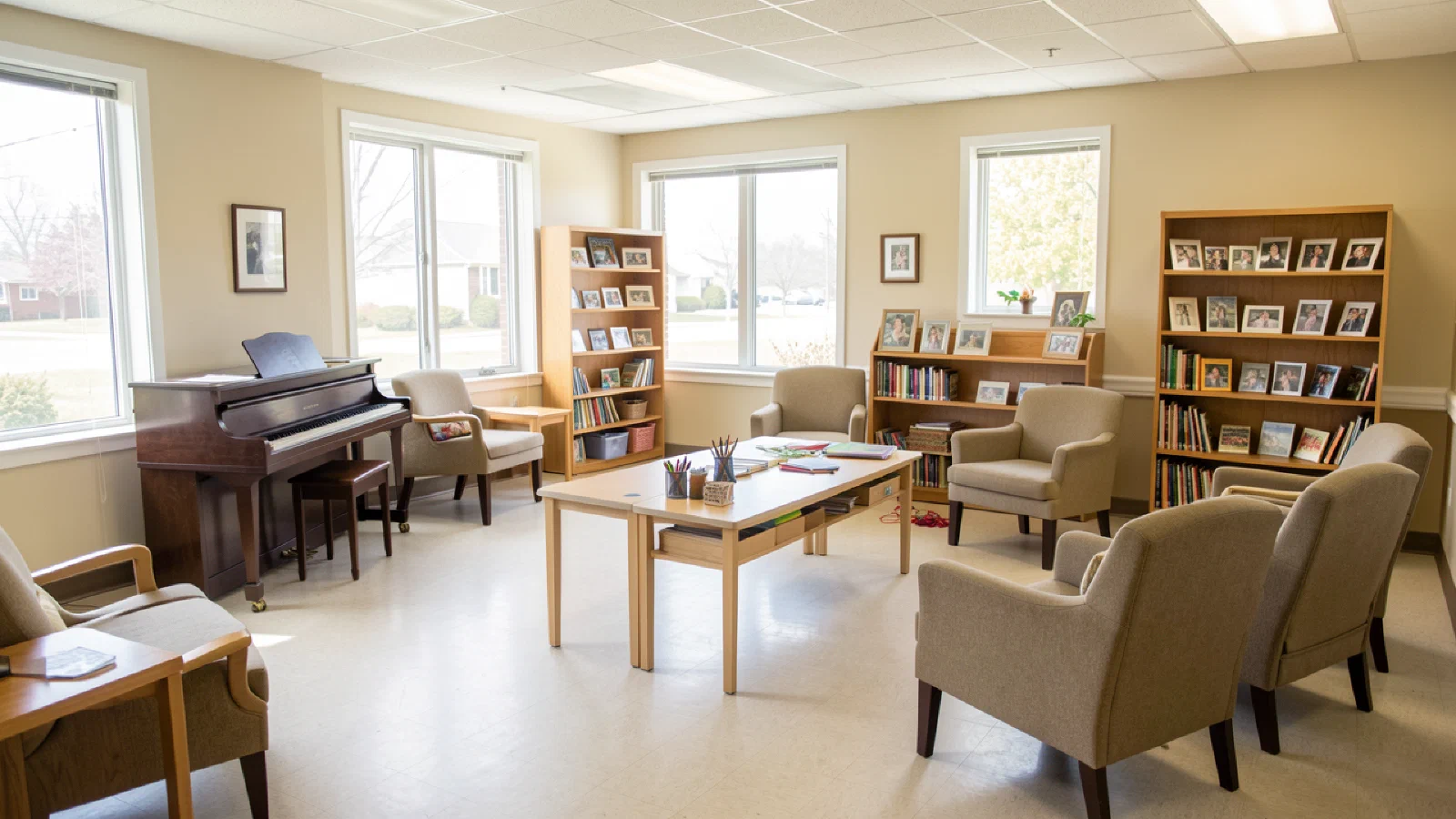
Tuesday is a day to be in the room with the person who is still there. To bring the music or the toolbox or the three index cards. To maintain the routine or rebuild it. To ask the question and wait for the answer. To hold the hand. To burn the toast.
The technology helps. The scaffold extends. The monitoring informs. The playlist opens doors. The tablet reconnects. None of it works without the person who shows up, who sits in the room, who waits through the silence, and who recognizes, in whatever form it arrives, that the person they love is still there.
Tuesday. The person is in the room. Be there with them.
How this article connects to others in Blue Mirror.
Sources cited in this article.
- Kitwood, Tom. "Dementia Reconsidered: The Person Comes First." Open University Press, 1997.
- Sabat, Steven R. "The Experience of Alzheimer's Disease: Life Through a Tangled Veil." Blackwell Publishers, 2001.
- Post, Stephen G. "The Moral Challenge of Alzheimer Disease: Ethical Issues from Diagnosis to Dying." Johns Hopkins University Press, 2000.
- Brooker, Dawn. "Person-Centred Dementia Care: Making Services Better." Jessica Kingsley Publishers, 2007.
- Hughes, Julian C., et al. "Dementia: Mind, Meaning, and the Person." Oxford University Press, 2006.
- Boyle, Patricia A., et al. "Effect of a Purpose in Life on Risk of Incident Alzheimer Disease and Mild Cognitive Impairment in Community-Dwelling Older Persons." Archives of General Psychiatry, vol. 67, no. 3, 2010, pp. 304-310.