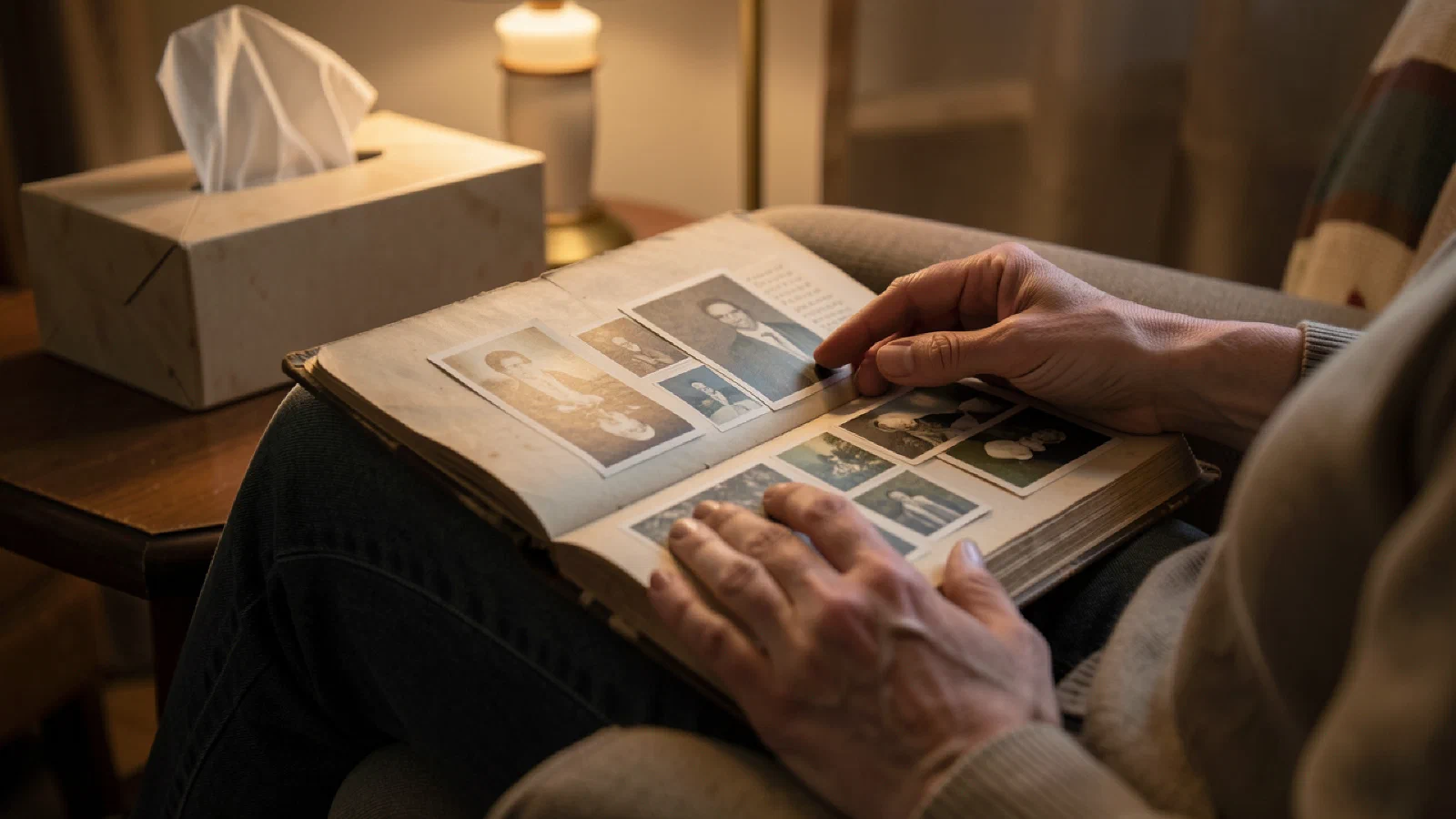
The Memory That Heals
Series 05: Who You Are When You Forget
Salvatore Ricci is 81, a retired bricklayer from Providence, Rhode Island, and he has not spoken a complete sentence in three months. He sits in the common room of his memory care facility most afternoons, quiet, present in the room but not reaching anyone in it. His daughter Angela has brought a cassette recording, an actual cassette played on a player she found at a thrift store, of the song that was playing on the radio the afternoon in 1967 when Salvatore proposed outside a restaurant on Federal Hill.
The song starts. Salvatore closes his eyes. He describes, in precise detail, the temperature that afternoon, what Angela’s mother was wearing, the exact words he said. The description is fluent, specific, and emotionally intact. It is the longest utterance anyone has heard from him in three months. Then the song ends. He returns to silence. Angela is crying. The activities coordinator writes in her notes: “Today was a good day.”
What Reminiscence Therapy Is#
Reminiscence therapy is a clinical intervention, not a sentimental exercise. It takes three forms, each with a different purpose and a different evidence base.
Individual reminiscence is one-on-one conversation guided by prompts, photographs, music, or sensory objects. A skilled facilitator uses personally meaningful materials to elicit specific memories, following the person’s lead rather than directing the conversation toward a predetermined topic. The facilitator’s job is not to produce a particular memory. It is to create the conditions under which the person can access whatever is accessible.
Group reminiscence brings people with similar generational backgrounds together for shared recall in a supported setting. The social dimension adds something individual sessions do not: the experience of being in a group where everyone’s memory is fragmented, where the norm is not perfect recall but shared effort, and where one person’s fragment can trigger another person’s.
Life review is the most structured form: a comprehensive, chronological autobiography conducted over multiple sessions with therapeutic intent. It is closer to psychotherapy than activity programming. The person constructs a narrative of their life, often with a trained facilitator, and the construction itself is the intervention. The act of organizing a life story engages cognitive capacities that passive reminiscence does not require. Life review overlaps with the documentation work in BML-05.07, though its intent is therapeutic rather than archival.
What the Evidence Actually Shows#
The evidence for reminiscence therapy is strong for some outcomes and weaker for others, and the honest distinction between these is the difference between deploying it effectively and using it to comfort families rather than serve the person.
Strong evidence: emotional wellbeing outcomes. Multiple systematic reviews and meta-analyses show that reminiscence therapy reduces depression and anxiety, improves mood, and increases positive affect in people with dementia. The effect sizes are moderate and consistent. The evidence is strongest for individual reminiscence with personally meaningful materials, weakest for generic group programs using era-specific materials that are not personally connected to the participants.
Strong evidence: social engagement. Reminiscence sessions produce more verbal output, more conversational turns, and more interpersonal engagement than any other structured activity in memory care settings. People talk more during reminiscence than during art therapy, music therapy, or unstructured social time. The talking is the mechanism. The engagement is the outcome.
Moderate evidence: relationship quality. Family-based reminiscence, where the family member and the person with dementia engage in structured recall together, produces improved relationship quality for both parties. The caregiver reports feeling closer to the person. The person shows more positive affect in the caregiver’s presence. The evidence is consistent but based on smaller samples.
Weaker evidence: cognitive outcomes. Reminiscence therapy does not reverse cognitive decline. Some studies show temporary improvements in specific cognitive measures during and immediately after sessions, but the improvements do not persist. Reminiscence is not a treatment for memory loss. It is a treatment for the experience of living with memory loss. The distinction matters because a family that expects reminiscence to slow the disease will be disappointed, and a family that expects it to improve the quality of the life being lived will find the evidence supports them.
What Makes It Work#
Specificity. Not “tell me about your childhood” but “tell me about the kitchen in the house where you grew up.” The specific question targets a specific memory with specific sensory content. The general question requires the person to search without a target, which is the exact cognitive operation that dementia impairs.
Sensory anchoring. The cassette tape. The photograph from that year. A piece of fabric with a familiar texture. The smell of the spice that was always in the kitchen. Sensory anchors provide the retrieval pathway that verbal prompts alone cannot always open. Salvatore’s song did what the question “tell me about your proposal” could not: it opened the door through a different channel.
Emotional safety. The facilitator must be able to hold whatever comes up. Not all memories are happy. The person who remembers the kitchen may also remember the argument that happened in the kitchen. The brother who died. The marriage that ended. The facilitator’s job is not to steer toward pleasant memories. It is to make it safe for the person to feel whatever the memory contains. A reminiscence session that only allows positive recall is not therapy. It is entertainment wearing a clinical label.
The right time. Cognitive function fluctuates throughout the day for most people with dementia. The same person who cannot engage at 9 AM may be accessible at 2 PM. The session should be timed to the person’s best window, which requires observation over multiple days to identify. BML-05.17 covers the concept of windows in depth.
What Families Can Do#
Structured reminiscence does not require a clinical facility. A family member with the right materials and the right approach can conduct effective reminiscence conversations at home.
Prepare the materials. Select three to five photographs, objects, or recordings with known personal significance. The biographical profile from BML-05.07 is the source. If the profile does not exist yet, start with the materials the family member knows are meaningful: the wedding photograph, the song from a significant year, the tool from the workshop.
Start with a specific prompt. “Tell me about this photograph” is better than “do you remember this?” The first invites. The second tests. People with dementia often respond to invitations and resist tests, because tests carry the possibility of failure and failure is the thing they are most afraid of.
Follow, do not lead. If the person takes the conversation in a direction the family member did not expect, follow. The memory that surfaces is the memory that is accessible. Redirecting toward a preferred memory interrupts the retrieval pathway that was open.
Know when the session is over. The person may signal fatigue with restlessness, decreased engagement, or changed affect. A session that runs past its natural end becomes a demand rather than an invitation. Twenty minutes is a good starting length. Some sessions will be five minutes. Some will be forty. The person determines the duration.
Expect inconsistency. The session that produced twenty minutes of vivid recall last Tuesday may produce nothing next Tuesday. The inconsistency is not failure. It is the nature of memory retrieval in a changed brain. The family that shows up with the materials every Tuesday regardless of the outcome is doing the work correctly.
The Technology Layer#
AI-guided reminiscence platforms are in development that will prompt family members through evidence-based conversation structures, suggest materials based on the person’s biographical profile, and organize recorded sessions into an archive that tracks which prompts produced responses and which did not. In one to two years, these tools will be available for home use.
What the technology adds: structure that most families do not have, biographical data organized into session-specific packages, and longitudinal tracking that shows which approaches work for this specific person. What the technology cannot add: the human presence that makes the session safe, the emotional attunement that knows when the session should end, and the relationship that gives the conversation its weight. Salvatore did not respond to the cassette tape because it was played on a technologically optimal schedule. He responded because Angela brought it, because Angela was sitting beside him, because the song held a memory that included a woman they both loved.
After the Song#
The song ends. Salvatore returns to silence. Angela is crying. The activities coordinator writes “Today was a good day.”
Was today a good day for Salvatore? The question is not a rebuke. It is the discipline of the dignity test applied to an intervention that feels entirely good. Salvatore remembered the temperature, the dress, the words he said. The memory was vivid and emotionally intact. Then it closed. He is back in the common room, back in the silence, and the question of whether the twenty minutes of vivid recall were pleasure or disturbance depends on the experience of the person who had them, not the experience of the daughter who witnessed them.
The answer may be both. The retrieval may have been a moment of being fully himself, which is a gift. The return to silence after being fully himself may have been a loss, experienced again. Both may be true. The honest practice of reminiscence holds both possibilities and lets the person’s response, not the family’s hope, determine whether to do it again.
Angela will bring the cassette again next Sunday. She will watch her father’s face when the music starts. If his eyes close and the words come, she will sit with the memory. If they do not, she will sit with the silence. Either way, she will be there, and the being there is what the cassette made possible: not the memory, but the reason to bring the cassette, the reason to sit beside him, the reason to keep coming back.
How this article connects to others in Blue Mirror.
Sources cited in this article.
- Woods, Bob, et al. "Reminiscence Therapy for Dementia." Cochrane Database of Systematic Reviews, no. 3, 2018, CD001120.
- Subramaniam, Ponnusamy, and Bob Woods. "The Impact of Individual Reminiscence Therapy for People with Dementia: Systematic Review." Expert Review of Neurotherapeutics, vol. 12, no. 5, 2012, pp. 545-555.
- O'Philbin, Lorcan, et al. "Reminiscence Therapy for Dementia: An Abridged Cochrane Systematic Review of the Evidence from Randomized Controlled Trials." Expert Review of Neurotherapeutics, vol. 18, no. 9, 2018, pp. 715-727.
- Lazar, Anja, et al. "Designing and Evaluating Life Story Work for People with Dementia and Their Families." International Journal of Human-Computer Studies, vol. 105, 2017, pp. 72-87.
- Elfrink, Teuntje R., et al. "Life Story Books for People with Dementia: A Systematic Review." International Psychogeriatrics, vol. 30, no. 12, 2018, pp. 1797-1811.