The Grandchild Who Listened
Series 05: Who You Are When You Forget
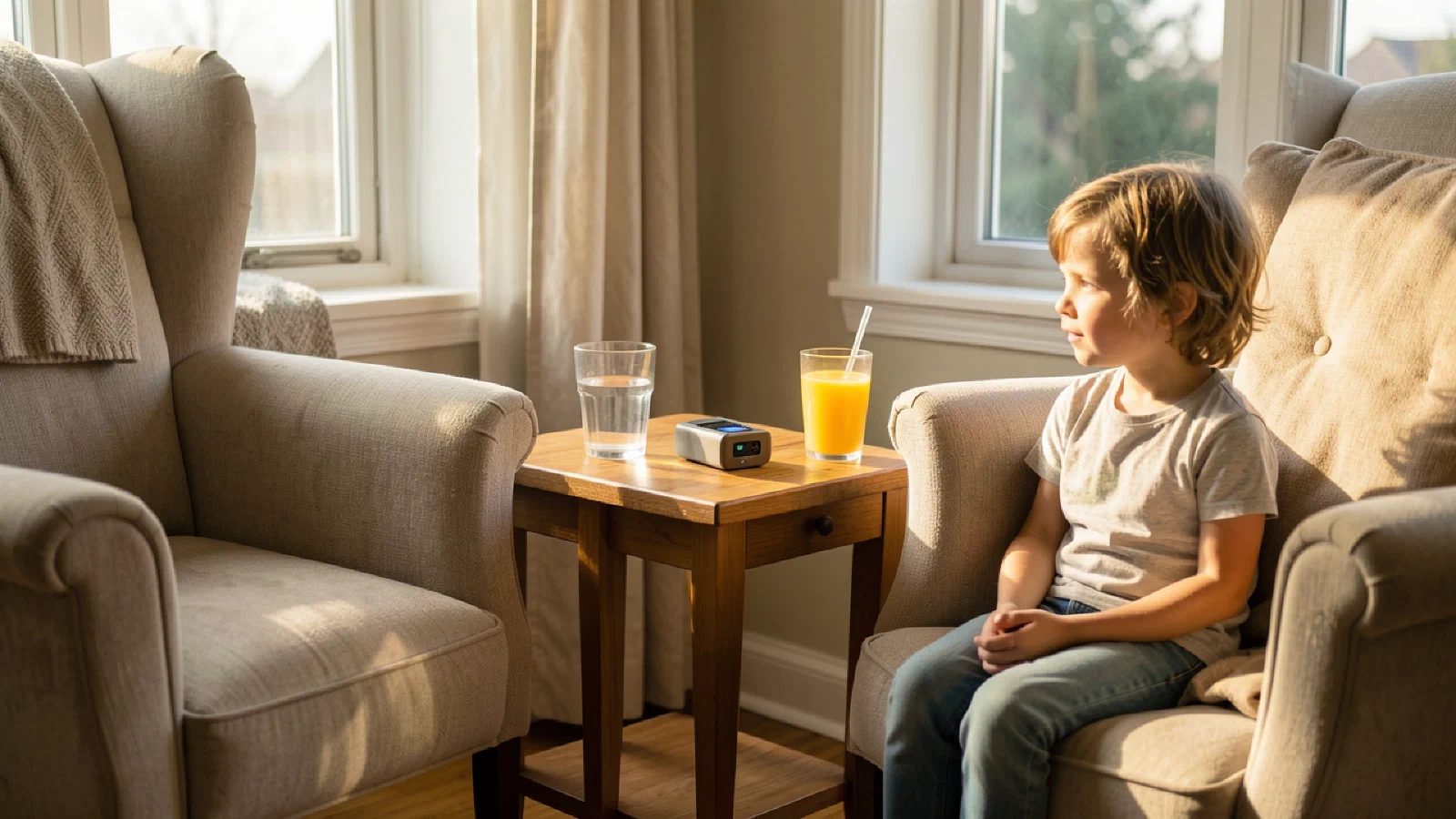
Maya Chen is 15, and she has been visiting her grandmother Linda, 81, every Saturday for nine months. Linda has moderate Alzheimer’s. Maya brings three questions written on index cards. The format never varies. Three cards, three questions, one Saturday. Maya writes the answers in a notebook.
Nine months of Saturdays have produced a family history that Linda’s own children never thought to ask for. The name of Linda’s first teacher. The color of the house on Maple Street. The summer Linda’s father built the porch and the argument that happened during the building and the way her parents made up afterward by slow-dancing in the kitchen when they thought nobody was watching. Maya has it all in the notebook.
This Saturday, Maya has brought something different. She has brought a page from the notebook: a story Linda told in March that Linda will not remember telling. Maya reads it to her. Linda listens. The story is about the summer Linda learned to swim in a lake in Wisconsin, and the cousin who pushed her off the dock, and the way the water tasted. Linda does not remember telling it. She listens as though someone else said it. When Maya finishes reading, Linda says: “Did I say that?” Maya says yes. Linda says: “Good.”
Why Grandchildren, Specifically#
The grandchild occupies a relational position that no other person holds. The grandchild is the future the grandparent’s life is producing. The grandparent is the past the grandchild’s life emerged from. What each gives the other is what no other relationship offers.
The grandparent receives what no medication provides: the experience of being needed by someone for whom they are irreplaceable. Maya’s questions cannot be answered by anyone else. The stories about the house on Maple Street, the cousin at the lake, the slow dance in the kitchen, exist in Linda’s memory and nowhere else. When Maya asks, Linda is the only source. The experience of being the only source, of holding knowledge that someone wants and cannot get elsewhere, is the experience of mattering. BML-05.17 and BML-05.18 call this the window of purpose. For Linda, the window opens on Saturdays, when a fifteen-year-old with three index cards makes her the most important person in the room.
The grandchild receives something equally specific. Maya is getting a family history that her parents do not have. The stories her mother never asked about because she assumed there would be time. The details that would have been lost when Linda can no longer tell them. Maya is also getting something harder to name: the experience of being trusted by an older person who is willing to be honest because she has lived long enough to know that honesty is the only thing worth offering. The exchanges between Linda and Maya are not clinical. They are familial. They are what families are for.
The Evidence on Intergenerational Contact#
Intergenerational programs in memory care facilities consistently produce positive outcomes when the contact involves meaningful exchange rather than mere presence. Improved mood, increased engagement, and better social cognition in people with dementia. The strongest effects occur when actual knowledge transfers: when the older person teaches something or shares something that the younger person receives as valuable.
Mere presence is not sufficient. A grandchild sitting in the room watching television with a grandparent who has dementia produces some benefit from companionship but does not engage the neural networks that purposeful exchange activates. The three-question format turns presence into exchange. The exchange is what produces the cognitive and emotional benefit.
The Three-Question Format#
Maya’s format works for specific reasons that follow from the neuroscience of preserved capacities and the practical constraints of cognitive impairment.
Three questions provide a specific, manageable demand. Not “tell me about your childhood,” which requires executive function to initiate, organize, and sustain a narrative. Instead: “What was the name of your first teacher?” A specific question requiring only retrieval. The specificity is the scaffold. The question tells Linda exactly what to look for, and the looking activates the retrieval pathway without requiring her to construct the search herself.
The index cards remove the requirement for Maya to manage conversational turns. Each card is a prompt. When one question is answered, the next card appears. The format is visual, tangible, and consistent. Linda’s procedural memory has learned what three index cards on a Saturday morning mean.
The consistent format uses procedural memory. Linda’s body knows how Saturday visits work. The chair, the table, the cards, the notebook. The routine is the scaffold. After nine months, the routine itself is part of Linda’s procedural landscape, and the body’s anticipation of the format is part of what opens the window.
Three questions are enough. More would exhaust. Fewer would not produce enough material for the exchange to feel meaningful. Three is a session that lasts twenty to thirty minutes, which is within the attention span of most people with moderate dementia and within the patience of most fifteen-year-olds.
Technology That Supports the Exchange#
Recording every session captures what might otherwise be lost. Maya uses her phone to record while she writes in the notebook. The recording preserves Linda’s voice, her phrasing, her pauses. The notebook preserves the content. Both will have value later: the recording as a reminiscence tool from BML-05.06, the notebook as a family archive from BML-05.07.
Scaffolding systems that provide biographical prompts can help Linda respond when retrieval is difficult. If Linda’s biographical profile from BML-05.07 has been built, a tablet or printed prompt sheet can offer contextual cues: “Your first teacher was at the school on Oak Street” might open the retrieval pathway that the bare question “What was the name of your first teacher?” cannot. The scaffold supports the answer without providing it.
Playing back a recording from a previous session is a therapeutic intervention in itself. Maya reading the March story to Linda is reminiscence therapy, conducted informally by a fifteen-year-old, producing exactly the response the clinical literature predicts: recognition not of the event but of the self. “Did I say that? Good.” Linda is recognizing herself in the story, acknowledging that the person who said it was right, and confirming that the story was worth saving. The playback is a mirror. Linda looks into it and sees someone she approves of.
The Knowledge That Transfers#
Knowledge transmits. The stories, the history, the facts about a family that exist nowhere except in the memory of the oldest living member. Maya’s notebook contains information that no archive holds. It will outlast Linda. It will be read by Maya’s children and their children. The notebook is a family document produced by a relationship that cognitive change tried to sever and that three index cards kept open.
Values transmit. What Linda believed, what she cared about, the principles she lived by. These come through in the stories, not as lectures but as the embedded ethics of a life lived according to certain commitments. The way Linda describes her parents’ argument and their reconciliation carries a value judgment: this is how people who love each other behave. Maya receives the judgment without it being labeled. It arrives inside the story.
Identity confirms. The person who tells their grandchild who they were is, in that telling, the person they were. The telling is an act of identity. Linda, recounting the summer at the lake, is the girl who learned to swim and the woman who became the grandmother telling the story. Both are present. The telling holds both. The diagnosis does not reach the telling because the telling is happening now, in the present tense, in a voice that is Linda’s voice even when the memory that feeds it is unreliable.
The Grandparent Who Is Needed#
Maya needs Linda’s stories. Not as therapy. Not as a clinical intervention. As family history that does not exist anywhere else. The need is genuine. Linda knows she is needed. She may not articulate the knowing, but the behavioral evidence is clear: she is more alert on Saturday mornings. She is calmer after Maya’s visits. She refers to “the girl with the cards” on days that are not Saturday.
The experience of being needed is what BML-05.18 called medicine. It requires only a Saturday, three index cards, and a grandchild who waits for the answer. The waiting is important. Maya does not fill Linda’s silences. She waits. The waiting communicates: your answer is worth my time. Your knowledge is worth my patience. You are the only person who can tell me this, and I am not in a hurry.
“Did I Say That? Good.”#
Linda does not remember telling the March story. She hears it read back to her by her granddaughter and receives it as something someone else said that she agrees with. The sentence “Did I say that?” is a genuine question. She does not remember saying it. “Good” is a genuine response. She approves of what was said. She recognizes, without remembering, that the person who told the story about the lake and the cousin and the way the water tasted was a person worth listening to.
“Good” contains everything this series has argued. The person is still there. The identity persists across the forgetting. The person who cannot remember telling the story can still recognize herself in it, can still approve of who she was, can still affirm that what she said was worth writing down. The forgetting did not erase the self. It obscured the self’s access to its own history. The notebook, the reading, the granddaughter’s voice returning the story to its source, these are the scaffold that closes the gap.
The grandchild who listened is the reason the story was written down. The person in the notebook is still Linda. And Linda, hearing herself through her granddaughter’s voice, says the only word that matters: “Good.”
How this article connects to others in Blue Mirror.
Sources cited in this article.
- Jarrott, Shannon E., and Kelly Bruno. "Shared Site Intergenerational Programs: A Case Study." Journal of Applied Gerontology, vol. 26, no. 3, 2007, pp. 286-303.
- Galbraith, Bernadette, et al. "Intergenerational Programs for Persons with Dementia: A Scoping Review." Journal of Gerontological Social Work, vol. 58, no. 4, 2015, pp. 357-378.
- Camp, Cameron J. "Origins of Montessori Programming for Dementia." Non-Pharmacological Therapies in Dementia, vol. 1, no. 2, 2010, pp. 163-174.
- George, Daniel R., and Peter J. Whitehouse. "Intergenerational Volunteering and Quality of Life for Persons with Mild-to-Moderate Dementia." Quality of Life Research, vol. 20, no. 7, 2011, pp. 987-995.
- Lokon, Elizabeth, et al. "Opening Minds Through Art: A Community Arts Program for People with Dementia." Journal of Mental Health and Aging, vol. 3, 2016, pp. 1-8.