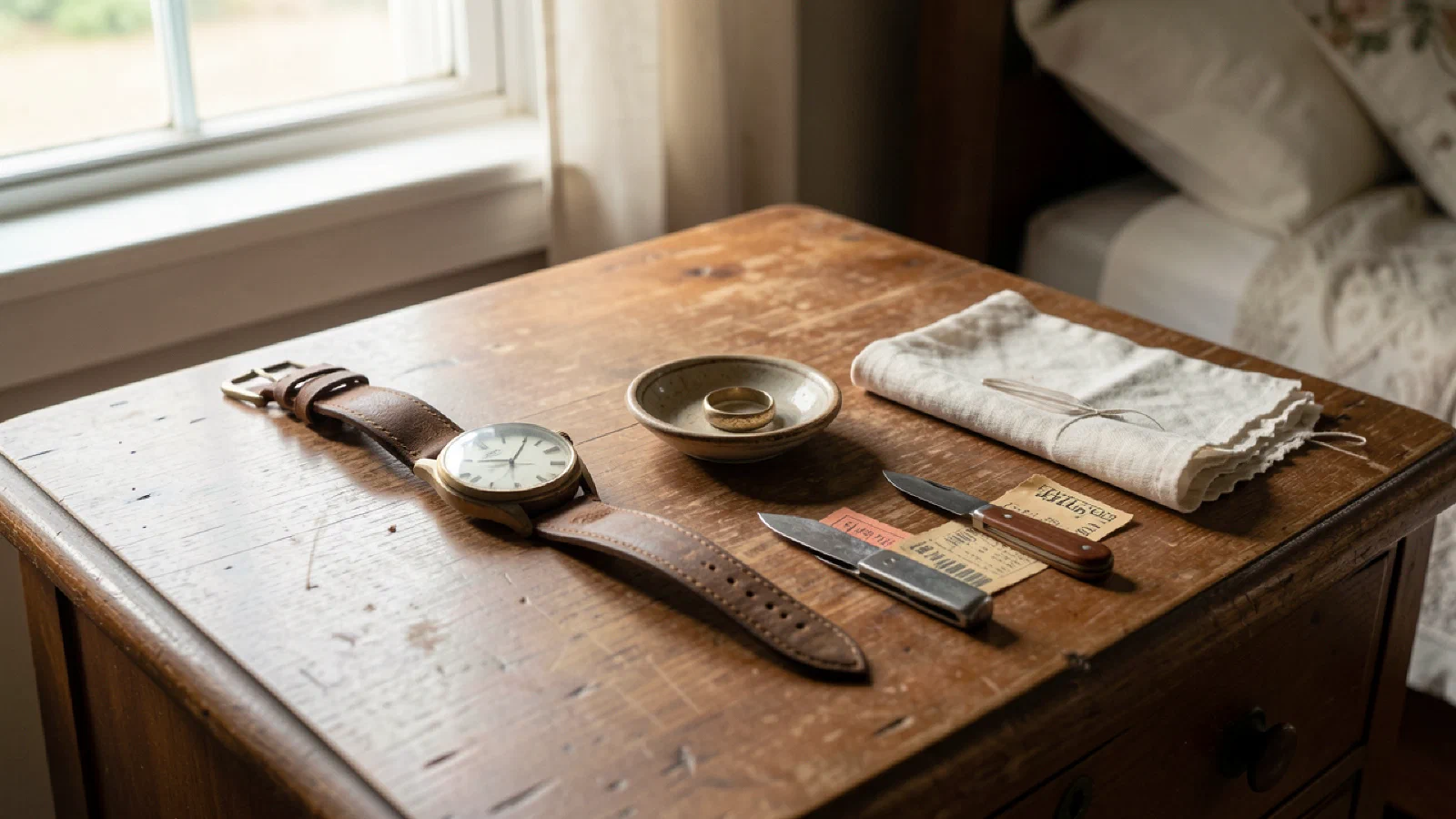
Objects, Places, and the Archaeology of a Life
Series 05: Who You Are When You Forget
Harold Watkins is 83, a retired furniture maker from Asheville, North Carolina, and he has not recognized his son Marcus in eight months. Marcus has been visiting every Saturday, sitting in the chair across from his father’s bed in the memory care facility, trying to have conversations that his father cannot hold. The conversations end in silence or confusion. Marcus has started dreading Saturdays.
Three weeks ago, Marcus brought his father’s toolbox. The toolbox has been in Marcus’s garage since Harold moved to the facility. Marcus brought it on a hunch, a memory of childhood afternoons in the workshop, the way his father’s hands moved when he was working. He opened the lid.
Harold’s hands went to the tools immediately. He named them without hesitation: bevel gauge, marking knife, shoulder plane. He picked up the marking knife and showed Marcus the correct grip, correcting the angle of Marcus’s wrist gently, precisely, the way he had corrected him in the workshop forty years ago. He did not know who Marcus was. He knew how to teach.
Why Objects Work#
Objects engage memory pathways that photographs and verbal prompts cannot reach because they activate the motor cortex, the cerebellum, and the premotor cortex through physical touch and manipulation. These brain regions process skilled movements and are among the last areas that Alzheimer’s pathology significantly affects. When Harold’s hands close around the marking knife, the grip activates a motor engram that was encoded through thousands of repetitions across decades of work. The engram does not require the hippocampus to retrieve it. The hands know.
This is different from showing Harold a photograph of his workshop. The photograph engages visual recognition and episodic recall, both hippocampus-dependent functions that Alzheimer’s has compromised. The photograph asks Harold to remember the workshop. The tool asks Harold to be in the workshop. The distinction is the difference between a retrieval demand and an activation trigger, and for people with moderate to advanced dementia, the activation trigger works when the retrieval demand does not.
The Evidence for Object-Based Reminiscence#
Research comparing object-based, photograph-based, and conversation-based reminiscence approaches shows consistent differences in engagement. Object-based approaches produce more conversational turns, longer session duration, and more positive affect in people with moderate to advanced dementia. The advantages increase with disease severity: the more impaired the episodic memory, the greater the relative advantage of tactile engagement over visual or verbal prompts.
The specificity principle applies with particular force. Harold’s actual tools outperform a generic antique tool. A familiar object carries personal motor memory, personal emotional associations, and personal sensory signatures: the specific weight of his marking knife, the wear pattern on his bevel gauge, the smell of the wood oil that has soaked into the leather tool roll for forty years. A generic object from the same era engages general procedural memory. The personal object engages the specific procedural memory of being Harold.
The Memory Box#
A memory box is a curated collection of objects selected for their capacity to engage multiple sensory pathways and trigger personal associations. Most families, when asked to prepare a memory box, fill it with photographs. Photographs are better than nothing. Objects are better than photographs.
What a good memory box contains: an object from the person’s primary occupation, something their hands held thousands of times. A piece of fabric with a specific texture associated with personal history, a grandmother’s apron, a child’s blanket, a work uniform. A tool or utensil connected to a skill the person practiced for years. Something that smells like a meaningful place, cedar shavings from a workshop, a particular soap, dried herbs from a garden.
The biographical profile from BML-05.07 is the blueprint for the memory box. The family member who has documented the person’s sensory landscape knows which objects carry the strongest associations. The family member who has not should start by asking: what did their hands do every day? What did their workplace smell like? What texture did they feel most often? The answers point toward the objects.
Building the box is not a one-time project. Objects can be rotated. Some will produce engagement and some will not, and the response may change over time. The object that produced nothing last month may produce something this month, because cognitive state fluctuates and the door that was closed can open. Keep the objects available. Try them periodically. The response belongs to the biology, not the effort.
Place-Based Memory#
Returning to a meaningful location produces some of the strongest reminiscence responses in the research literature, even when the person does not consciously recognize the place. Harold’s workshop, his childhood home, the church he attended for forty years: each of these places carries a full sensory signature that activates multiple memory systems simultaneously. The light, the acoustics, the smell, the spatial layout, the temperature. The body recognizes the place even when the mind does not name it.
The logistics are demanding. The person must be mobile enough for the trip. The place must be accessible. The caregiver must manage the transition from the familiar environment to the unfamiliar one and back. Not every place-based visit is possible. When it is possible, it is worth the effort.
Marcus took Harold to the workshop once, three months before the toolbox visit. Harold walked in and stood still for a long time. He did not say the word “workshop.” He walked to the workbench and ran his hand along the surface. He stood there for twenty minutes, touching the wood, and then he was ready to leave. Marcus does not know what Harold experienced. He knows that Harold’s face changed when he touched the bench, and he knows that the ride home was the calmest Harold had been in months.
Virtual Reality as a Place#
VR-based place reminiscence is in active clinical research. Multiple small-scale trials have shown positive emotional outcomes and reduced agitation when people with dementia experience virtual environments recreating meaningful places. The research is promising. It is not yet ready for unsupported home use.
What VR can do that a physical visit cannot: recreate a place that no longer exists. Harold’s childhood home was demolished in 1994. A VR reconstruction built from photographs and family descriptions could provide a spatial experience of a place that exists only in memory. The technology to do this at therapeutic quality is in development. In three to five years, VR place-based reminiscence platforms with documented therapeutic protocols may be commercially available.
What VR cannot do: replicate the full sensory environment. A VR workshop provides the visual and spatial experience. It does not provide the smell of wood oil, the weight of the marking knife, or the texture of the workbench surface. The most effective reminiscence approaches combine multiple sensory channels. VR provides one or two channels with high fidelity. The toolbox in Harold’s hands provides all of them.
The Curation Question#
When a person with dementia moves from home to a memory care facility, the question of what to bring is usually answered by space constraints and the family’s instinct. Most families bring photographs, clothing, and a few personal items. The toolbox stays in the garage.
The evidence suggests a different priority order. Occupation-specific objects first: the tools of the trade, the instruments of the hobby, the equipment of the skill the person practiced for decades. These engage the deepest motor memories and the most resistant neural networks. Then personal history objects: the items with known biographical significance documented in BML-05.07. Then daily pleasure objects: the coffee mug they always use, the blanket they prefer, the radio that plays the station they have listened to for thirty years.
The person who helps with selection should be the person who knows the biographical history. An adult child who spent childhood afternoons in the workshop knows that the marking knife is more important than the family portrait. A spouse who remembers what the person’s hands did every evening knows which objects the hands will recognize.
Harold’s Lesson#
Harold does not know who Marcus is. He is teaching Marcus the correct grip for the marking knife, correcting the angle of his wrist with the patient precision of a man who taught the same correction in the same workshop for forty years. The correction is not a memory of teaching. It is teaching, happening now, through the motor pathways that still hold everything the workshop encoded.
The toolbox did not return Harold’s episodic memory. He does not remember the workshop. He does not remember Marcus as a boy. He does not remember the afternoons. What the toolbox returned is Harold’s identity as a teacher, as a craftsman, as a person who knows things worth knowing and whose hands carry the knowledge even when his hippocampus does not.
That is not the same as remembering. It is not nothing. It is a man at a table with his tools, showing his son how to hold a knife, in a language the disease has not taken. Marcus has stopped dreading Saturdays. He brings the toolbox now, every week, and they spend an hour at the table. Harold teaches. Marcus learns. Neither of them names the relationship that makes this possible. The relationship does not need to be named. The hands are holding it.
How this article connects to others in Blue Mirror.
Sources cited in this article.
- Phinney, Alison, et al. "Exploring the Meaning of Objects for People with Dementia." Journal of Aging Studies, vol. 21, no. 2, 2007, pp. 118-128.
- Subramaniam, Ponnusamy, and Bob Woods. "Digital Life Storybooks for People with Dementia Living in Care Homes." Clinical Interventions in Aging, vol. 11, 2016, pp. 1263-1276.
- Lopes, Tânia Sofia, et al. "Sensory Stimulation Programs in Dementia Care: A Systematic Review of Methods and Effectiveness." Dementia, vol. 15, no. 5, 2016, pp. 859-888.
- Rose, David, et al. "Immersive Virtual Reality in Dementia Care: A Systematic Review." Innovation in Aging, vol. 3, suppl. 1, 2019, S378.
- Chapoulie, Emilie, et al. "Reminiscence Therapy Using Image-Based Rendering in VR." IEEE VR Conference Proceedings, 2014, pp. 45-50.