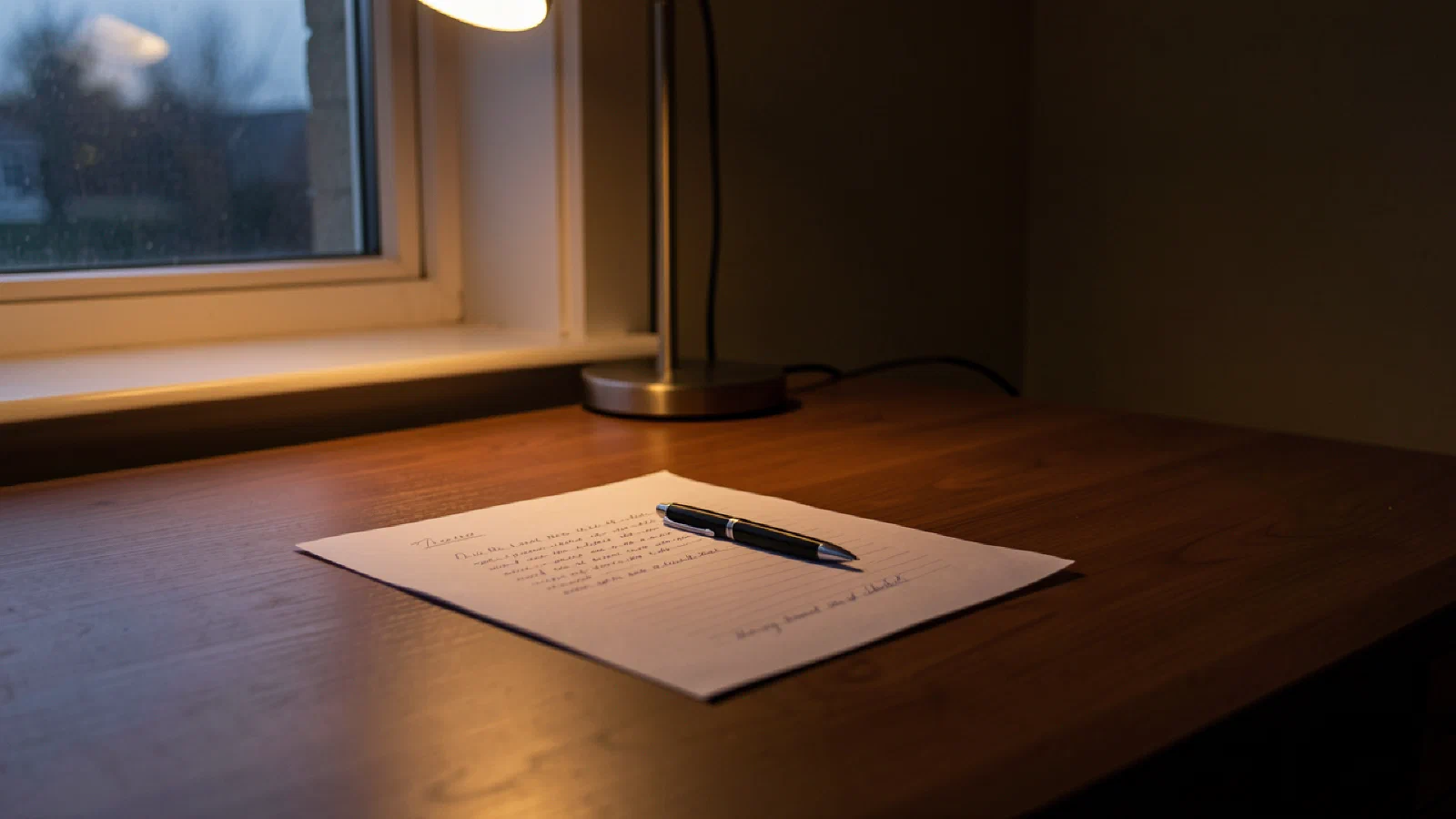
A Letter to the Person I Will Become
Series 05: Who You Are When You Forget
Dear.
That is the first difficulty. Who to address. Not the person I will be, because I do not know who that will be. Not a stranger, because you are not a stranger. You are me, at a distance I cannot measure, reading this, or having this read to you, and the distance between us is the subject of this letter.
I am writing to the person who is still me. You may be reading this in a year when not much has changed. You may be reading this in a decade when everything has. You may not remember writing it. That is all right. I remember writing it. And I am writing it so that the people who care for you will know who they are caring for, and so that you will know, if you can take this in, who you used to be. Who you still are. I cannot prove that second claim from where I sit. I can write as though it is true, and the writing is the proof I have.
How I Take My Coffee#
Strong. A small amount of oat milk. At 6:30 in the morning, before anyone else is awake.
This is not important. It is specific. That is the point of this letter. I am not leaving you a list of virtues or a summary of my accomplishments. I am leaving you the texture of being me, because the texture is what the people who care for you will need, and a medical chart does not hold it.
The coffee is a ritual. I stand at the counter. I watch the light come through the kitchen window, which faces east. I do not check my phone. I do not turn on the news. I stand there and drink the coffee and the morning is mine for those minutes. If there is a moment in my day that is entirely mine, it is this one. I want the people who take care of you to know this, because if they put a cup of coffee in front of you at 6:30 in the morning and you hold it and look toward the window, you are not confused. You are doing the thing I have always done. Let you do it.
The Song#
When nothing else works, when the day has been bad and the agitation is high and nothing is settling, play this: Van Morrison, “Into the Mystic.” Not because it is my favorite song. It is not. It is the song that does something to me that I cannot explain and have never needed to explain. The opening notes change the way I breathe.
I heard it for the first time in a car, at night, on a highway I do not remember, with a person I loved very much at a time when loving that person was the primary occupation of my life. The song holds that night. Not the facts of it. The feeling. And the feeling is stored somewhere in me that I believe, based on everything I have read in this series, will outlast the facts.
Play it. Watch what happens. If nothing happens, play it again next week. If something happens, you will know. The breathing changes first.
The Story That Makes Me Laugh#
I was nine. My brother was seven. We were at our grandmother’s house, and our grandmother had a cat named Chairman, for reasons she never fully explained and that we were too young to question. Chairman weighed approximately twenty pounds and moved through the house like a small, hostile ottoman.
My brother decided to give Chairman a bath. I helped. We filled the bathroom sink with warm water and dish soap and placed Chairman in the sink. Chairman did not approve. What followed was approximately ninety seconds of the purest chaos either of us had experienced: a wet, soapy, twenty-pound cat on the bathroom ceiling, or so it appeared, and my brother and I screaming and laughing and slipping on the wet floor while our grandmother stood in the doorway saying “I told you” in a voice that was trying very hard not to laugh.
Nobody was hurt. Chairman survived. The bathroom did not. And I have been laughing about those ninety seconds for decades. I do not know why. The story is not objectively that funny. It is mine, and it makes me laugh every time, and if you are reading this and you are laughing, then you are still me, and if you are not laughing, that is all right too. The story is here. It will wait.
The Name I Called Her#
My sister’s name is Margaret. I have never called her Margaret. I called her Maggie from the time I could talk, and then I called her Mags when I was a teenager, and now I call her Mags, and she calls me a name I will not write here because it is hers to tell, and these are the names that mean us.
If Mags is in the room with you and you cannot find her name, try “Mags.” The word is stored in a different place than “Margaret.” It was said more often, with more feeling, in more kinds of weather. It is the name I whispered when I was afraid and the name I shouted when I was angry and the name I said on the phone every Sunday for forty years. It is the name that means my sister, and my sister is the person I would want in the room if I had one person to choose.
Mags, if you are reading this instead of me: I wrote this for both of us. I wrote it because I know you will be there, and I want you to have the words I may not be able to find when you are.
What I Want Them to Let Me Do#
Open the window.
I mean this literally. I want the window open. I want the air. I have spent my entire life needing the air from outside, even in winter, even when everyone else in the room is cold. I will not be able to tell them this if I cannot find the words. I am telling them now.
And I mean it figuratively. I want them to let me do something that matters. I do not care if it is small. I do not care if I cannot do it consistently. I want to be useful to someone. I have read BML-05.17 and BML-05.18. I know that the window of capability opens and closes. I want someone to be there when it opens with something for me to do, something that requires what I know, something that makes me, for those minutes, a person who is giving rather than only receiving.
If there is a grandchild with three index cards, let them come. If there is a student with a question, let them ask. If there is nothing, let me fold the towels or sort the mail or water the plants. Let me contribute. The contribution is mine. Do not take it from me because it is easier to do it yourself.
What I Want Them to Know About Who I Was#
Not the resume. The person.
I cared about fairness more than I cared about almost anything else. When I saw something unfair, I could not let it pass. This made me difficult sometimes. It also made me worth knowing.
I was afraid of being a burden. I am writing this letter partly because of that fear, partly to outrun it. I want the people who care for me to know that the fear is mine, not theirs. They are not causing it by providing care. It is a fear I carried before the diagnosis and will carry after, and the best thing they can do with it is not try to talk me out of it but acknowledge it and then do the thing anyway.
I moved through a room quickly. I talked with my hands. I always sat near the door in restaurants. I said “I’m fine” when I was not fine, and the people who knew me knew to ask twice. When I was overwhelmed, I went outside. When I was happy, I cooked. When I was trying to be kind, I always said the same thing: “I’m glad you told me.”
This is the texture of being me. It is specific and arbitrary and entirely mine. I leave it here so that the person who reads it, whether that person is me or someone caring for me, has not a diagnosis but a person. The person who liked the window open. The person who cared about fairness. The person who was afraid of being a burden and said “I’m fine” when she was not and went outside when it was too much and came back when she was ready.
This Is Not Goodbye#
This letter is not a goodbye. It is a handoff. The person writing this letter and the person who may read it are the same person at a distance the letter is built to bridge.
I do not know what the distance will be. I do not know how much of me will be there when this is read. I know that the coffee will still taste like coffee. I know that “Into the Mystic” will still do whatever it does to the breathing. I know that the name “Mags” is stored somewhere deep enough that the deepest parts of this disease may not reach it. I know that the story about Chairman is mine regardless of whether I can laugh at it.
I am writing this now, while the writing is possible, as an act of being present for myself ahead of time. The letter is me, waiting on the other side of whatever is coming, holding a cup of coffee, humming a song I cannot name, reaching for the hand of the sister I have always reached for.
This is not goodbye. This is: I was here. I am still here. And the person reading this, whether it is me or someone who loves me, should know that the person who wrote it was not afraid of the future. She was afraid, yes. But she wrote the letter anyway, because the writing is the act of showing up for yourself, across whatever distance the years impose, and the showing up is the thing that matters.
The window is open. The air is coming in. The coffee is strong. The morning is mine.
How this article connects to others in Blue Mirror.