When Words Start to Fail
Series 04: The Mind's Companion
Paul Dietrich is 71 and a retired journalist from Kansas City. He spent forty years putting words to things. Words were the material he worked in, the way a carpenter works in wood. He was good at it. The sentences arrived when he called them. The right word was always close.
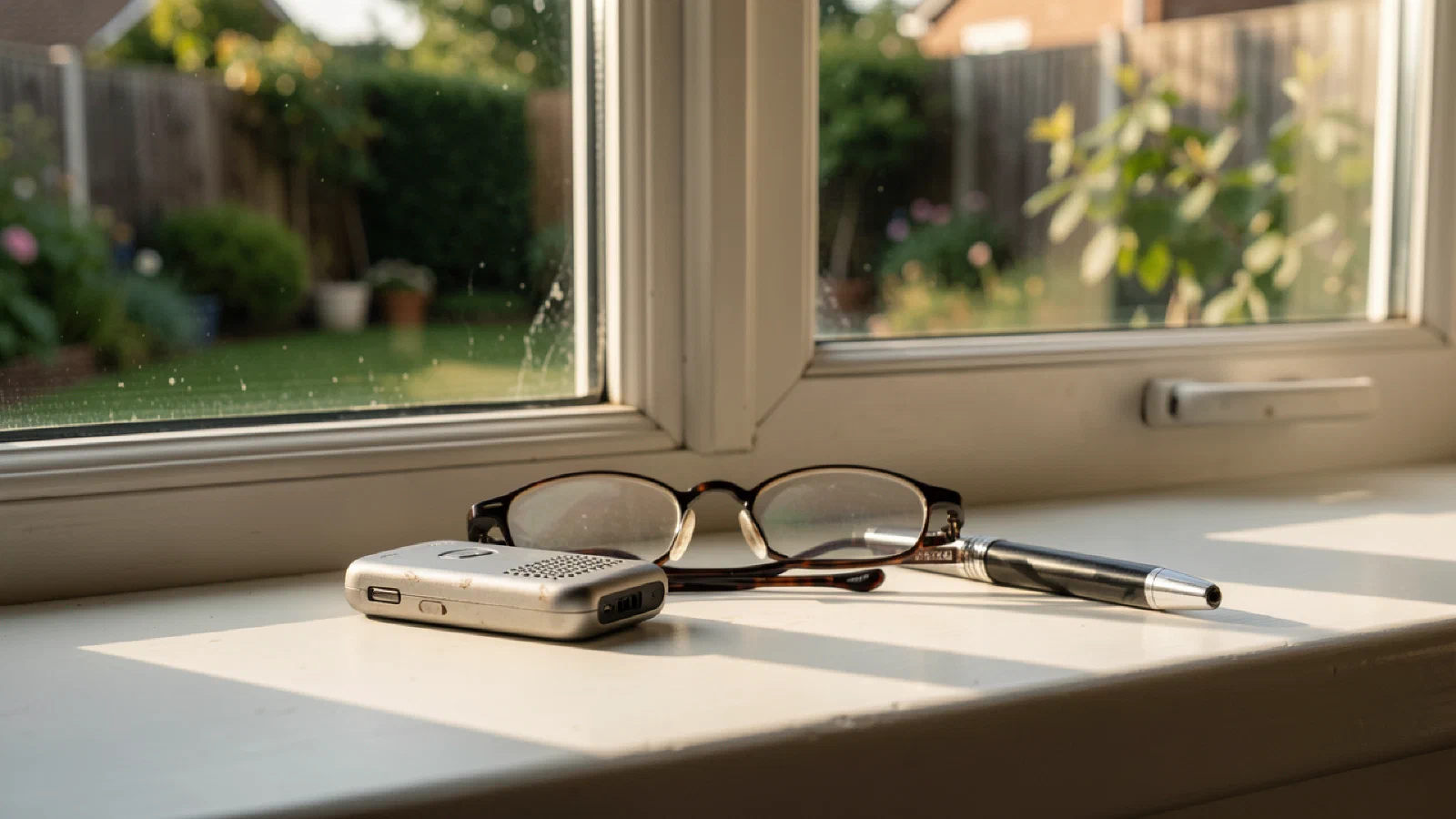
This morning at the kitchen table, Paul reaches for the word “window” and cannot find it. He can see the thing. He knows what it does. He describes it instead: the glass thing, the one that lets in light, the square in the wall. His wife Carol understands. She has been understanding for eight months, filling in the words he reaches for and cannot grasp, so smoothly that a visitor would not notice the exchange happening.
Paul narrates the moment into the voice recorder he keeps for moments like this. He is not losing his mind, he says. He is losing his words. There is a difference, and it matters.
How Language Changes With Different Dementia Types#
The word-finding difficulty Paul experiences is called anomia, and in Alzheimer’s disease it has a specific character. The word exists. With prompting, with time, with a running start from a related word, it sometimes arrives. In the meantime, Paul uses circumlocution: he describes the thing instead of naming it. His conversational intent, what he is trying to communicate, is preserved. The retrieval mechanism is impaired.
Frontotemporal dementia produces a different language change. Semantic loss, the degradation of word meaning itself, is the primary feature of the semantic variant. The person does not simply fail to retrieve the word. The meaning of the word has eroded. Showing them a picture of a window does not help because the concept “window” has become unreliable. This is a different disease with a different trajectory and different implications for communication support.
Parkinson’s disease dementia affects speech production rather than language content. The words are available. The motor system that produces speech, the volume, the articulation, the speed, is compromised. Speech becomes quieter, faster, harder to understand. The person knows exactly what they want to say. The body does not deliver it cleanly.
These distinctions matter because the communication strategies that help with anomia are different from the strategies that help with semantic loss, which are different from the strategies that help with motor speech impairment. The family that knows which kind of language change they are dealing with can choose the right tools.
What Changes in the Conversation#
Carol and Paul are no longer exchanging information the way they did for forty-three years of marriage. The conversations they built their relationship on, the ones where an idea passed from one person to the other and came back changed - those conversations are becoming harder. Not impossible. Harder. The flow has changed. The pace has changed. The assumptions about what each person heard and understood require checking more often.
What is replacing the old conversation is not silence. It is something Carol does not have a word for either: a form of communication that carries less information and more connection, where the content matters less than the contact. Paul tells a story she has heard three times this week, and she listens each time as though it is the first, because his pleasure in telling it is the same each time, and her role in the conversation has shifted from receiving information to maintaining a relationship through something that is no longer quite information exchange.
This shift costs something. Carol misses the conversations. She misses the man who could finish her sentences and whose sentences she could finish. She does not miss an abstraction. She misses specific things: the way he used to read an article and tell her what it meant, the shorthand they developed over four decades, the inside jokes that required both of them to hold the context. Some of that context has loosened on his side. She holds it alone now. That is a form of loneliness that occurs inside a marriage, and it deserves to be named.
The Strategies That Work#
Communication across cognitive change has a specific set of strategies developed over decades of clinical speech-language pathology and caregiver research. They are not intuitive. They require learning.
Simplify sentence structure: one idea per sentence, not two. “Would you like coffee?” works better than “Should we have coffee before or after your walk, and do you want the regular or the decaf?” Reduce questions. Yes-or-no questions produce more successful communication than open-ended ones. “Did you enjoy lunch?” produces a response. “How was your day?” may produce confusion about where to begin.
Follow the emotional content when the factual content is garbled. If Paul says something that is factually wrong but emotionally clear, the emotional content is the message. He is telling Carol how he feels, not what happened. Correcting the facts produces frustration. Receiving the feeling produces connection.
Allow longer response time. The retrieval is slower. The word is coming. The silence between the question and the answer is not a failure. It is processing. Jumping in too quickly, filling the word he was reaching for, takes the retrieval opportunity away from him and makes the next retrieval harder, because the brain builds retrieval pathways through use and loses them through disuse.
Validation therapy, developed by Naomi Feil, provides a framework for entering the emotional reality of the person rather than correcting the factual one. If Paul says he needs to go to work (he retired six years ago), the validation approach responds to the emotion (he feels purposeless, or he feels the need to contribute) rather than the fact (you’re retired, Paul). The correction produces distress. The validation produces engagement.
What Technology Can Add#
AI-assisted predictive text is learning Paul’s specific vocabulary and semantic preferences. When he types a message and pauses at a word he cannot find, the system offers three options based on the context and his historical word usage. The word “window” might be suggested after he types “the glass” because his personal AI has learned that he reaches for that word in that pattern. This is not a generic autocomplete. It is a word-finding aid calibrated to one person’s language.
Communication boards, low-tech and often stigmatized, are highly effective when verbal communication becomes too effortful. A laminated card with photographs of common needs, meals, bathroom, bed, pain, music, allows the person to point to what they need when the words are not available. The stigma is real. The effectiveness is also real. The family that introduces a communication board early, before it is desperately needed, normalizes it before the crisis that would otherwise introduce it with stress and confusion.
Speech-generating devices, available as clinical-grade hardware and as app-based tools, produce spoken words from text or icon selection. They bridge the gap between what the person intends to communicate and what their verbal capacity can produce. Within one to two years, AI communication aids are expected to learn the vocabulary patterns and semantic preferences of a specific person with dementia, offering word-finding support in real time. Within three to five years, real-time AI communication support that bridges the gap between what the person is attempting to express and what the listener can understand is anticipated.
Paul’s Journal#
Paul keeps the voice recorder because he is a journalist and a journalist records. He narrates the moments that contain the change he is experiencing: the word that did not come, what he used instead, what he felt when the substitution happened. He is not documenting his decline. He is documenting his experience of his decline, and there is a difference.
The recordings contain something no medical record captures. They contain Paul’s account of what it feels like to be inside a mind that is changing. He describes the frustration as specific, not general: it is not that he cannot think. It is that the path between the thought and the word has grown a gap in it, and the gap is not always the same width. Some mornings the words come easily. Some mornings the gap is wide enough that he sits in it and waits and nothing crosses. He is not losing his mind. He is losing specific retrieval pathways. The distinction matters to him because it preserves the difference between who he is and what the disease is doing. He is still Paul. The retrieval failure is the disease.
What the Loss Means for the Relationship#
Carol and Paul built their marriage on conversation. It was the foundation of their courtship, the structure of their evenings, the medium through which they solved problems and expressed affection and processed the news and raised their children and grew old. What happens to a marriage when one of its primary currencies begins to depreciate?
The answer is not that the marriage ends. It is that the marriage becomes something different. The something different is both loss and adjustment, and both are true simultaneously. Carol grieves the conversations. She also finds something in the new shape of their communication that she did not expect: a tenderness that operates below language, a physical proximity that carries meaning the words used to carry, a quality of attention that she did not know she was missing until the words fell away and the attention was all that remained.
This is not consolation. Carol would choose the words back in a heartbeat. It is description. The relationship changes shape. The changed shape has qualities that are different from what it replaced, and some of those qualities are not diminishments. They are discoveries that the old shape, with its abundance of language, did not require.
The Language Beneath the Language#
Paul reaches for Carol’s hand across the kitchen table. The word “window” is still missing. Carol’s hand is not missing. The technology can scaffold the words. It can offer predictions and communication boards and speech-generating devices that approximate what Paul’s voice used to produce without assistance. These tools are real and worth using.
They cannot replace the hand. They cannot replace the look that crosses Paul’s face when the word arrives after a ten-second search, the small triumph of retrieval that lights up the same circuits that lit up when he filed a story on deadline forty years ago. They cannot replace Carol’s decision to wait in the silence rather than fill it, which is an act of love that no algorithm can produce.
Paul is losing his words. He is not losing his language. There is a language beneath the language, one that operates in touch and timing and presence, and it does not require nouns. The technology serves the words. The marriage lives in the language beneath the words. Both are worth preserving. They are preserved by different means.
How this article connects to others in Blue Mirror.
Sources cited in this article.
- Feil, Naomi. "The Validation Breakthrough: Simple Techniques for Communicating with People with Alzheimer's-Type Dementia." Health Professions Press, 3rd edition, 2012.
- Henry, Julie D., et al. "A Meta-Analytic Review of Verbal Fluency Deficits in Alzheimer's Disease." Neuropsychology, vol. 19, no. 4, 2005, pp. 462-473.
- Bourgeois, Michelle S. "Communication Treatment for Adults with Dementia." Journal of Speech, Language, and Hearing Research, vol. 34, no. 4, 1991, pp. 831-844.
- Gorno-Tempini, Maria Luisa, et al. "Classification of Primary Progressive Aphasia and Its Variants." Neurology, vol. 76, no. 11, 2011, pp. 1006-1014.
- Savundranayagam, Marie Y., et al. "The Effects of Communication Modifications on Caregiver Burden in Dementia." American Journal of Alzheimer's Disease & Other Dementias, vol. 20, no. 1, 2005, pp. 37-43.