What Music, Art, and Movement Can Do
Series 04: The Mind's Companion
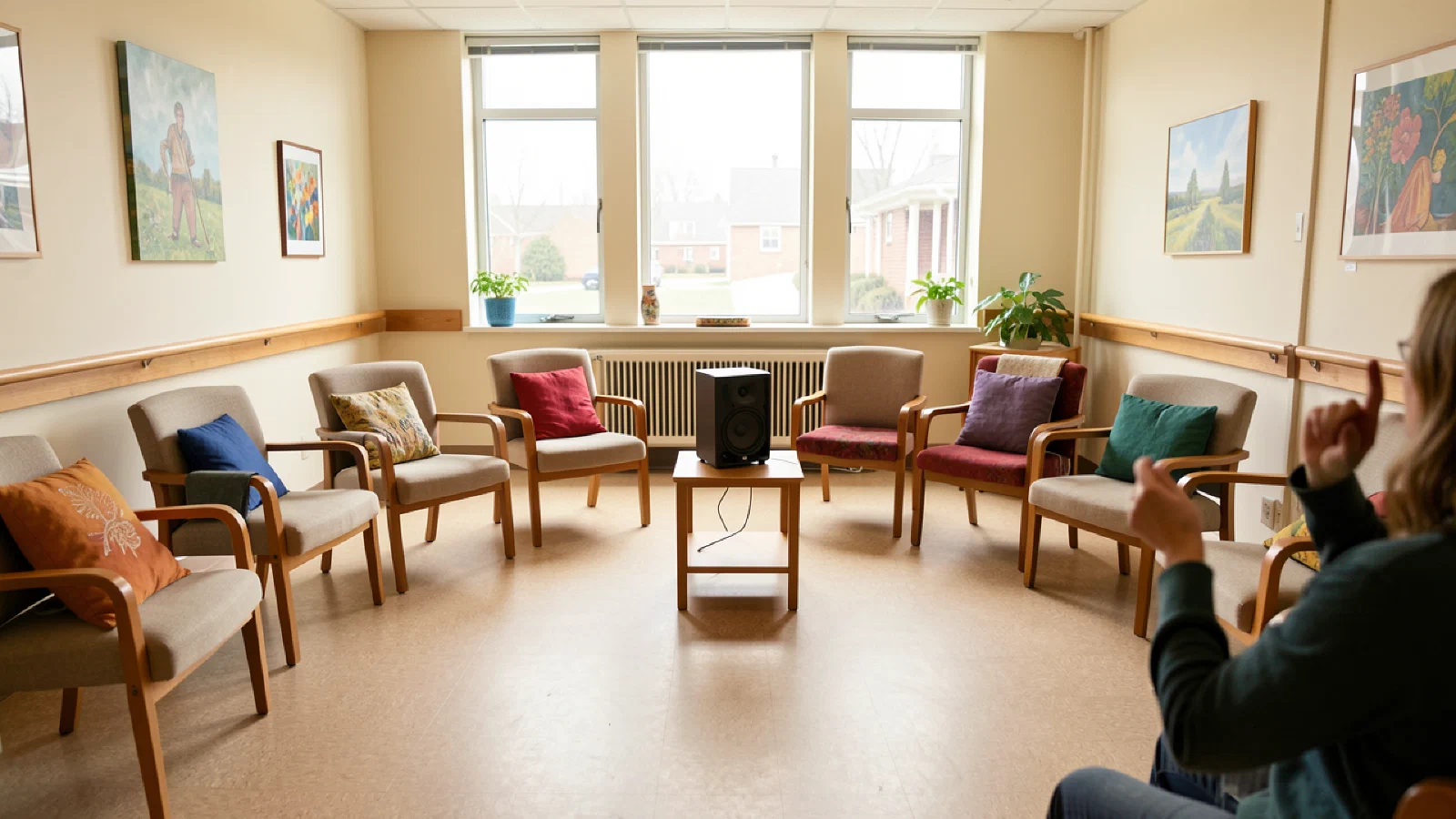
Sarah Kimura has been the activity director at Summerfield Memory Care in Phoenix for four years. She rebuilt the facility’s activities program two years ago around the preserved capacities research, replacing generic activity schedules with individualized engagement profiles based on who each resident had been before the disease. She has 22 residents with moderate to severe dementia. It is 9:55 AM on a Wednesday. The morning music session is about to begin.
The person leading the session is not Sarah. It is Eloise Marsh, 86, who had a music career that spanned three decades, who cannot reliably tell you what year it is or who the president is, and who in this room, with this music, is not a person with advanced dementia. She is a conductor. Her hands move with the precision of someone who has led an ensemble a thousand times. The precision is procedural memory, stored in brain regions that Alzheimer’s affects last. Her hands know what her declarative memory has forgotten. The room follows her.
What “Evidence-Based” Means When the Evidence Is Messy#
Non-pharmacological interventions for dementia face a methodological challenge that pharmacological interventions do not. You cannot blind a patient to whether she is receiving music therapy. She knows if there is music. This means the gold standard of pharmaceutical research, the double-blind randomized controlled trial, does not apply in its usual form.
This does not make the evidence worthless. It means the evidence is harder to interpret. Studies of music therapy show consistent positive effects, but the question of how much of the effect comes from the music itself and how much comes from the social engagement, the structured activity, or the attention of a therapist is difficult to disentangle. The piece is honest about this distinction because the reader who is evaluating these interventions deserves to know what the evidence can and cannot tell them.
What the evidence can tell them is that multiple interventions produce measurable, replicable improvements in specific outcomes. The outcomes are not always cognitive. Some are behavioral. Some are emotional. Some are functional. All of them matter.
Music Therapy: The Strongest Case#
The evidence for music therapy in dementia is the strongest among non-pharmacological interventions for behavioral and emotional outcomes. Multiple randomized controlled trials demonstrate reduction in agitation, the behavioral symptom most exhausting for caregivers and most disruptive to quality of life. Consistent improvement in mood and emotional engagement across studies. Facilitation of social interaction in group settings. Reduction in anxiety and depression symptoms.
The neurological mechanism is specific. Musical memory is stored in brain regions, including the supplementary motor area and the cerebellum, that are among the last affected by Alzheimer’s disease. A person who cannot remember her daughter’s name may remember every word of a song she sang at 25. The memory is intact. The retrieval pathway is intact. The music opens a door that other stimuli cannot open because the door was built in a part of the brain the disease has not yet reached.
The MUSIC & MEMORY program, active in thousands of facilities nationwide, uses individualized playlists built from the patient’s personal music history. The program is not a generic relaxation playlist. It requires biographical research: what music did this person listen to at 18, at 25, at 35? The specificity matters because era-specific personal music activates autobiographical memory networks in ways that generic music does not.
Art Therapy: The Emerging Case#
Art therapy evidence in dementia is more limited and methodologically weaker than music therapy evidence. Consistent improvements in engagement and mood are documented across studies. Cognitive outcome evidence is more limited. The challenge is the same one that affects all non-pharmacological research: small sample sizes, difficulty blinding, and heterogeneity across dementia types and stages.
The value is real even where the evidence is partial. Creative expression engages capacities that verbal communication cannot: visual thinking, fine motor coordination, color perception, and the experience of making something that exists outside of yourself. A person with moderate Alzheimer’s who cannot follow a conversation may spend forty minutes painting a landscape with concentration and satisfaction. The painting is not a cognitive test score. It is evidence that the person is still producing, still choosing, still expressing something that belongs to them.
The distinction between evidence for a specific cognitive outcome and evidence for a person’s quality of life matters here. Art therapy may or may not slow measurable cognitive decline. It consistently produces engagement, satisfaction, and the experience of agency in people for whom many other forms of engagement have become inaccessible.
Dance and Movement: The Underestimated Case#
Dance and movement therapy has the strongest evidence base among non-pharmacological interventions for gait stability, fall prevention, and dual-task cognitive outcomes. Dance specifically shows social and emotional engagement benefits that undifferentiated exercise does not, because dance combines physical activity with music, social connection, and real-time cognitive challenge in a single activity.
The Tango Therapy research in Parkinson’s disease and dementia populations is specific and replicable. Argentine tango, which requires continuous cognitive decision-making about where to step and how to respond to a partner’s movement, produces greater improvement in balance, gait, and dual-task performance than walking exercise of equivalent intensity. The social dimension of partnered dance adds emotional engagement that solo exercise cannot replicate.
For residents at Summerfield, Sarah introduced a seated movement-to-music program that adapts dance concepts for people who cannot safely stand. Upper body movement, rhythm response, and partner interaction produce the social and emotional engagement of dance without the fall risk of standing movement in a population with impaired balance.
What Sarah Changed at Summerfield#
When Sarah arrived at Summerfield, the activity schedule was generic. Morning activities, afternoon activities, all residents in the same room doing the same thing. Bingo on Tuesday. A movie on Thursday. The schedule was built for the facility, not for the people.
She spent three months building individualized engagement profiles. She reviewed intake questionnaires, family interviews, and social histories for every resident. She identified who had a music background, who had been a painter or craftsperson, who had been a dancer. She redesigned the activity space to allow multiple concurrent activities rather than one group activity for everyone.
The results over eighteen months: behavioral incident rates declined by 34%. Use of as-needed behavioral medication declined. Family satisfaction scores increased. Staff turnover, which correlates with resident behavioral management burden, declined. These are facility-level outcomes, not clinical trial data. They are also what Sarah pointed to when she presented the program to Summerfield’s parent company and secured funding to expand it to two additional facilities.
Access and Cost#
Some of the most effective non-pharmacological interventions are among the least expensive. The MUSIC & MEMORY program operates through libraries and senior centers at no cost in many communities. Certified Music Therapists charge session fees comparable to other therapy services, and some Medicare Advantage plans cover music therapy as a supplemental benefit. Community dance and movement programs for older adults are increasingly available through parks and recreation departments, YMCAs, and Parkinson’s and dementia wellness programs.
Art supplies are inexpensive. A set of watercolors, a pad of paper, and a table by a window cost less than one month of any brain training app subscription. The barrier to these interventions is usually knowledge and access, not expense. The family that knows music therapy has strong evidence, that knows how to build a personalized playlist, and that knows their community dance program exists is equipped to access interventions that cost little and produce measurable benefit. The family that does not know these things buys the app.
Eloise, After the Session#
The music ends at 10:40. Eloise’s hands come down. She looks around the room the way a person looks around after being somewhere else. She is, again, a woman with advanced dementia who needs help finding her room and who does not know what she had for breakfast. The session produced forty minutes of something no medication produces: the full presence of a person whose disease has withdrawn most of the channels through which presence is typically expressed.
Sarah knows the window will close. She knows it will open again tomorrow at 10 AM when the music starts. She has built her program around the windows, because the windows are what the disease cannot take, and what opens them is not expensive, not technological, and not complicated. It is a room, a song from 1962, and a woman whose hands remember what her mind has forgotten.
How this article connects to others in Blue Mirror.
Sources cited in this article.
- Livingston, Gill, et al. "Dementia Prevention, Intervention, and Care: 2020 Report of the Lancet Commission." Lancet, vol. 396, no. 10248, 2020, pp. 413-446.
- Van der Steen, Jenny T., et al. "Music-Based Therapeutic Interventions for People with Dementia." Cochrane Database of Systematic Reviews, no. 7, 2018.
- Hackney, Madeleine E., and Gammon M. Earhart. "Effects of Dance on Movement Control in Parkinson's Disease: A Comparison of Argentine Tango and American Ballroom." Journal of Rehabilitation Medicine, vol. 41, no. 6, 2009, pp. 475-481.
- MUSIC & MEMORY. "Program Overview." Music & Memory, 2024.
- Sauer, Paul E., et al. "Art Therapy for People with Dementia: A Systematic Review of Outcomes." International Psychogeriatrics, vol. 28, no. 9, 2016, pp. 1413-1424.