What AI Can See That You Cannot
Series 04: The Mind's Companion
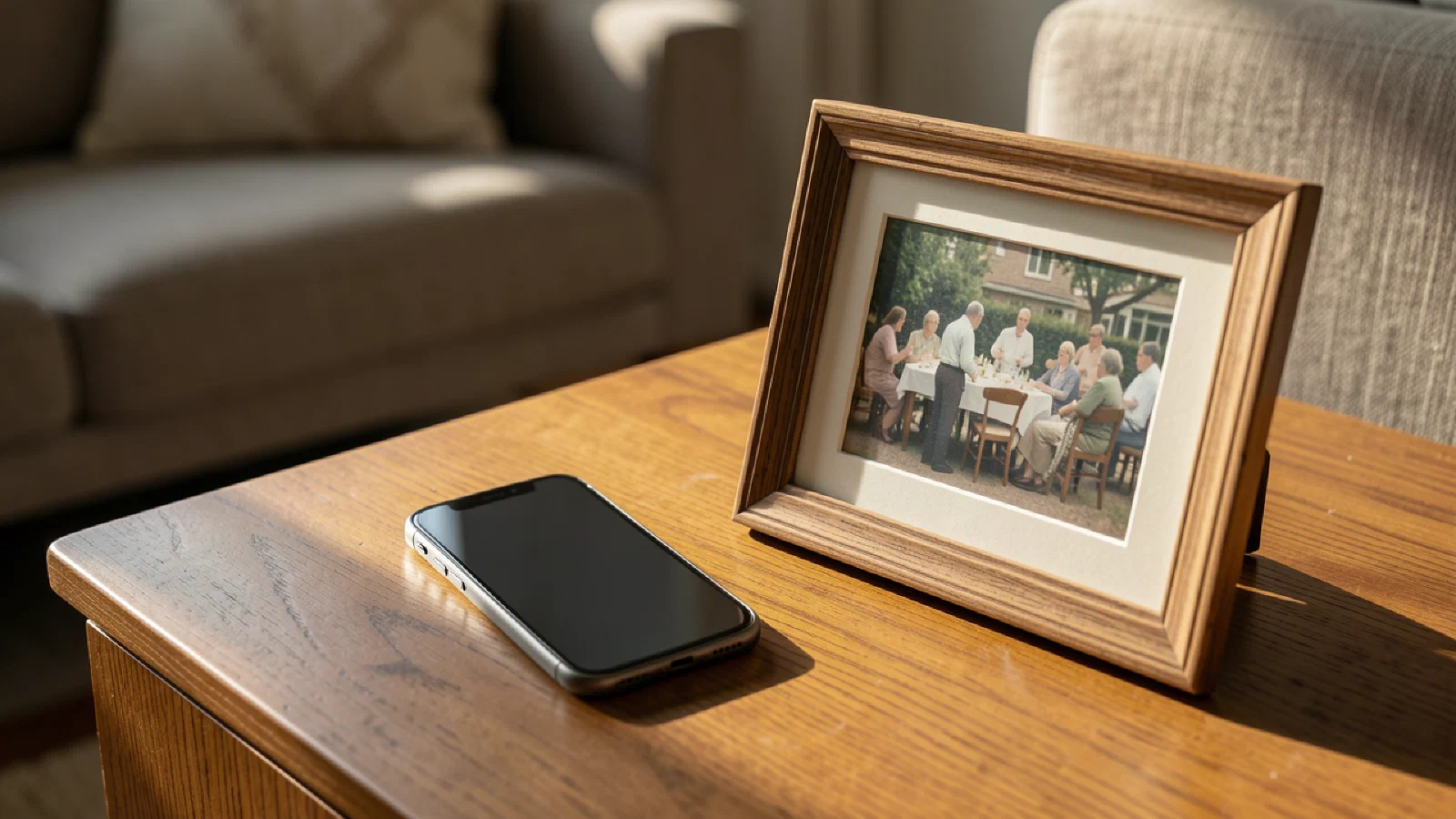
The family videos start in 1998. Priya Vasanthan was twelve, her mother was 48, and the camera was a Sony Handycam her father pointed at birthday parties and holiday dinners. The footage is shaky and overexposed, the way home video always is. What it contains, underneath the bad lighting and the birthday cake, is her mother’s voice.
Priya is 46 now, a computational neuroscientist at UCSF, and she has analyzed those recordings with tools her twelve-year-old self could not have imagined. She found what she expected to find and did not want to find: the early linguistic markers of Alzheimer’s disease were present in her mother’s speech three years before the diagnosis. Reduced information density per sentence. Longer pause intervals before naming specific objects. A gradual flattening of prosodic variation, the rise and fall of speech that carries emotional emphasis. Changes invisible to everyone who loved her, because the changes were below the threshold human listeners can reliably detect.
This afternoon, Priya’s personal AI has flagged a pattern in her father’s daily voice check-ins over the past seven months. Reduced prosodic variation. Longer pause intervals before specific nouns. A small but statistically consistent decline in information density per sentence. Her father is 73. He passed his annual cognitive screening two months ago. Priya knows what she is looking at. She also knows she does not want to.
What the Research Has Found#
The detection modalities that researchers have been developing for two decades are not science fiction. They are peer-reviewed findings, replicated across multiple studies, that have not yet made the jump from research laboratory to clinical practice.
Speech analysis is the most developed. Information density, the amount of meaningful content per sentence, declines measurably in early Alzheimer’s disease. Pause intervals before specific nouns lengthen as word retrieval becomes more effortful. Prosodic variation, the melodic contour of speech, flattens. These changes are present months to years before clinical diagnosis in multiple longitudinal studies. They are present in the home videos Priya analyzed retrospectively, which means they were present in real time, and nobody heard them.
Typing cadence tells a parallel story. Keystroke timing and error patterns correlate with cognitive status in studies of both healthy aging and early dementia. The patterns are subtle: slightly longer intervals between keystrokes, increased use of the backspace key, shifts in the ratio of planning pauses to execution pauses. No human observer would notice. An algorithm calibrated to individual baseline patterns can.
Gait analysis has been validated in multiple research settings and is entering clinical deployment in some memory clinics. Walking speed and stride variability are documented early markers of cognitive decline. The relationship between gait and cognition is bidirectional: cognitive impairment changes how you walk, and changes in how you walk predict cognitive decline before screening tests catch it. The motion sensors described in BML-03.01 can detect these gait changes passively, in the home, without requiring a wearable device.
Retinal scanning represents the newest frontier. Amyloid deposits, the same protein plaques that accumulate in the brains of people with Alzheimer’s, are visible in the retinal vasculature. Multiple clinical trials are evaluating whether a retinal scan can detect amyloid accumulation before clinical symptoms appear. This is not yet clinically available.
The Integration Insight#
Each detection channel has value on its own. The speech analysis tool operating against a population norm can detect gross deviations from expected patterns. The gait analysis tool measuring against average walking parameters for age and sex can flag outliers. Used independently, against population-level calibration, these tools catch large changes.
Used together, calibrated against the specific individual’s own baseline, they catch small changes. That is the integration insight, and it is the most important analytical point in this article. Priya’s AI has not compared her father’s speech to the speech of an average 73-year-old man. It has compared his speech today to his speech seven months ago, and yesterday to last month, and this month to the month before that. The signal is not that he sounds abnormal. The signal is that he sounds different from himself, in specific and quantifiable ways, in a direction that the research literature identifies as concerning.
The personal AI that has accumulated twelve months of a specific person’s daily voice check-ins, walking data from home motion sensors, and typing patterns from daily use has something no population-calibrated screening tool has: a baseline that belongs to one person. Deviation from that baseline is a far more sensitive signal than deviation from a population average. For the full account of why the longitudinal baseline matters, see BML-04.02.
What Exists Outside a Research Setting#
This is where the honesty matters most. Very little of what the research shows is clinically available in standard practice. Priya’s father cannot go to a speech analysis clinic. Retinal amyloid screening is not available outside clinical trials. Typing cadence analysis is a research tool, not a consumer product.
What he can do is agree to daily voice check-ins with his personal AI. The AI can analyze speech patterns, not with the precision of Priya’s research tools, but with enough sensitivity over time to detect directional changes in the metrics that the research has identified as meaningful. This is not a clinical diagnostic. It is a signal worth taking to a neurologist. Consumer AI platforms are beginning to integrate basic speech pattern and language complexity analysis into daily check-in interpretation. Within one to two years, some research-to-clinical translation for speech-based screening is expected.
Home motion sensors from BML-03.01 can provide gait data without requiring any wearable. The walking data that the house collects for fall prevention can be integrated into a cognitive monitoring profile. The home intelligence system described in Series 3 is already watching how Priya’s father moves through his house. The question is whether the cognitive interpretation of that movement data is integrated with the home’s other monitoring functions.
The Ethics of Surveillance for Cognition#
Priya’s father agreed to daily voice check-ins. He understood them as a way to stay connected and to monitor his general wellness. He did not specifically authorize the use of those check-ins for cognitive pattern analysis. The analytical layer is a step beyond what he consented to.
This tension does not have a clean resolution, and the article will not pretend otherwise. The data exists because he agreed to a system. The analysis of that data for a purpose he did not explicitly authorize is a consent gap. Priya will not tell her father that an AI thinks he might have early cognitive impairment. She will make an appointment with his neurologist and bring the data. The neurologist will order the clinical workup. The conversation about what the AI found and how it found it will happen in a medical context, between a physician and a patient, with Priya present.
Whether that sequence is ethically sufficient depends on how you weigh the value of early detection against the value of explicit consent for every analytical use of personal data. Reasonable people disagree. The piece names the tension rather than resolving it because the reader who is considering monitoring a parent deserves to think through the question before the answer is needed.
The Pattern That Was Already There#
Seven months. The pattern in Priya’s father’s speech has been present for seven months. His MoCA was normal two months ago. The AI and the MoCA are measuring different things, and both measurements are real. The MoCA measures performance at a single point. The AI measures trajectory across time. A normal MoCA and a concerning trajectory can coexist in the same person, because they are answering different questions about the same brain.
The data that will prompt the next clinical step came from seven months of Priya’s father saying “Good morning” into his phone. The detection tools that researchers have been developing for decades are most powerful not as standalone diagnostics but as channels feeding into a personal AI that already knows his baseline, making the threshold for detecting deviation far lower than any population-calibrated tool can achieve. Within three to five years, passive continuous speech analysis from smart home devices is expected to become a validated cognitive monitoring channel, and integration of multiple detection channels into a unified cognitive profile will become standard.
Priya knows what the data shows. She also knows that the data does not tell her father anything about himself that he does not already suspect, somewhere in the quiet register where people hold the things they are not yet ready to say aloud. The AI saw the pattern. The family will address the pattern. The research that made the pattern visible began with a twelve-year-old’s home videos and a mother whose voice was changing before anyone could hear it.
How this article connects to others in Blue Mirror.
Sources cited in this article.
- Fraser, Kathleen C., et al. "Linguistic Features Identify Alzheimer's Disease in Narrative Speech." Journal of Alzheimer's Disease, vol. 49, no. 2, 2016, pp. 407-422.
- König, Alexandra, et al. "Automatic Speech Analysis for the Assessment of Patients with Predementia and Alzheimer's Disease." Alzheimer's & Dementia: Diagnosis, Assessment & Disease Monitoring, vol. 1, no. 1, 2015, pp. 112-124.
- Verghese, Joe, et al. "Motoric Cognitive Risk Syndrome: Multicountry Prevalence and Dementia Risk." Neurology, vol. 83, no. 8, 2014, pp. 718-726.
- Koronyo, Yosef, et al. "Retinal Amyloid Pathology and Proof-of-Concept Imaging Trial in Alzheimer's Disease." JCI Insight, vol. 2, no. 16, 2017.
- Lau, Haakon, et al. "Typing Patterns as a Digital Biomarker for Cognitive Decline." Scientific Reports, vol. 12, 2022.