The Map of the Journey
Series 04: The Mind's Companion
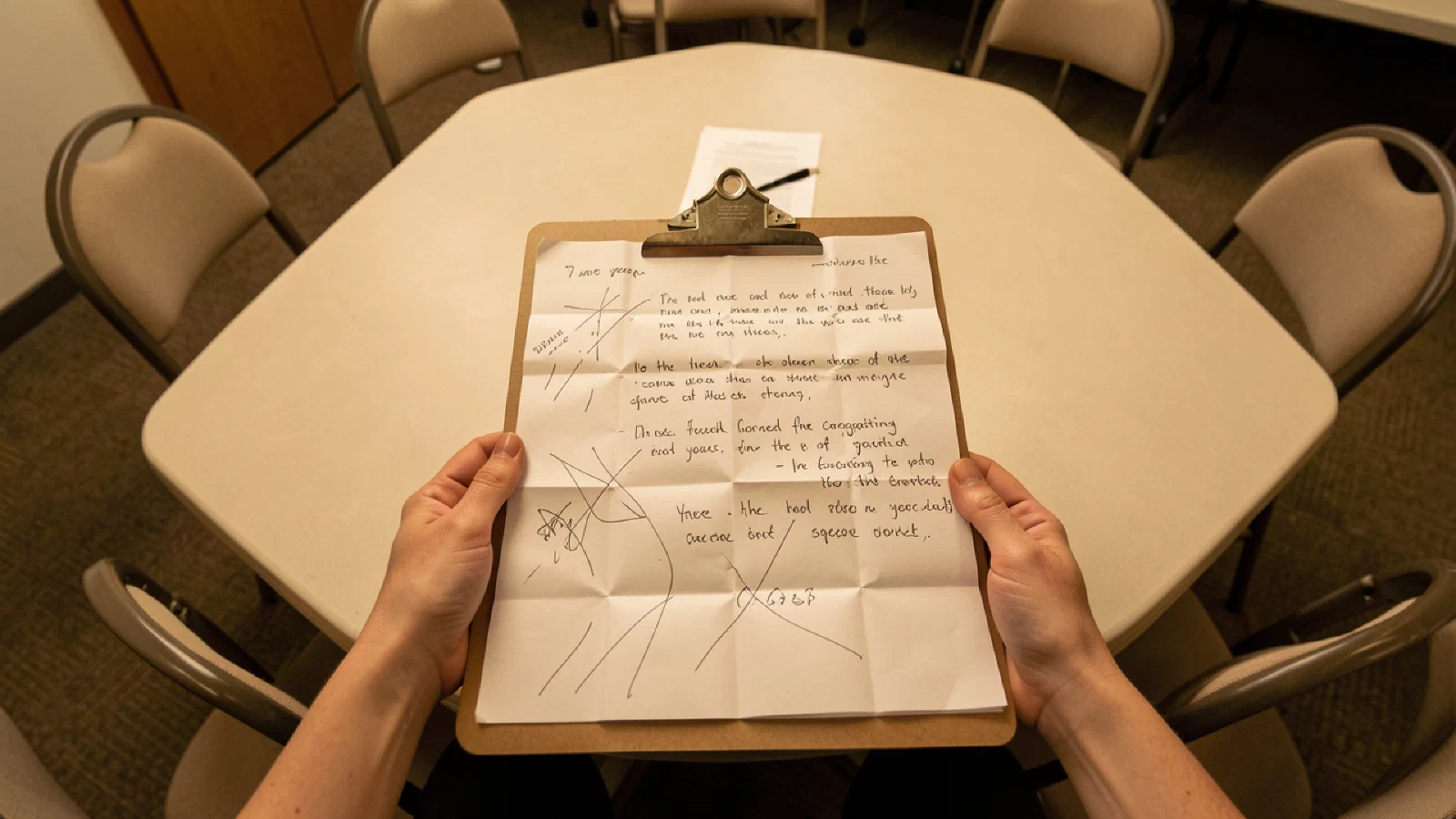
Diane Chambers has a single sheet of paper. It contains seven years, five technology configurations, one husband, and the concentrated wisdom of a woman who has cared for someone through every stage of Alzheimer’s disease and wants the people in this room to know what she wishes she had known at the beginning.
She is 66. Richard, her husband, is 72 and in advanced-stage Alzheimer’s. He is at home with the overnight aide. Diane is at a caregiver support group at the Alzheimer’s Association chapter in Minneapolis, where the facilitator has asked her to speak to the newly diagnosed families. There are eight of them in the circle. Three are crying. Two are taking notes. The rest are holding their faces in the careful neutral of people who have not yet decided whether to fall apart or organize.
Diane unfolds the sheet of paper. She tells them that dementia is not one disease. It is five diseases wearing the same name, each one requiring different tools, different expectations, and a different understanding of what the person needs versus what the family needs. Most of what they will read in the next month is designed for one stage and will fail at the transitions. She learned this the hard way. She would like them not to.
Stage One: Subjective Cognitive Decline#
You notice something. Nobody else does. Your spouse has not noticed. Your children have not noticed. Your physician has not noticed. You notice because you are the person inside the experience, and you can feel that something has shifted, even if you cannot point to what.
This is the stage where the cognitive baseline tools from BML-04.02 have their greatest value, because they can confirm or disconfirm what you feel. The detection methods from BML-04.03 can identify patterns in your speech and behavior that are below the threshold of human observation. At this stage, the technology’s role is evaluation and, if the evaluation is reassuring, honest reassurance.
What technology should not do at this stage: surveil you or restrict you. You are a person who has noticed something. You are not a patient who needs to be managed. Diane’s first mistake was installing a GPS tracker on Richard’s phone at this stage, when he was still working and still driving and still fully independent. He found it. The conversation that followed cost them six months of trust. She tells the room: do not confuse worry with action. The right action at this stage is establishing the baseline and making the physician appointment. Everything else is premature.
Stage Two: Mild Cognitive Impairment#
Measurable change, preserved independence. The MoCA score has crossed a threshold. The neurologist has used the letters MCI. The person is still the person. They drive. They manage their finances. They maintain their relationships. They also forget appointments, lose the thread of conversations more often, and take longer to learn new procedures.
The technology at this stage: cognitive monitoring continues. Medication management from BML-01.01, because the medication list is about to get more complex. Calendar and reminder systems, not as replacements for memory but as scaffolding that preserves independence by reducing the number of things that need to be held in working memory. Legal documents from BML-02.10, because the window of full legal capacity is open now and will not stay open indefinitely.
The mistake families make at this stage is treating MCI as early dementia. Diane’s daughter suggested that Richard stop driving when his MCI diagnosis came. Richard was still a safe driver. His neurologist confirmed it. Taking the keys from a person who can still drive safely costs the person their independence and the family its credibility. When the driving conversation becomes necessary, and it will, the family that cried wolf has a harder time being heard.
MCI is the stage of maximum agency and maximum planning opportunity. The person can participate fully in every decision about their future care. They should.
Stage Three: Early-Stage Dementia#
The diagnosis has been made. The word Alzheimer’s or Lewy body or frontotemporal is on a piece of paper. The person knows. This is the stage of the greatest emotional complexity, because the person is aware of what the diagnosis means. They understand that their future has changed. They grieve. They plan. They do both at the same time.
The technology adds structured daily routine support, because the routines that were automatic are now requiring conscious management. Simple communication aids for the word-finding difficulties that are becoming more frequent. GPS safety tools begin to be relevant, not because the person is wandering, but because the possibility is approaching and the family needs the safety net in place before it is needed. For the practical playbook for the first days and weeks after diagnosis, see BML-04.C1.
Diane tells the room something that no pamphlet mentions: early-stage dementia is when Richard wrote his letters. To her. To their children. To his brother. He wrote what he wanted them to know about him while the words were still available to him. Those letters are the most valuable things she owns. They were written at this stage because at this stage, the words were still his.
Stage Four: Moderate Dementia#
Supervision is needed. Communication is changing. The person Diane married is still present, but the channels through which he expresses himself have narrowed. He does not always recognize the neighbors. He needs help dressing. He asks the same question four times in ten minutes. He is sometimes frightened by things that are not there.
The technology shifts. Safety systems become primary: wandering prevention from BML-04.11, nighttime monitoring from BML-03.02. Communication aids are adapted for reduced language capacity, using the approaches from BML-04.09. Behavioral management tools from BML-04.12 become daily necessities rather than occasional resources. Music therapy and sensory engagement from BML-04.07 become the most reliable pathways to connection.
The caregiver transition at this stage is the hardest one. Diane went from Richard’s partner to Richard’s manager, and the transition happened so gradually that she did not notice until she realized she had not had a conversation with him in the old sense, the kind where two people exchange ideas and build on each other’s thoughts, in over a year. The conversation had been replaced by something else: care instructions, gentle redirections, and the search for the ten-minute windows when Richard was fully present and fully himself. The windows were real. They were also unpredictable, and the technology that mattered most at this stage was not the GPS tracker or the nighttime monitor. It was the personal AI from Series 5 that helped her remember who Richard was on the days when Richard could not remind her himself.
Stage Five: Advanced Dementia#
Full dependence. Preserved emotional and procedural channels. Richard cannot form new memories. He cannot reliably recognize Diane. He can respond to her touch, her tone of voice, and the music they listened to in 1985. He can still smile. The smile is real. It is not a reflex. It is a response to something he feels but cannot name.
The technology at this stage simplifies to the minimum necessary. The cognitive monitoring is no longer generating useful data because the trajectory is past the point where monitoring changes care decisions. What technology can still do: play his music, monitor for pain through behavioral indicators, document comfort care preferences, and maintain the structured environment that reduces the agitation advanced dementia produces when the world is unfamiliar and frightening.
The human element is primary. The aide who knows that Richard calms down when you hold his left hand, not his right. The daughter who reads to him on Sunday afternoons even though he does not understand the words, because the sound of her voice is something his body recognizes even when his mind does not. The technology at this stage is a supporting player. The care is human.
The Transition Failures#
What Diane learned through seven years of mistakes: the technology that works at one stage becomes a source of frustration and agitation at the next. The calendar reminders that preserved Richard’s independence at MCI stage became a source of anxiety at early-stage dementia, because he could see the reminders but could no longer reliably act on them, and the gap between seeing and doing produced distress. She removed them. She should have adjusted them earlier.
The GPS tracker that was intrusive at the subjective decline stage became necessary at moderate stage. The music therapy that supplemented other activities at early stage became the primary engagement channel at advanced stage. The safety systems appropriate for moderate stage, door alarms and motion sensors, would have been counterproductive and insulting at early stage.
Every transition required rebuilding the technology configuration, and there was no guide that told Diane when to rebuild or what the next configuration should look like. She learned by watching Richard’s response to the tools: when the tool helped, it stayed. When the tool produced agitation, confusion, or a loss of dignity, it went. The rebuilding happened five times in seven years. Each time, she wished someone had told her the transition was coming.
Stage-specific information resources exist, but they are scattered across disease-specific organizations, medical centers, and caregiver support networks. Most consumer technology for dementia is designed for early stage and becomes irrelevant or counterproductive later. Within one to two years, AI-guided care planning tools that adjust recommendations based on current assessed stage and flag when the configuration needs to change are expected. Within three to five years, adaptive technology that automatically adjusts support levels as cognitive stage changes may reduce the transition management burden on caregivers.
What She Tells the New Families#
Diane folds the sheet of paper. She looks at the eight families in the circle. She tells them one thing. Know what stage you are in, not what stage you are afraid of. The map is not the territory. The territory will surprise you in ways the map cannot predict: the good days that arrive without warning, the bad weeks that resolve for no discernible reason, the moment your person says something so clear and so themselves that you forget for thirty seconds that anything is wrong.
But having the map prevents the mistake that costs the most: using a moderate-stage tool on an early-stage person, which costs the person their dignity, or using an early-stage tool on a moderate-stage person, which costs the family their energy and the person their safety. The tool that helps today will be the wrong tool in eighteen months. Knowing that the transition is coming does not make the transition easy. It makes the transition navigable.
She puts the sheet of paper in her purse. She drives home. Richard is in the living room with the aide. He smiles when she walks in. She does not know if he knows who she is today. She knows the smile is real.
How this article connects to others in Blue Mirror.
Sources cited in this article.
- Reisberg, Barry, et al. "The Global Deterioration Scale for Assessment of Primary Degenerative Dementia." American Journal of Psychiatry, vol. 139, no. 9, 1982, pp. 1136-1139.
- Morris, John C. "The Clinical Dementia Rating (CDR): Current Version and Scoring Rules." Neurology, vol. 43, no. 11, 1993, pp. 2412-2414.
- Gitlin, Laura N., et al. "A Nonpharmacologic Approach to Address Challenging Behaviors of Veterans with Dementia: Description of the Tailored Activity Program-Veterans (TAP-V) and Illustrative Case Studies." BMC Geriatrics, vol. 16, 2016.
- Alzheimer's Association. "2024 Alzheimer's Disease Facts and Figures." Alzheimer's & Dementia, vol. 20, no. 5, 2024.
- Brodaty, Henry, and Marika Donkin. "Family Caregivers of People with Dementia." Dialogues in Clinical Neuroscience, vol. 11, no. 2, 2009, pp. 217-228.