The Hardest Hours
Series 04: The Mind's Companion
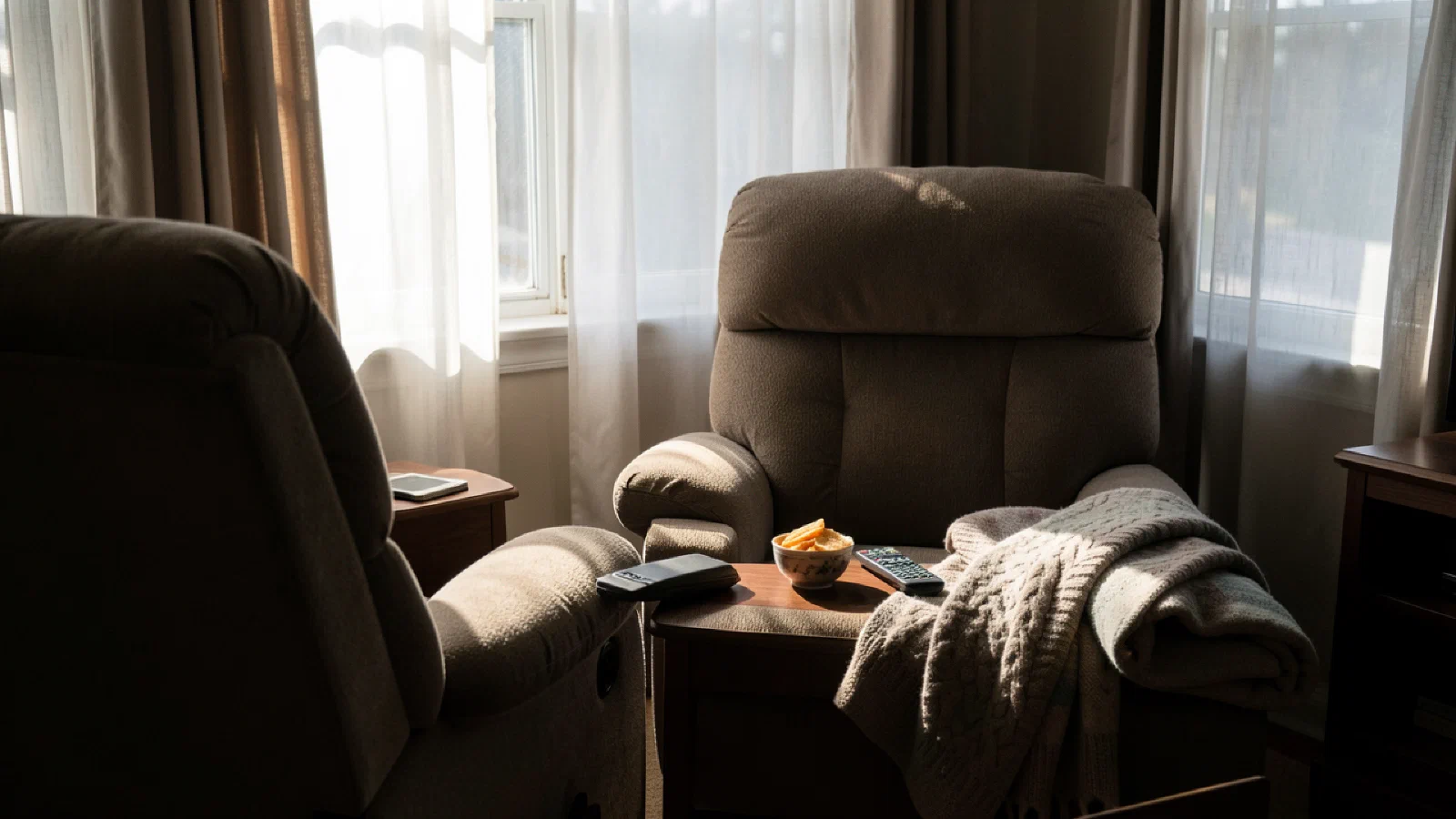
It is 3:15 PM. Vincent Marcello, 70, retired restaurant owner from Philadelphia, is preparing the room. The warm-spectrum lighting shifted automatically at 3 PM, the way it does every day. The music is queued on the speaker by the window: Tony Bennett, Dean Martin, the Italian-American standards Rosa listened to in her twenties. The dinner plate is covered on the counter, ready when it is needed. The blanket is on the couch. The television is off.
Vincent has been caring for his mother Rosa, 91, with advanced Alzheimer’s for four years. Every day around 3:30 PM, she becomes a different person. Agitated. Frightened. Sometimes combative. Sometimes in tears about something she cannot name. This is sundowning. Vincent has learned its shape the way he learned the shape of a dinner rush in forty years of running a restaurant: the escalation at 3:30, the peak around 5:30, the gradual settling after dinner if dinner goes well. He has learned its triggers. He has fifteen minutes. He has done this before.
What Sundowning Is#
Sundowning is not a behavioral choice. It is not a reflection of poor care. It is a neurological event with a predictable pattern, produced by the convergence of three physiological processes in a damaged brain.
The suprachiasmatic nucleus, a small cluster of cells in the hypothalamus that regulates the body’s internal clock, is among the brain structures damaged by Alzheimer’s disease. When this clock is impaired, the circadian signals that tell the body the difference between afternoon and evening, between wakefulness and sleep, become unreliable. The brain loses its orientation in the day.
Melatonin production declines with age in everyone. In people with Alzheimer’s, the decline is steeper and the evening surge that normally promotes sleep is blunted. The result: a brain that is already circadian-impaired receives less of the chemical signal that would normally counteract the late-afternoon neurological instability.
The third factor is fatigue. A brain that has been working to compensate for cognitive damage all day, rerouting processing through alternate pathways, managing the confusion and the effort of maintaining awareness in a world that feels less and less familiar, is exhausted by mid-afternoon. The exhaustion does not produce sleepiness. It produces agitation, because the brain’s remaining coping mechanisms are depleted, and the stimuli that were manageable at 10 AM are overwhelming at 3:30 PM.
What Vincent Has Learned#
Rosa’s pattern is specific to Rosa. Vincent has documented it over six months. Escalation begins at 3:30. The first sign is restlessness: she shifts in her chair, picks at her clothing, asks where her mother is. The middle phase involves pacing, sometimes crying, sometimes sharp words she would never have used five years ago. The peak is around 5:30. After dinner, if the routine holds, she settles. By 7:30, she is tired enough to sleep.
The triggers he identified through observation and a log he kept for three months: overstimulation in the afternoon, particularly television noise and multiple people talking simultaneously. Caffeine from the tea she liked, which he stopped serving after 1 PM. Unstructured time between 2 and 4 PM, when no activity was scheduled and Rosa was left with a mind that could not occupy itself and a body that was not tired enough to rest. Hunger, which he discovered when the behavioral symptoms were consistently worse on days when the midday snack had been skipped.
Every person’s triggers are different. The log is the tool. Vincent did not discover Rosa’s triggers through a medical textbook. He discovered them through three months of writing down what happened at 3:30 PM and what preceded it, and then looking for the pattern. The pattern was there. It had been there the entire time.
The Lighting Intervention#
Multiple randomized controlled trials demonstrate that timed lighting reduces agitation and improves nighttime sleep in people with dementia. The mechanism is circadian: bright blue-spectrum light in the morning, mimicking natural sunlight, reinforces the wake signal. Warm amber light in the late afternoon, reducing blue-spectrum exposure, supports the transition toward evening rest.
In practice, this means a programmable lighting system, available through standard smart home platforms, that shifts color temperature and intensity on a daily schedule. Vincent’s living room shifts to warm amber at 3 PM, an hour before the escalation typically begins. The shift is subtle enough that he barely notices it. Rosa’s response over seven months suggests it matters: the agitation onset has moved from 3:30 to 4:15, which is forty-five minutes of afternoon that Vincent did not have before.
The lighting system is part of the home intelligence described in BML-03.01, and it can be configured without the full smart home integration. A set of Philips Hue or similar programmable bulbs, scheduled through a phone app, produces the circadian lighting shift for under $200 in equipment cost. The intervention is low-tech in concept and moderately high-tech in execution, but the evidence is real and the cost is manageable.
What Medication Can and Cannot Do#
Melatonin at low doses (0.5 to 3 mg) taken in the early evening has modest evidence for improving sleep initiation in people with dementia. It is safe, available over the counter, and worth trying. It is not a treatment for sundowning itself. It addresses one contributing factor: the blunted melatonin surge that impairs sleep onset, which in turn worsens the next afternoon’s behavioral symptoms through accumulated sleep deprivation.
Low-dose antipsychotic medications, including risperidone, quetiapine, and olanzapine, are sometimes prescribed for severe behavioral symptoms in dementia. They carry an FDA black box warning for increased mortality risk in elderly patients with dementia. They are overused in institutional settings, where they are sometimes prescribed for the convenience of staff rather than the benefit of the resident. The distinction between behavioral management and chemical restraint is real, and the piece names it clearly because the families who read this article will encounter the decision.
Antipsychotics are sometimes appropriate. When behavioral symptoms create a genuine safety risk, when the person is injuring themselves or others, when non-pharmacological interventions have been fully tried and have failed, a carefully prescribed, closely monitored antipsychotic at the lowest effective dose may be the right choice. That decision belongs to the patient’s physician, with full informed consent from the legal decision-maker, and it should be revisited regularly because the behavioral symptom it addresses may resolve or change, and the medication carries ongoing risk.
The Caregiver’s Experience#
Four years of 3:30 PM. That is what Vincent carries. Not the diagnosis, which he has processed. Not the medical facts, which he understands. The 3:30 PM, every day, when the mother he knows becomes temporarily unreachable and the two hours that follow require the full concentration of a man who used to channel that concentration into a dinner service and now channels it into making sure his mother does not fall, does not hurt herself, does not hurt him, and gets through the evening to the point where the settling begins and the night becomes possible.
What it costs Vincent: he has not had a conversation with a friend after 3 PM in three years. His blood pressure, which was fine at 66, is managed with medication at 70. He sleeps in thirty-minute blocks when Rosa is awake at night, which happens two or three times a week. His sister covers Saturdays, which gives him one day when 3:30 PM is just 3:30 PM. For the full account of what sustained caregiving costs the brain and body of the caregiver, see The Caregiver’s Brain on Blue Gray Matters.
What Technology Adds#
The automated lighting shift happens whether Vincent is watching the clock or not. On the days he is exhausted and loses track of time, the lights still change at 3 PM. The music playlist queues at the same time. These are not complex interventions. They are scheduled routines that a smart speaker and a set of programmable bulbs execute without requiring Vincent to remember, to manage, or to be present in the room.
The behavioral monitoring that is coming within one to two years will detect pre-agitation arousal before escalation begins, through changes in movement patterns, vocal tone, and physiological signals detectable by a wearable. The system would trigger environmental interventions, the lighting, the music, the reduction of stimulation, before the peak rather than during it. The sleep tracker that correlates nighttime sleep quality with next-afternoon behavioral severity is available now and gives Vincent data he can bring to Rosa’s physician to support medication and schedule adjustments.
Seven Months Later#
The sundowning has not ended. It will not end. It is a neurological symptom of a progressive disease, and no lighting schedule or music playlist or snack timing will cure it. What has changed is its shape. The onset has moved from 3:30 to 4:15. The peak is still around 5:30. The settling comes with the music and the dinner and the predictability of a routine that Rosa’s damaged circadian system cannot produce internally but can follow when it is produced for her.
One hour of the hardest hours, recovered. Vincent described the current state to his sister on a Saturday phone call. He searched for the word that captured what the lighting and the music and the snack schedule and the four years of learning had produced. “Bearable,” he said. “Bearable is the best word I have for any of it.”
Bearable is not a cure. It is not a resolution. It is the specific dignity of having learned to carry something with competence, of having studied a problem until the problem’s shape became predictable, and of having found the interventions that reduce its severity without pretending to eliminate it. The hardest hours are still the hardest hours. They are one hour shorter, and the man who carries them knows what he is carrying and why.
How this article connects to others in Blue Mirror.
Sources cited in this article.
- Canevelli, Marco, et al. "Sundowning in Dementia: Clinical Relevance, Pathophysiological Determinants, and Therapeutic Approaches." Frontiers in Medicine, vol. 3, 2016.
- Figueiro, Mariana G., et al. "Tailored Lighting Intervention for Persons with Dementia and Caregivers Living at Home." Sleep Health, vol. 6, no. 3, 2020, pp. 387-391.
- Khachiyants, Nataliya, et al. "Sundown Syndrome in Persons with Dementia: An Update." Psychiatry Investigation, vol. 8, no. 4, 2011, pp. 275-287.
- Schneider, Lon S., et al. "Risk of Death with Atypical Antipsychotic Drug Treatment for Dementia: Meta-Analysis of Randomized Placebo-Controlled Trials." JAMA, vol. 294, no. 15, 2005, pp. 1934-1943.
- Livingston, Gill, et al. "Dementia Prevention, Intervention, and Care: 2020 Report of the Lancet Commission." Lancet, vol. 396, no. 10248, 2020, pp. 413-446.