Safety, Freedom, and the GPS in His Shoe
Series 04: The Mind's Companion
The dot is moving north on Oakdale Avenue. Martin Chaves, 69, is watching it on his phone from the bathroom where he was when his father opened the front door and walked out of the house. Eduardo Chaves is 88, has moderate Alzheimer’s, and has walked three miles every morning for fifty years. His body still wants to walk. His mind no longer reliably holds the concept that he cannot find his way home.
The GPS tracker is sewn into Eduardo’s left shoe, the brown one he wears every day, the one that survived the wearable phase (he removed the watch), the clip-on phase (he took it off and left it on a park bench), and the jacket pocket phase (he wore a different jacket). The shoe has been reliable. Eduardo puts it on every morning the way he has put on shoes every morning of his adult life. He does not know there is a transmitter in it. Martin’s sister thinks this is an invasion of privacy. Martin’s brother thinks it is insufficient and wants a locked front door.
Eighteen minutes after Eduardo leaves the house, the dot stops at a diner three miles north on Oakdale Avenue. Eduardo is having coffee. He is perfectly content. He does not know where he lives. Martin drives to the diner. Eduardo is pleased to see him. He asks Martin if he would like some coffee.
The Numbers That Justify the Tension#
Sixty percent of people with dementia will wander at some point during the disease. Among those not found within 24 hours, the mortality rate is approximately 50%. These numbers are not presented to justify surveillance. They are presented to establish why the tension between safety and freedom exists and why it does not have a clean resolution.
Eduardo is in that 60%. He has walked out of the house four times in the past six months. Each time, the GPS tracker in his shoe allowed Martin to find him within thirty minutes. Each time, Eduardo was safe, uninjured, and in a location where his lifelong walking habit had carried him. Each time, Martin’s heart rate did not return to normal for an hour.
The statistics describe a population. Eduardo is a person. The tension lives not in the statistics but in the specific question of what Eduardo is owed as a human being whose body wants to walk and whose brain cannot reliably get him home.
The Autonomy Case#
Eduardo walked three miles every morning for fifty years. He walked through his children’s childhoods, through his career, through his retirement. He walked when his wife was alive and after she died. He walked in rain and heat and the early darkness of winter mornings. The walk is not an activity. It is an identity. It is the thing Eduardo’s body has done every day of his adult life, and his body still knows how to do it even when his mind has forgotten why the walk should end at a particular house on a particular street.
What does Eduardo’s autonomy mean when his body wants something his brain cannot safely manage? This question does not have an answer that satisfies everyone in the room. A locked door preserves safety and eliminates the walk entirely. An unlocked door with a GPS tracker preserves the walk and accepts a residual risk. No configuration produces perfect safety and complete freedom simultaneously. The ethical work is not choosing between them. It is deciding where on the spectrum between full restriction and full autonomy Eduardo’s dignity is best served, and recognizing that the answer may change as the disease progresses.
The dignity test that governs this series applies here with particular force: does this intervention serve Eduardo, or does it serve the family’s need to manage Eduardo? The GPS tracker serves Eduardo because it allows him to walk. The locked door serves the family because it eliminates the fear. The question is whose need takes priority, and the answer, in this series, is the person’s.
What the Tools Actually Do#
GPS trackers for people with dementia come in several form factors, and the form factor matters more than the feature set because the most sophisticated tracker in the world is useless if the person does not wear it.
Wearable watches, including Apple Watch with Family Sharing and Samsung Galaxy Watch, provide GPS tracking with geofencing alerts. They also require the person to wear a watch, keep it charged, and not remove it. For people with moderate to advanced dementia, removal rates are high. Eduardo took his off and put it in a drawer within a week.
Dedicated GPS devices like AngelSense and Jiobit are smaller and can be clipped to clothing or worn as a pendant. They are more reliable than watches for dementia use because they are less conspicuous and less likely to trigger the person’s desire to remove an unfamiliar object. Eduardo removed the clip-on and left it on a park bench.
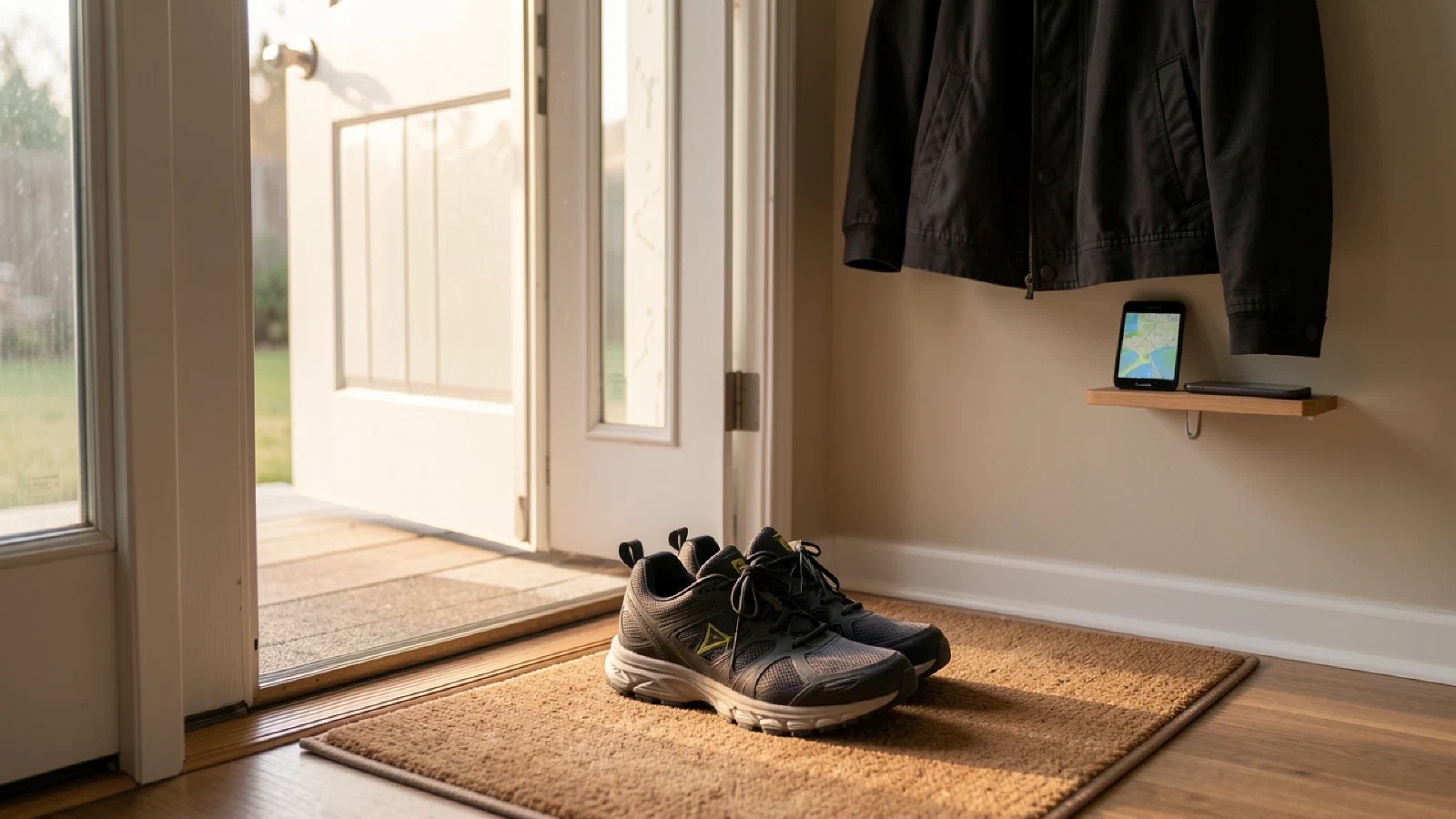
GPS trackers sewn into clothing or shoes are the most reliable option for people who consistently remove other devices. The tracker is invisible. The shoe is part of the daily routine. Eduardo puts on the brown shoes because he has always put on the brown shoes. The GPS is along for the walk.
Geofencing systems alert the caregiver when the person leaves a defined geographic area. Martin’s system sends an alert when Eduardo is more than six blocks from home. The six-block radius was not arbitrary. It was calibrated over three months: close enough that Martin can reach him by car in ten minutes, far enough that Eduardo’s normal porch and yard activity does not trigger false alerts.
Door and window sensors with alerts are covered in BML-03.02 for nighttime wandering prevention. For daytime use, door alarms are more controversial. An alarm that sounds when Eduardo opens the front door of his own home treats his home as a containment facility. Martin chose not to install one during the day. The nighttime sensor is different: Eduardo’s nighttime exits are disoriented and dangerous in ways the daytime walks are not.
The Legal Dimension#
The law distinguishes between capacity and confinement. A person with diminished cognitive capacity retains legal rights until a court determines otherwise. Locking a person in their home, even a person with dementia, without legal authority to do so, is unlawful restraint in most jurisdictions. Guardianship provides the legal authority to make safety decisions on behalf of a person who cannot make them independently. It also costs the person their legal autonomy across multiple domains, not just wandering.
A GPS tracker occupies a different legal space than a locked door. The tracker does not prevent movement. It monitors movement. The distinction matters legally and ethically. Martin has not confined Eduardo. He has accepted Eduardo’s movement and added information to it. The information allows Martin to respond. The movement remains Eduardo’s.
Whether monitoring without the person’s explicit understanding constitutes consent is a question that current law does not fully address for dementia. Eduardo cannot meaningfully consent to GPS monitoring because he does not consistently understand what a GPS tracker is. Martin has healthcare power of attorney. The physician supports the tracking. The legal framework is adequate but not precise, and the family navigating it will find that the law provides less guidance than they expect.
What Martin Negotiated#
Eduardo can walk. He wears the GPS shoe. Martin receives an alert if Eduardo is more than six blocks from home and does not turn around within fifteen minutes. This is not perfect. Eduardo has been to the diner four times. Martin has driven to the diner four times. The diner staff know Eduardo by sight now. They give him coffee and watch for Martin’s car.
The compromise preserves Eduardo’s walking and Martin’s ability to function during the day without standing at the front door. It accepts a residual risk: Eduardo could fall, could encounter traffic, could become confused in a location where help is not immediately available. The risk is real. It is also the cost of preserving the walk, and Martin has decided that the walk is worth the cost because the walk is what Eduardo has left of the life he built.
Martin’s brother disagrees. He wants the door locked. Martin’s sister disagrees differently. She thinks the GPS tracker is an invasion of their father’s privacy, a man being tracked like a package. Martin held the middle with his physician’s support. The family meeting where this was discussed lasted three hours and produced no consensus, only a decision that Martin, as the primary caregiver and the person with power of attorney, would make. He made it. He lives with the consequences every time the dot moves north on Oakdale Avenue.
The Conversation About Safety Tools#
The conversation about safety tools in dementia is never only about safety tools. It is about what the family owes the person and what the family owes itself. Martin’s brother’s desire for a locked door is not cruelty. It is fear. Fear that his father will be hurt, fear that Martin will be blamed, fear of the phone call that begins with “We found him” and ends differently than the previous four times.
Martin’s sister’s objection to the GPS tracker is not naivety. It is principle. The principle that a man who walked freely for fifty years should not be tracked without his knowledge, that the loss of cognitive capacity should not automatically mean the loss of bodily autonomy, that there is something wrong with a world where the solution to a vulnerable person’s movement is a transmitter in his shoe.
Both positions are honest. Neither is complete. The decision Martin made holds both positions in tension and resolves them in the only way the situation allows: imperfectly, with the person’s dignity as the primary criterion, knowing that the dignity of walking freely and the dignity of not being tracked without consent are in direct conflict, and that no amount of technology eliminates the conflict.
Coffee at the Diner#
Eduardo is pleased to see Martin. He asks if Martin would like some coffee. He does not know how he got to the diner. He does not know who will drive him home. He knows that coffee is good and that the man who just walked in is someone he is happy to see.
Martin sits down. He orders coffee. The dot on his phone shows their location together, father and son, at a diner three miles north of home. The walk was Eduardo’s. The coffee is shared. The GPS did what it was designed to do: it allowed Martin to find his father without preventing his father from being found somewhere worth being.
They drive home. Eduardo asks where they are going. Martin tells him. Eduardo seems satisfied. The walk was three miles, the coffee was hot, and the afternoon is still ahead of them. The dot is home. Eduardo is home. The shoe is by the door, ready for tomorrow.
How this article connects to others in Blue Mirror.
Sources cited in this article.
- Alzheimer's Association. "Wandering and Getting Lost." Alzheimer's Association, 2024.
- Rowe, Meredith A., et al. "Persons with Dementia Who Become Lost: Prevalence, Characteristics, and Outcomes." American Journal of Alzheimer's Disease & Other Dementias, vol. 26, no. 2, 2011, pp. 86-91.
- Bantry White, Emer, and Paul Montgomery. "Electronic Tracking for People with Dementia Who Get Lost Outside the Home: A Study of the Experience of Familial Carers." British Journal of Occupational Therapy, vol. 77, no. 5, 2014, pp. 232-238.
- Landau, Ruth, and Shirli Werner. "Ethical Aspects of Using GPS for Tracking People with Dementia: Recommendations for Practice." International Psychogeriatrics, vol. 24, no. 3, 2012, pp. 358-366.
- Algase, Donna L., et al. "Wandering and the Physical Environment." American Journal of Alzheimer's Disease & Other Dementias, vol. 25, no. 4, 2010, pp. 340-346.