What the Home Tells Your Doctor
Series 03: The Home That Knows You
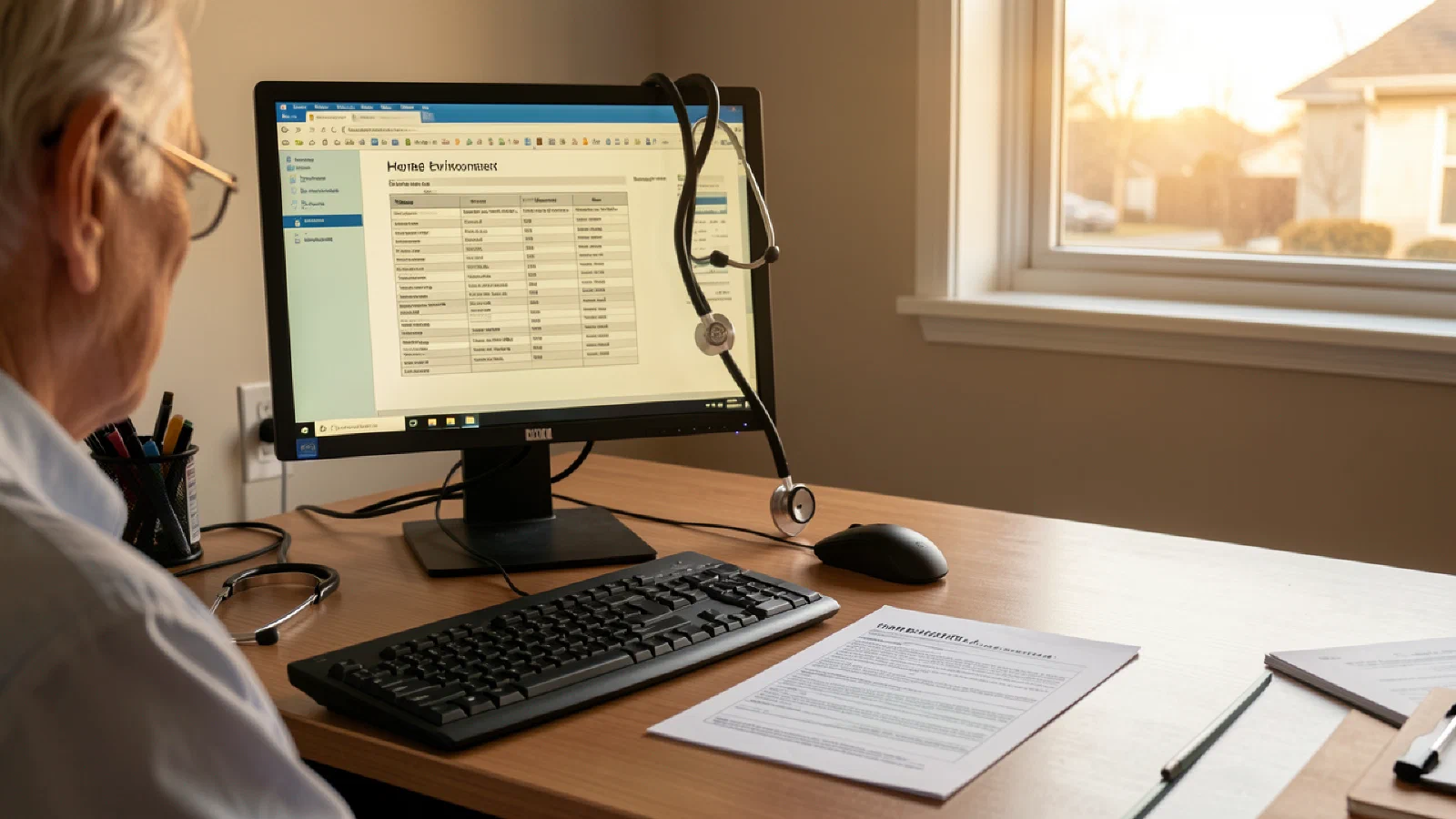
On a Tuesday afternoon in Minneapolis, Dr. Nadia Petrov opens a pre-visit summary for her 3:20 PM patient, Bernard Chung, 79. Dr. Petrov is 61, a geriatrician in private practice, 22 years of experience, careful and evidence-based and appropriately skeptical of technology claims. She has read thousands of pre-visit summaries. This one is different. For the first time, a home environment report is integrated into the summary.
Bernard’s home monitoring data shows a 17% decline in movement speed through his home over three weeks. It shows a reduction from three meals a day to one, inferred from refrigerator and microwave usage patterns. It shows that Bernard has not left his house in eight days. His door sensor data confirms what his activity data suggests: he is withdrawing.
Bernard’s self-report, submitted through the patient portal two days ago, describes him as “fine, a little tired.”
Dr. Petrov makes a diagnosis in four minutes that she tells a colleague afterward she would have missed for four months without the home data.
What the 12-Minute Appointment Cannot See#
The physician who sees a patient for twelve minutes twice a year has almost no information about how that patient functions in the environment where he spends the other 99.9% of his time. This is not a failure of the physician. It is a structural limitation of outpatient medicine.
Bernard says he is fine because Bernard genuinely believes he is fine. He is a little tired. He has been eating less because he has not felt like cooking. He has not been going out because the weather has been cold. Each of these explanations is plausible in isolation. Together, they form a pattern that Bernard does not see because he is inside it. Three weeks of progressive functional decline looks different from the inside than it does from the outside. From inside, each day feels like a reasonable variation on the day before. From outside, the trajectory is visible.
The patient who says “fine, a little tired” and has not eaten a full meal in three weeks is not being deceptive. He is accommodating. He is adjusting his expectations downward at a pace that makes each adjustment feel minor. The home sees what the patient cannot report because the home does not accommodate. The home measures. It does not evaluate whether the measurement is concerning. It presents the data to someone who can.
What Home Data the Clinical Record Has Never Had#
Bernard’s home AI tracks information that no clinical system has ever held for an outpatient patient. Daily movement patterns through each room, timestamped and mapped. Time from bed exit to kitchen arrival, which functions as a morning mobility index: Bernard’s has increased from four minutes to eleven minutes over three weeks. Number of meals per day, inferred from refrigerator open-close events and microwave usage. Time outside the house, from door sensor data. Sleep architecture from bed sensors: total sleep time, sleep disruption count, time of final morning rising.
Each of these metrics, individually, is a data point. Together, they form an environmental picture of a person’s daily functioning that the clinical record has never had access to. The physician reading this data is reading a patient she has never been able to read before. Not his vitals, which she has. Not his lab work, which she reviews. His life. How he moves through his house. Whether he eats. Whether he goes outside. Whether his sleep has changed.
Dr. Petrov has treated Bernard for six years. She knows his medical history, his medication list, his chronic conditions, his family history. What she has never known is what his Tuesday looks like. Whether he made coffee this morning. Whether he opened the front door yesterday. The home data gave her the Tuesday, and the Tuesday told her something the medical history could not.
The Diagnosis Dr. Petrov Made in Four Minutes#
Dr. Petrov looked at the home data and saw textbook geriatric depression. Progressive social isolation: no visitors logged by the door sensor in eight days, no outgoing door events, phone call frequency (from the smart speaker log) declining from four calls a day to one. Reduced appetite: meal preparation events dropping from three daily to one over three weeks. Psychomotor slowing: morning mobility time nearly tripling. Sleep disruption: waking episodes increasing from one per night to four.
None of this appeared in Bernard’s self-report. He did not consider mentioning that he had not been outside in over a week, because the weather was cold and staying in felt reasonable. He did not mention the reduced appetite because he has always been a light eater and the change did not feel dramatic to him. He is not hiding his symptoms. He does not recognize them as symptoms.
Dr. Petrov initiated a depression screening in the office. Bernard scored 14 on the PHQ-9, indicating moderately severe depression. She started treatment that afternoon: a combination of an SSRI at a low initial dose and a referral to a geriatric psychologist with availability that week. At a two-month follow-up, Bernard’s home data showed movement speed returning to baseline, meal preparation events back to three per day, and three outgoing door events in the preceding week. He told Dr. Petrov he was feeling better. This time, the data and the self-report agreed.
Four minutes. The diagnosis that would have taken four months without the home data took four minutes with it. Not because Dr. Petrov is a faster diagnostician than her peers. Because she had a starting point she had never had before.
What the Data Cannot Tell Her#
Home AI data has no mechanism for context. It cannot tell Dr. Petrov whether Bernard’s reduced food intake is depression, a painful dental problem, a medication side effect suppressing his appetite, or grief over a friend who died six weeks ago. The data generates the hypothesis. It cannot confirm the hypothesis. The three-week pattern of functional decline is equally consistent with depression, early-stage cognitive impairment, a new medication interaction, a worsening chronic pain condition, or a thyroid disorder.
The physician’s clinical judgment is unchanged. Her training, her experience, her knowledge of this specific patient, and her ability to ask the right follow-up questions in the room are exactly what they were before the home data arrived. What changed is her starting point. Instead of beginning with a self-report that described the patient as “fine, a little tired,” she began with environmental data that suggested the patient was not fine and not just a little tired. The data did not make the diagnosis. It told Dr. Petrov where to look.
This distinction matters because overstating the data’s diagnostic power would be as harmful as ignoring the data entirely. Home AI is not a diagnostic tool. It is a surveillance system for functional change. It catches the drift that the patient cannot see and the twelve-minute appointment cannot detect. The physician still does the medicine. She does it with a starting point she has never had before, and the starting point matters because geriatric depression in a 79-year-old man living alone, untreated for four months, produces consequences that are difficult to reverse.
The Privacy Question She Cannot Stop Thinking About#
After the appointment, Dr. Petrov sits in her office and thinks about something the clinical outcome does not address. Who owns Bernard’s movement data? What happens to it now that it has entered the clinical record? Can an insurance company request it? Can it be subpoenaed in an estate dispute or a competency hearing? If Bernard’s home monitoring data shows declining function over six months, can a family member use that data to support a petition for guardianship?
Bernard authorized the home monitoring system. His daughter helped him set it up. He signed the consent form that included a clause about data sharing with health care providers. He may or may not have understood that the data would arrive in his physician’s pre-visit summary as a structured environmental report. He may or may not have considered that the data would become part of his permanent medical record, accessible to anyone with legitimate access to that record.
These questions are not resolved. HIPAA covers the data once it enters the medical record, but the data’s journey from the home sensor to the clinical system passes through at least two commercial platforms that are not covered entities under HIPAA. The regulatory framework for home-generated health data is incomplete, evolving, and not keeping pace with the technology that generates the data. This is not a reason to reject the data. The diagnosis Dr. Petrov made in four minutes is a reason to want the data. But the privacy question is inseparable from the diagnosis, because the diagnosis came from data the patient may not have fully understood he was sharing.
The Equity Dimension#
Bernard has a home AI system because he has a daughter with the technical literacy to research it, the financial resources to purchase it, and the time to install and configure it. Bernard has the broadband connection the system requires and the smartphone that serves as its interface. Bernard lives in Minneapolis, where his geriatrician’s practice has invested in the integration protocols necessary to receive and display home environment data.
The patient who needs this data most is not Bernard. It is the 82-year-old man living alone in rural Mississippi on Medicare and Social Security, with no family nearby, no broadband connection, and a physician practice that uses a paper-based charting system. His depression would not be caught in four minutes because no data stream connects his home to his physician’s office. His depression might not be caught in four months, or six months, or at all, until a hospitalization reveals what months of progressive functional decline produced.
The data advantage is currently distributed exactly opposite to the clinical need. Affluent, educated, connected patients with engaged families are the most likely to have home AI generating environmental data. Isolated, lower-income patients without family nearby are the most likely to need it and the least likely to have it. This gap is a health equity problem that the technology alone cannot solve. It requires the infrastructure investments, the broadband access, the insurance coverage, and the clinical integration protocols that would make environmental data available to the patients whose physicians need it most.
The Geriatrician’s New Starting Point#
Dr. Petrov still has twelve minutes. The clinical judgment is still hers. The medical training, the geriatric fellowship, the 22 years of experience, the ability to sit across from a patient and ask the question that opens the conversation he did not know he needed to have: none of this has changed.
What changed is the starting point. She begins with environmental context she has never had before. She knows what Bernard’s Tuesday looks like before Bernard walks in. She knows whether he ate, whether he slept, whether he went outside, whether his movement speed has changed. She knows these things not because Bernard told her but because the home told her, and the home told her because the home was watching with the patient’s consent and the physician’s willingness to look.
Four minutes is not accidental. It is the time saved by not having to reconstruct from an inadequate self-report what the environment has already recorded. The self-report was not malicious. It was not even inaccurate, from Bernard’s perspective. He is fine. He is a little tired. The home data provided the context that transformed “fine, a little tired” into a treatable condition caught early enough to treat well. The starting point is what changed. The starting point, it turns out, is everything.
How this article connects to others in Blue Mirror.
Sources cited in this article.
- Kroenke, Kurt, et al. "The PHQ-9: Validity of a Brief Depression Severity Measure." Journal of General Internal Medicine, vol. 16, no. 9, 2001, pp. 606-613.
- Meystre, Stéphane. "The Current State of Telemonitoring: A Comment on the Literature." Telemedicine and e-Health, vol. 11, no. 1, 2005, pp. 63-69.
- National Institute on Aging. "Depression and Older Adults." NIA, 2024.
- Kaye, Jeffrey A., et al. "Intelligent Systems for Assessing Aging Changes: Home-Based, Unobtrusive, and Continuous Assessment of Aging." The Journals of Gerontology Series B, vol. 66B, suppl. 1, 2011, pp. i180-i190.
- U.S. Department of Health and Human Services. "HIPAA Privacy Rule and Sharing Information Related to Mental Health." , 2024.
- Health Level Seven International. "FHIR Overview." , 2025.