The Robot in Your House
Series 03: The Home That Knows You
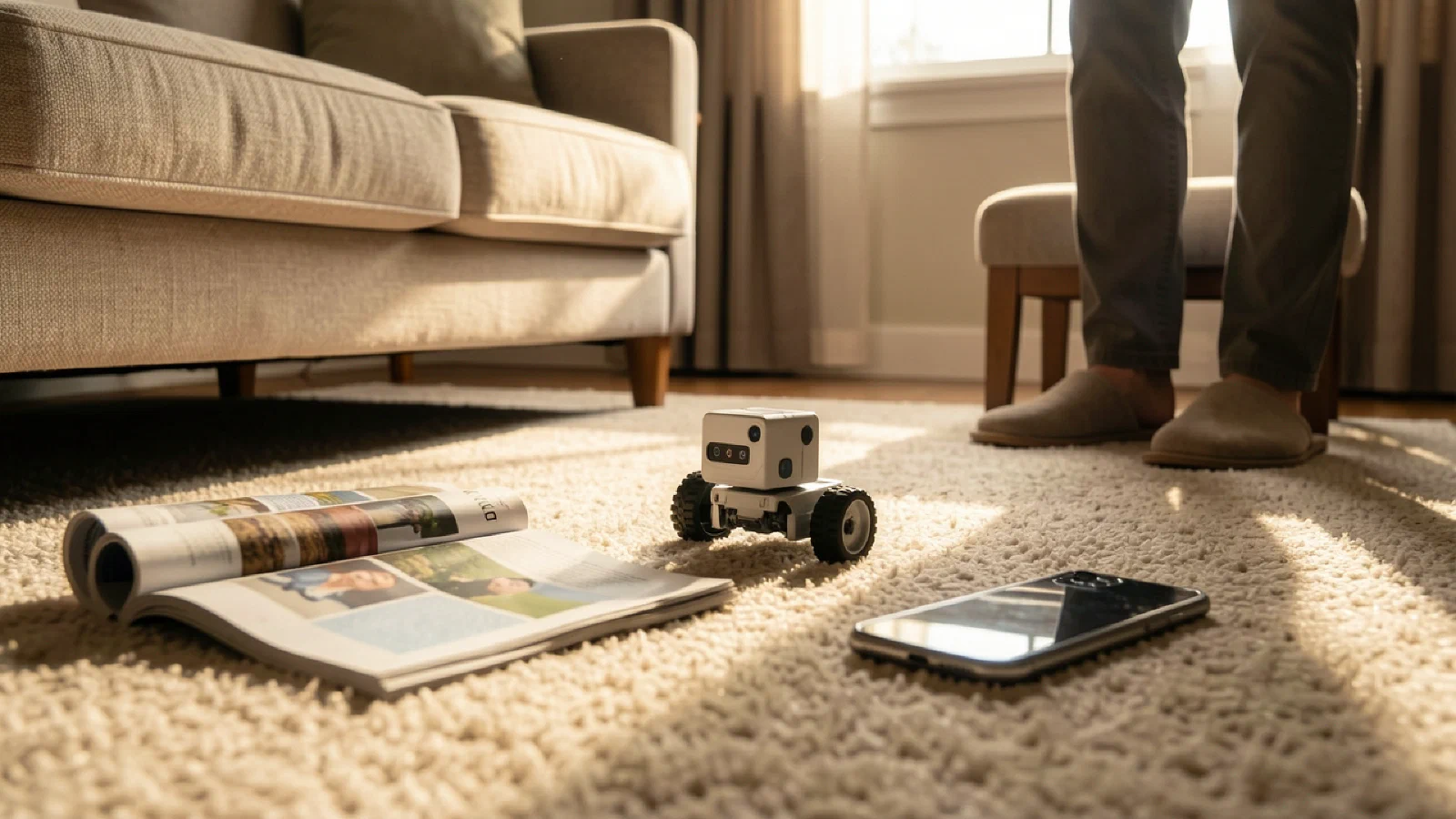
Dr. Catherine Merrill is at 35,000 feet, somewhere over the Pacific, with a notebook open and assumptions in the process of revision. She is 54, a gerontologist from Chicago, returning from a three-week research delegation to Japan where she observed deployed care robotics in residential and institutional settings. On her third day in Osaka, she spent three hours watching an 81-year-old woman named Keiko Yamamoto interact with a mobile care robot in Keiko’s own home. The robot brought Keiko her morning medication at 7:42 AM. It brought her evening tea at the time she preferred. When she dropped a magazine, the robot retrieved it. When she dropped her glasses, the robot retrieved those too. Dr. Merrill had seen demonstration robots at conferences for fifteen years. She had never watched one work in a home for three hours.
On the flight home, she is trying to separate what she observed from what she expected to observe. She expected to see a prototype performing well in a controlled environment. She saw a deployed consumer product performing consistently in an ordinary apartment. She expected to feel uneasy about the interaction. She felt uneasy about her unease. She expected Keiko to describe the robot with qualifications. Keiko said, “It does not judge me.”
What Fifteen Years of Deployed Robotics in Japan Has Produced#
Japan’s demographic crisis is not approaching. It arrived. The country has the oldest population of any major economy, a rapidly shrinking working-age population, and a care worker shortage so severe that the government has invested directly in care robotics as a matter of national infrastructure. No other country has matched the scale of Japan’s deployment, and no other country has the deployment data Japan has accumulated over fifteen years.
What the data actually shows is more complicated than either the enthusiasts or the skeptics present. User acceptance rates among care recipients are consistently above 70% when the user controls the robot’s role and can set boundaries on what the robot does. Acceptance rates among care workers are lower, driven primarily by fear of replacement rather than objections to the technology itself. Transfer-assist robots in institutional care settings have measurably reduced caregiver physical injury rates, which is a genuine and significant outcome. Cognitive engagement outcomes from social robots have been inconsistent, with some populations showing benefit and others showing no measurable difference from standard activities.
The honest summary is this: care robotics in Japan works when the robot does specific physical tasks reliably, when the user has control over the robot’s scope, and when the robot supplements rather than replaces human care. It works less well when deployed as a social companion without clear task utility, or when the user feels the robot was imposed rather than chosen.
The Current Generation: What Exists in American Homes Today#
The robots in American homes today are not the robots of press conferences. They are autonomous vacuums and robotic lawn mowers, and they are useful in ways that the conversation about care robotics typically overlooks.
An autonomous vacuum in a household where the resident cannot safely bend to sweep the floor is not a gadget. It is a fall prevention tool. Floor maintenance in a home where bending increases fall risk and where clutter on the floor creates trip hazards is a genuine safety function. Approximately a third of American homes now have an autonomous vacuum. Most of those owners do not think of it as assistive technology. For an older adult with balance challenges, it is.
Robotic lawn mowers address a different hazard. Lawn maintenance in summer heat, on uneven terrain, with a gas-powered push mower, is responsible for a meaningful number of older adult injuries and heat-related emergency department visits each year. A Husqvarna Automower or its competitors eliminates the physical risk entirely. It costs $1,500 to $3,000, runs autonomously within a defined perimeter, and does not require the operator to be present.
Amazon’s Astro home robot is the closest thing to a mobile care robot currently available to American consumers on a limited basis. It can navigate a defined home environment, deliver items from a designated surface, and serve as a remote camera platform for family members to check in. It cannot retrieve items from the floor. It cannot pick up a dropped phone or a fallen magazine. The distinction between delivering from a table and retrieving from the floor is the distinction between what current consumer robotics can do and what the next generation will do, and the distinction is a function of grasping and object recognition software, not motor capability.
The Next Generation: What Is Genuinely Close#
Mobile robots that can retrieve specific items from specific locations in a home are not a research fantasy. The motor capability to navigate a home, extend an arm, and grasp an object exists in laboratory demonstrations today. The technology challenge is the software: the grasping and object recognition that allows a robot to pick up a dropped phone from an arbitrary location on an uncontrolled floor surface, distinguish it from the remote control next to it, and return it to the person who dropped it.
This is a solved problem in research environments with controlled lighting, known objects, and flat surfaces. It is a one-to-two-year problem for limited commercial deployment in homes with variable lighting, unfamiliar objects, and floors that have rugs, pet toys, and extension cords. The first generation of limited-capability mobile retrieval robots entering the US consumer market through specialty channels is estimated for 2026 to 2027. These will be capable of retrieving specific items from specific locations, navigating a defined home environment, and delivering medication from a designated dispenser. They will not be capable of retrieving arbitrary objects from arbitrary locations. That is a three-to-five-year capability.
In three to five years, the trajectory includes mobile robots capable of limited physical transfer assistance, meaning steadying a standing transfer, not lifting. Some personal care task assistance in the least intimate categories: medication management, food and beverage delivery, laundry retrieval from the dryer. The sequence from floor retrieval to transfer assistance to personal care will be incremental, capability by capability, and each step will require trust that the previous step earned.
The Japan Comparison: Dignity and Machines#
What Keiko told Dr. Merrill was four words: “It does not judge me.” The robot does not sigh when asked to retrieve something a third time. It does not communicate the effort that physical assistance creates in a human helper. It does not rearrange its facial expression when Keiko drops the same magazine she dropped yesterday.
This is the part no product specification captures. Keiko is 81 and lives alone. She needs help with small physical tasks multiple times a day. Before the robot, that help came from a home care aide who visited three times a week and from Keiko’s own calculations about whether an item was worth the effort of asking someone to retrieve it. The calculation itself is the problem. Whether to call the aide about the dropped glasses. Whether the magazine on the floor is important enough to mention. Whether asking for help with the third dropped item in an hour makes her appear incompetent.
The robot eliminates the calculation. Keiko presses a button, the robot retrieves the item, and there is no social cost. No judgment. No gratitude required. No relationship negotiated. Dr. Merrill, who has spent her career studying dignity in aging, spent the flight home thinking about what it means that the absence of social cost in a mechanical helper can feel more dignifying than the presence of a compassionate human who nonetheless requires the older person to perform the role of grateful recipient.
The American Cultural Resistance#
Americans respond to care robotics differently than Japanese populations do, and the difference is not simply national technology attitudes. The specific American resistance is the conflation of being cared for by a machine with being abandoned by humans. The worry that if a robot retrieves your dropped phone, it means no human cared enough to do it. The fear that accepting mechanical help is accepting that human help has been withdrawn.
This fear is not irrational. In a country where the caregiving infrastructure is fragmented and underfunded, the introduction of robotic assistance can feel like permission for the system to stop trying. If the robot can do it, why should Medicare pay for the aide? If the home can monitor her, why should the family visit? These concerns deserve honest engagement rather than dismissal, because the history of cost-cutting in elder care gives them legitimate foundation.
The question is direct: is this resistance a values judgment worth maintaining, or a cultural habit worth examining when the alternative is a caregiver shortage that will leave millions of older adults without adequate help by 2030? Japan arrived at its answer through demographic necessity. The United States is approaching the same necessity on a different timeline. The question is whether American culture will adapt before or after the shortage becomes a crisis.
What Robots Cannot Do#
Physical tasks requiring contextual judgment that exceeds current AI capability: recognizing that a person who is lying on the floor is resting there voluntarily versus having fallen. Providing emotional presence. Noticing that the person is quieter than usual. Sitting with someone who is afraid. Adapting to an environment that differs substantially from the one the robot was configured for.
A retrieval robot that encounters a rug it was not trained on may fail to navigate. A care robot that encounters a pet may behave unpredictably. A medication delivery robot that arrives at 7:42 AM every morning cannot know that today the person is too nauseated to take the medication, unless it is integrated with a health monitoring system that has flagged the nausea. Each of these limitations is specific and solvable on different timelines. None of them are trivial. Overpromising is the fastest way to lose the trust of an audience that has been promised miracles by technology companies for decades.
The presence that notices, cares, and stays is irreducibly human. No robot in this series replaces it. No robot in the three-to-five-year horizon replaces it. The robot retrieves the phone. The person who calls to ask how you are doing today is someone else entirely, and both matter, and they do not substitute for each other.
Keiko’s Morning#
Back in Osaka. The robot brings the medication at 7:42 AM, the same time every morning. Keiko knows it will come. She has stopped checking the clock for it. That reliability, for a person living alone, is not a substitute for human presence. Keiko has a daughter who visits on Sundays and a neighbor who brings soup on Wednesdays. The robot is not her social life. It is the thing that handles the physical tasks that used to require waiting for the aide, calculating the social cost, and deciding whether the dropped item was worth mentioning.
Dr. Merrill’s notebook, on the flight home, contains a sentence she has underlined twice: “Reliable is not the same as loving, but reliable is not nothing.” Keiko’s morning medication arrives at the same time every day. The tea arrives at the time she prefers. The dropped magazine is retrieved without comment. For a person whose body has made consistency harder to find, the mechanical consistency of a helper that never forgets, never sighs, and never makes her feel like a burden is a specific kind of value that the word “robot” does not adequately describe.
How this article connects to others in Blue Mirror.
Sources cited in this article.
- Japan Ministry of Economy, Trade and Industry. "Robot Policy and Market Trends." METI Robot Industry Office, 2025.
- Broadbent, Elizabeth, et al. "Attitudes Towards Health-Care Robots in a Retirement Village." Australasian Journal on Ageing, vol. 31, no. 2, 2012, pp. 115-120.
- Amazon. "Astro Home Robot." , 2025.
- Husqvarna. "Automower Robotic Lawn Mowers." , 2025.
- Smarr, Cory-Ann, et al. "Domestic Robots for Older Adults: Attitudes, Preferences, and Potential." International Journal of Social Robotics, vol. 6, no. 2, 2014, pp. 229-247.
- PHI National. "Direct Care Workers in the United States: Key Facts." PHI, 2024.
- Robotic Industries Association. "Service Robots for Personal and Domestic Use." RIA Market Report, 2025.