The Night Shift
Series 03: The Home That Knows You
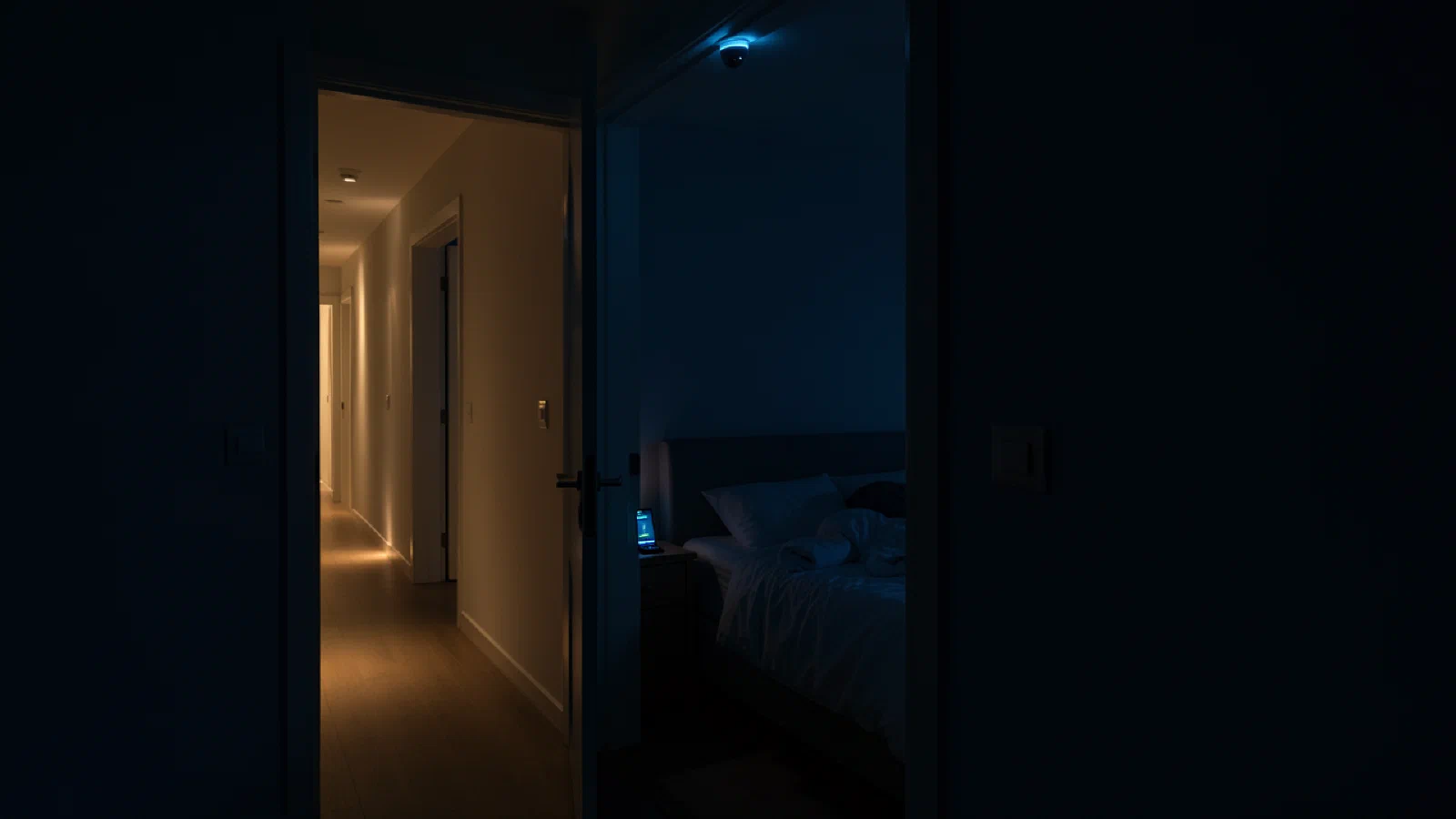
At 2:47 AM, Leonard’s phone shows a single quiet notification. Adaeze is up, moving toward the kitchen. Motion-activated pathway lights have come on at minimum brightness along the hallway, twelve percent, enough to see by, not enough to startle. The system recognizes her movement pattern and logs it: pace consistent with her recent nighttime trips, no impact signature, direction toward the kitchen rather than the back door. Leonard reads the notification, watches the movement log for sixty seconds, and does not get out of bed. By 3:04 AM, Adaeze is back in the bedroom. The system notes the return. Leonard sleeps until 6:15.
Leonard Okafor is 68, a retired high school history teacher from Cincinnati. His wife of 41 years, Adaeze, has moderate-stage Alzheimer’s. Leonard has not slept a full night in fourteen months. He lies awake and listens. She gets up, on average, three times a night. Sometimes she finds the bathroom. Sometimes she finds the back door. Twice she has been outside in January in her nightgown before Leonard woke.
Fourteen months of broken sleep is not just exhausting. It is medically dangerous. Caregiver sleep deprivation at this level is associated with elevated risk of depression, cardiovascular disease, and cognitive decline. Leonard knows this the way he knows the causes of the Civil War: he can teach it clearly while it is happening to him. The night shift system did not make the night safe. It made the night manageable. That is the honest measure.
Why Nighttime Is the Riskiest Time#
Falls happen disproportionately at night. Disorientation, darkness, urgency, and the compromised balance that accompanies interrupted sleep produce the conditions for the most dangerous falls in a home. Among people with dementia, wandering peaks in late afternoon and overnight. The bathroom trip at 3 AM, for a person with Alzheimer’s, can become a walk to the back door and then a walk into a January night.
Medication errors happen at 3 AM because the person taking the medication is half-awake and the person who normally supervises the medication is exhausted. The caregiver who has not slept a full night in fourteen months makes worse decisions during every subsequent day. Not small decisions. The decision to leave the stove on because she forgot to check. The decision to drive to the pharmacy when her reaction time is degraded. The decision to skip her own doctor’s appointment because she cannot leave Adaeze alone long enough.
All of these are connected. The home monitoring system addresses all of them simultaneously because all of them originate in the same place: the night.
What the Night Shift System Actually Does#
Leonard’s system is specific. Motion-activated pathway lighting runs from the bedroom to the bathroom and from the bedroom to the kitchen. The lights are calibrated to the minimum brightness that illuminates the path without disrupting sleep. Eight to twelve percent, not a hundred. The difference matters because a fully lit hallway at 3 AM wakes the person up completely, disrupting sleep architecture for both the person who rose and anyone else in the house.
Bed exit detection uses a pressure sensor under the mattress that registers when weight leaves the bed. The system distinguishes between Adaeze getting up and returning within a normal interval and Adaeze getting up and not returning. If she has not returned to bed within a timeframe the system has learned from her patterns, the alert escalates from a quiet notification to an audible tone on Leonard’s phone. The escalation has never triggered because she has always returned. The fact that Leonard knows it exists is the thing that lets him stay in bed.
Door sensors on both exterior doors trigger an immediate alert when an exterior door opens at night. This is the one that matters most. The twice-she-was-outside-in-January scenario is the one that ends in a missing person report. The door sensor does not prevent Adaeze from opening the door. It tells Leonard within seconds that the door has opened, which is the difference between a two-minute intervention and a forty-five-minute search in the dark.
Acoustic monitoring runs continuously in the hallway and the kitchen. It knows the difference between Adaeze’s deliberate nighttime shuffle and an impact. It has learned this over four months by recording thousands of her footsteps and establishing an acoustic baseline. A sudden sound that deviates from the shuffle pattern triggers an immediate alert, regardless of time. This has triggered once, when Adaeze dropped a glass in the kitchen at 1:30 AM. Leonard found her standing over the broken glass, unhurt, confused by the noise. The system did not clean up the glass. It told Leonard where to go.
The Wandering Problem#
Approximately 60% of people with dementia will wander at some point during the course of the disease. Among those who wander and are not found within 24 hours, the mortality rate approaches 50%. These numbers are not abstractions. They are the reason Leonard has not slept in fourteen months.
Wandering in dementia is not purposeful exploration. It is a product of disorientation, restlessness, and the erosion of spatial memory that makes familiar environments feel unfamiliar. The person who opens the back door at 3 AM is not choosing to go outside. She is responding to an impulse the disease has made urgent and incomprehensible simultaneously. From inside the experience, the world is confusing and the door is a door. From outside, the person is in danger and does not know it.
Specialized wandering detection systems exist and have existed for years. Project Lifesaver, AngelSense, and others provide GPS tracking for people with dementia. These are wearable solutions that require the person to wear the device, which is a meaningful limitation for someone in moderate-stage Alzheimer’s who may remove unfamiliar objects. Home-based monitoring systems like the one Leonard uses address the same risk from the environment rather than the body. The door sensor does not require Adaeze to wear anything. The path lighting does not require her cooperation. The system watches the home, not the person, and the distinction matters for dignity as much as for reliability.
Integration With the Health AI#
The night shift is most important on the nights when the body AI from the health monitoring system predicts elevated risk. After a medication change, the behavioral model adjusts its alertness thresholds for 72 hours. Following three consecutive nights of disrupted sleep, the system lowers the interval before an alert escalates from a notification to an audible tone. When the cognitive tracking data from Adaeze’s monitoring shows an unusual pattern, the system increases the frequency of its environmental scans.
This integration is in early stages. Most home monitoring systems and most health AI platforms do not yet communicate with each other in real time. The system Leonard uses has a limited integration with Adaeze’s wearable, enough to receive sleep quality data but not enough to adjust home monitoring thresholds automatically based on cognitive assessment scores. That level of cross-system communication is one to two years from standard commercial deployment. What exists now is the beginning of a conversation between the body’s data and the home’s data. What is coming is a home that knows when to pay closer attention because the body said so.
The Caregiver Dimension#
Leonard’s story is not only about Adaeze’s safety. It is about Leonard’s survival. A person who has not slept a full night in fourteen months is a person at elevated risk of depression, cardiovascular disease, falls of his own, medication errors of his own, and the cognitive decline that sleep deprivation accelerates in a brain already under the sustained stress of caregiving.
The night shift system is a caregiver health intervention as much as it is a safety intervention. The nights Leonard sleeps until 6:15 are nights his body recovers. The nights he lies awake listening are nights his body deteriorates. This is not a metaphor. Sleep is when the brain clears metabolic waste associated with neurodegeneration. Sustained disruption of that process has measurable consequences that compound over months and years.
The research on caregiver health outcomes is unambiguous. Spousal caregivers of people with dementia have higher rates of mortality than age-matched non-caregivers. The primary mediating factor is chronic stress, and chronic sleep deprivation is the most direct physiological expression of that stress. A system that gives Leonard four consecutive hours of sleep on a night when Adaeze gets up three times is not a convenience. It is a medical intervention for both of them.
Privacy and Consent in Dementia Care#
Adaeze cannot consent to monitoring the way a person without cognitive impairment can. This is a real ethical tension that does not resolve cleanly. Leonard authorized the system on her behalf, with medical power of attorney and the support of her neurologist. He made the decision a caregiver makes: the decision that serves the person’s safety in a condition where the person cannot fully evaluate the tradeoff between safety and privacy.
The dignity test applies here with full force. Does this system serve Adaeze, or does it comfort Leonard? The answer is both. Pretending the system is purely about Adaeze’s safety would be dishonest. Leonard’s sleep is not Adaeze’s clinical objective. It is Leonard’s survival requirement. The system serves Adaeze’s safety and Leonard’s health simultaneously, and the motivations overlap rather than being entirely selfless.
The system does not restrain Adaeze. It does not lock the doors. It does not prevent her from moving through her home. It watches, and it tells Leonard what it sees, and Leonard decides what to do. The agency belongs to the person with the judgment to exercise it, which in this case is Leonard, not because Adaeze’s agency does not matter but because the disease has made her unable to protect herself from the consequences of her own impulses. This is a hard truth about dementia care. The system makes the truth manageable. It does not make it easy.
6:15 AM#
Leonard slept until 6:15. Adaeze was up three times in the night. The system tracked each movement, lit each path, noted each return. None of the three trips became an emergency. None of them became a search.
Fourteen months ago, Leonard would have been awake for all three. He would have followed her to the kitchen. He would have checked the back door. He would have lain awake after each trip, listening for the next one. By morning, he would have been exhausted, irritable, and less capable of the patience that caregiving requires during the day.
The system did not make the night safe. Adaeze has Alzheimer’s. No amount of monitoring makes Alzheimer’s safe. What the system did was take the night shift so that Leonard could function during the day, and functioning during the day is the requirement that keeps Adaeze in her home rather than in a facility. The system watches so Leonard can sleep, and Leonard sleeps so Adaeze can stay. That is the honest measure of what it does.
How this article connects to others in Blue Mirror.
Sources cited in this article.
- Alzheimer's Association. "Wandering and Getting Lost." Alzheimer's Association, 2025.
- Schulz, Richard, and Paula R. Sherwood. "Physical and Mental Health Effects of Family Caregiving." Journal of Social Work Education, vol. 44, no. 3, 2008, pp. 105-113.
- National Institute on Aging. "Home Safety and Alzheimer's Disease." NIA, 2024.
- Rowe, Meredeth A., and Sherry S. Glover. "Antecedents, Descriptions and Consequences of Wandering in Cognitively-Impaired Adults." American Journal of Alzheimer's Disease and Other Dementias, vol. 16, no. 6, 2001, pp. 379-384.
- SafelyYou. "AI-Powered Fall Detection for Memory Care." SafelyYou, 2025.
- Centers for Disease Control and Prevention. "Caregiving for Family and Friends." CDC, 2024.