The Kitchen, the Bathroom, and the Stairs
Series 03: The Home That Knows You
Louise Petersen is 77, a retired librarian from Madison, Wisconsin, and she is sitting at her kitchen table with two lists and a contractor quote. The first list is from the home safety company: a $4,200 proposal for smart home modifications including motion-sensing floor panels, an integrated camera system, automatic stove monitoring, and a bathroom fall detection array. The second list is from her occupational therapist, Karen, who has done more than 400 home safety assessments in her career. Karen’s list starts with a $12 grab bar.
Louise has had three near-falls in the past year. One in the kitchen, where she turned from the stove while distracted and caught the counter in time. One in the bathroom, where she slipped getting out of the tub. One on the stairs, where she miscounted the bottom step in poor light. None became a fall. She is aware the fourth may not be as forgiving. She is sitting at this table because the near-falls have accumulated into a decision she can no longer defer, and the two lists in front of her describe two different versions of what that decision looks like.
The Kitchen: Where Distraction Becomes Risk#
Kitchens are dangerous for older adults, and the danger is not dramatic. It is the accumulation of heat sources, wet surfaces, distraction, and the cumulative cognitive fatigue that peaks in late afternoon. Cooking equipment is responsible for approximately 50,000 home fires annually in the United States, and adults over 65 are disproportionately represented in those numbers.
The stove is the most dangerous appliance in the house. Not because stoves are inherently hazardous but because the stove requires sustained attention, and sustained attention is the cognitive resource that aging and fatigue deplete first. The person who puts water on to boil and walks to the living room to check the news is not being careless. She has made that walk ten thousand times without consequence. The consequence arrives the time her attention does not return, and the difference between that time and the previous ten thousand is a measurement too fine for the person making it.
A stove shut-off device costs approximately $149. Wallflower and iGuardStove are the two most widely available consumer models. Both plug into the outlet behind the stove and monitor whether the burner has been on longer than a preset interval or whether the cook has left the room. The technology is simple: a motion sensor, a timer, and a relay that cuts power to the stove. It works. It has worked for years. It requires no configuration beyond the initial setup and no ongoing technical maintenance.
The $4,200 proposal on Louise’s table includes smart stove monitoring as part of a package. The standalone device does the same job for $149 and installs in twenty minutes. The question is not whether the expensive version is better. The question is whether the expensive version is $4,051 better. For the stove specifically, it is not.
The Bathroom: The Most Dangerous Room in the House#
One in three adults over 65 falls in the bathroom each year. The specific risk factors compound in a small space: wet surfaces, the exertion of rising from a seated position on the toilet, inadequate lighting during nighttime trips, and the urgency that makes a person move faster than her balance can support.
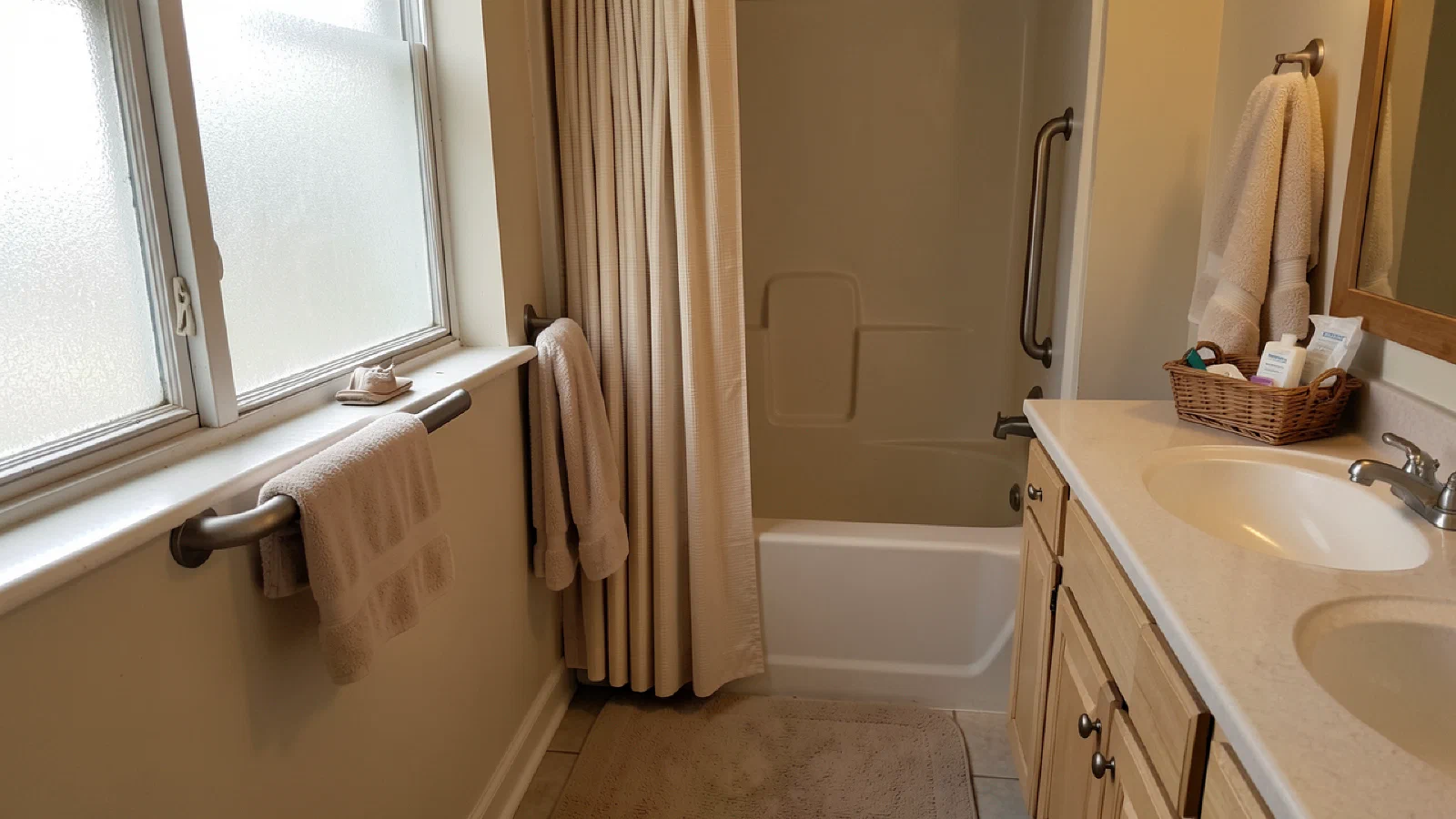
The modifications that matter most, in order: grab bars at every tub, shower, and toilet. A handheld showerhead that allows seated bathing. A shower seat. Non-slip mats inside the tub and on the floor outside it. These four modifications together cost between $80 and $300, depending on the grab bar models and whether the installation requires a contractor or a competent family member with a drill.
The grab bar deserves its own paragraph because it is the single highest-value safety modification available per dollar spent. A properly installed grab bar costs under $40 and reduces fall risk in the bathroom by approximately 40%. Nothing else in home safety produces that return on investment. Not smart floors. Not sensor arrays. Not acoustic fall detection. The grab bar has been the correct first answer for decades, and it remains the correct first answer in 2026.
After the basics, the smart bathroom becomes a genuine addition. Floor sensors that distinguish a fall impact from a dropped shampoo bottle are moving from research to commercial deployment. Toilet-based health monitoring systems from Toto and Kohler can track some biomarkers over time. Bathroom mirror systems with gait and balance analysis are in development for the three-to-five-year horizon. These are real capabilities with real value. They are also second-order additions to a foundation that must start with the $12 grab bar and the $8 non-slip mat.
The Stairs: The Binary Risk#
Stairs either work or they produce catastrophic injury. There is very little middle ground. The kitchen has minor burns and near-misses. The bathroom has slips and catches. The stairs have a fall from height that produces hip fractures, traumatic brain injuries, and the hospitalization that, for many older adults, marks the transition from independent living to facility care.
The risk factors are specific: inadequate lighting, irregular step spacing (common in homes built before modern building codes), inadequate handrails, and cognitive confusion about step count. Louise miscounted the bottom step in poor light. She caught herself. The intervention that would have prevented the near-fall entirely is a $15 motion-activated light strip on the bottom three stairs and a handrail on the second side of the staircase. Total cost: under $200.
The smart staircase exists in concept and in limited deployment. Integration with a fall prediction model, such that stair lighting adjusts to full brightness on days when the wearable’s daily risk assessment is elevated, is a genuine capability arriving in the one-to-two-year horizon. Adaptive lighting triggered by gait analysis from the health AI, so the stairs are brighter on mornings when balance data suggests higher risk, is a three-to-five-year proposition. These are valuable additions. They do not replace the handrail.
At some point, the stairs exceed what modification can address. The stairlift is the correct answer when lighting, handrails, and attention are no longer sufficient. Stairlifts cost $2,000 to $5,000 installed. This is a significant expense. It is also substantially less than one fall-related hospitalization, which averages over $30,000 and frequently costs more.
What AI Actually Adds in These Three Spaces#
The stove shut-off that knows you left the room, not just that the stove has been on for twenty minutes. The bathroom floor that can detect a fall impact acoustically and distinguish it from the sound of a toilet lid closing. The stair lighting that adjusts to full brightness automatically on days when the fall prediction score from the wearable is elevated. These are the specific additions that AI brings to the kitchen, the bathroom, and the stairs.
Each of these is genuine. Each addresses a gap that basic modifications cannot close. The stove shut-off device that monitors presence rather than just time is more useful than the timer-only model because the problem is not that the stove has been on too long but that the person has left while the stove is on. The acoustic fall detection in the bathroom catches the event that the grab bar was supposed to prevent but did not. The adaptive stair lighting responds to the person’s condition on that specific day rather than illuminating at the same level regardless of risk.
What AI adds is context. The basic modifications are general: they serve any person in any condition on any day. The AI modifications are specific: they serve this person, with this condition, on this day. General is the foundation. Specific is the extension. The foundation still comes first.
The OT’s Perspective#
Karen has done more than 400 home safety assessments. She has seen the full range: the family that spent $12,000 on a smart home system and never installed grab bars in the bathroom. The woman who fell in the shower six months after her daughter bought her a fall detection pendant she never wore. The man whose stairlift saved his independence for four years at a cost less than two months of assisted living.
Her perspective, earned over 400 assessments, is not complicated. The technology that saves the most lives still costs $12 and installs with four screws. The technology that prevents the most suffering is the system that knows when to intervene before the fall happens. Both statements are true, and they are not in conflict. They are a sequence. The grab bar comes first because it works immediately, costs almost nothing, and prevents the falls that happen regardless of whether a monitoring system is present. The monitoring system comes second because it adds the context that the grab bar cannot provide.
Karen has a framework she uses with every client. Start with what costs under $50 and installs in a weekend: grab bars, non-slip mats, motion-activated lighting, a handheld showerhead. Then add what costs under $500 and requires a contractor: additional handrails, stove shut-off devices, bathroom lighting improvements. Then evaluate what costs over $1,000 and requires ongoing maintenance: integrated monitoring systems, smart floor sensors, stairlifts. The sequence is the practical value. Start cheap, start effective, add complexity only where the simple version leaves a gap.
Louise’s List, Revisited#
Louise installed the $12 grab bar first. Then the motion-activated bathroom light, $24. Then the stove shut-off device, $149. Then the non-slip mats, the handheld showerhead, the second stair handrail. Total cost for the first round of modifications: $430. Time to completion: two weekends.
The $4,200 quote is still on her kitchen table. Some of it is worth it. The acoustic fall detection for the bathroom may be worth the investment for someone who lives alone and whose bathroom falls would otherwise go undetected. The integrated motion monitoring for the hallway and stairs adds genuine nighttime safety beyond what basic lighting provides. The smart stove system is not worth it for Louise because the $149 standalone device does the same job.
Karen helped her tell the difference. The grab bar was installed first because the grab bar should always be installed first. The monitoring system is worth evaluating after the basics are in place, not instead of them. The most dangerous thing about a $4,200 smart home proposal is not that it is too expensive. It is that it can make a person feel she has addressed the problem when the $12 solution she skipped would have done more.
How this article connects to others in Blue Mirror.
Sources cited in this article.
- National Fire Protection Association. "Cooking Equipment Fire Statistics." NFPA, 2024.
- Stevens, Judy A., et al. "Unintentional Fall Injuries Associated with Walkers and Canes Among Older Adults Treated in U.S. Emergency Departments." Journal of the American Geriatrics Society, vol. 57, no. 8, 2009, pp. 1464-1469.
- Centers for Disease Control and Prevention. "Cost of Older Adult Falls." CDC STEADI Initiative, 2024.
- Wallflower Technologies. "Wallflower Smart Stove Monitor." , 2025.
- Stark, Susan L., et al. "Client-Centred Home Modifications Improve Daily Activity Performance of Older Adults." Canadian Journal of Occupational Therapy, vol. 76, 2009, pp. 235-245.
- Toto, Patricia E. "Home Modification and Fall Prevention." Occupational Therapy Practice, vol. 18, no. 3, 2013, pp. 7-12.