The House That Learned Her Name
Series 03: The Home That Knows You
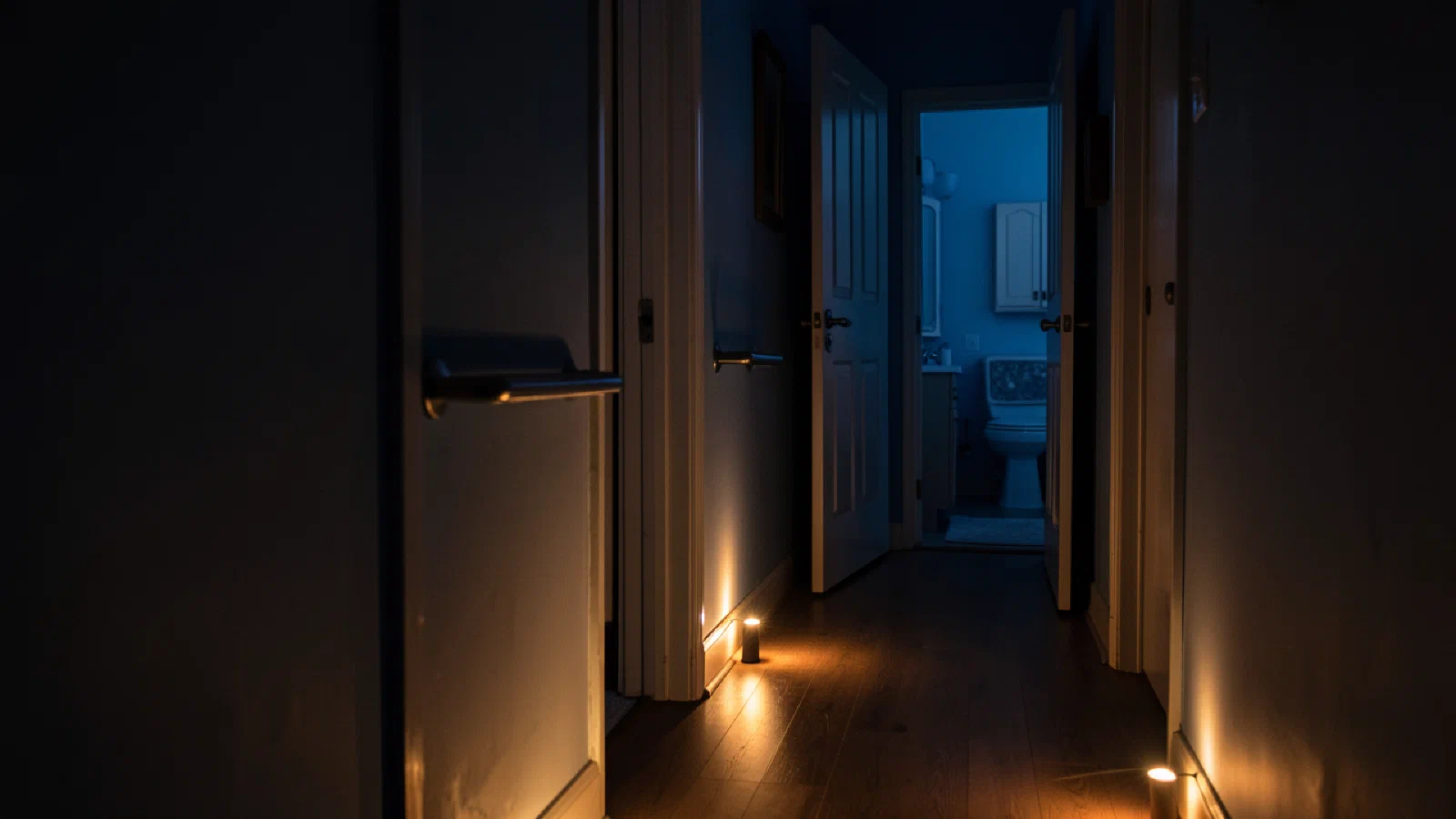
The hallway light came on at 4:10 AM, before Vivienne took her first step. It came on at 8% brightness, enough to see the floor, not enough to shock her awake. She had not touched a switch. She had not called out. She had not asked for anything. The home had noticed her bedroom movement pattern, the same restless shifting it had recorded before every 4 AM waking over the past six months, and it turned on the hallway light two seconds before she put her feet on the floor.
Vivienne Park is 72, a retired occupational therapist from Eugene, Oregon. She was diagnosed with early-stage Parkinson’s eighteen months ago. The tremor wakes her on bad nights, and bad nights have become more frequent. She favors the left side of the hallway because her balance pulls right when the tremor is active. She sleeps best at 68 degrees, dropping to 65 after midnight. Her home knows all of this because her home has spent six months learning her.
That hallway light contains the entire argument of this series. The light was not a response. It was an anticipation. The home did not react to Vivienne getting out of bed. The home predicted she was about to get out of bed and prepared the path before she needed it.
What “Knowing the House” Actually Means#
A house with smart speakers and motion sensors is not a house that knows you. It is a house that follows commands and responds to triggers. The motion sensor turns on the light when you enter the room. The smart speaker plays music when you ask. The thermostat adjusts when you press a button. Every interaction starts with you.
Vivienne’s home is different because it has built a behavioral model of the person inside it. Over six months, seven sensor streams running simultaneously have produced a picture of Vivienne that Vivienne herself does not entirely possess. Her sleep architecture across 180 nights. Her movement patterns through the kitchen, hallway, and living room at different times of day. The acoustic signature of her walking gait versus a stumble. The correlation between tremor severity at night and movement speed the following morning. The temperature at which she sleeps longest without waking.
None of this is a single device. A motion sensor cannot build a behavioral model. A smart speaker cannot integrate sleep data with gait acoustics. A thermostat cannot know that last night’s disrupted sleep means this morning’s fall risk is elevated. What makes a learning home categorically different from a smart home is a hub that takes multiple data streams, stores behavioral patterns persistently, updates the model as patterns change, and connects to the health AI from a wearable or health platform so the home knows when the body’s data warrants elevated environmental vigilance. The behavioral model is the product. The sensors are the ingredients.
What It Took to Build#
Vivienne’s system required installation of a sensor network: bed sensors, hallway motion detectors, kitchen activity monitors, bathroom motion and acoustic sensors, door sensors, a home AI hub to integrate the data, and a connection to her wearable health tracker. The installation took a full day with a technician. The first two weeks produced little of value because the model had no baseline. By month two, the system had learned her morning routine well enough to adjust kitchen lighting before she arrived. By month four, it had mapped the correlation between disrupted sleep and slower morning movement. By month six, it anticipated the 4 AM hallway light.
Six months is a long time to wait for a system to become useful. This is one of the honest limitations of a learning home. It cannot be smart on the first day. A motion-triggered night light is smart on the first day, because it does not need to know anything about the person. A learning home needs time because the model it builds is specific to one person in one house, and specificity takes data, and data takes time.
The Honest State of Home AI Today#
Blue Gray Matters assessed the smart home landscape for seniors as fragmented, expensive, and overpromised. That assessment still holds for most consumer products available in 2026. Amazon Echo, Google Home, and Apple HomeKit are command-response systems. They respond well to voice instructions. They do not learn the person using them, and they do not integrate data streams into a behavioral model.
True learning-home platforms that integrate multiple sensor streams into a single anticipatory system exist primarily in pilot programs and research environments. Several companies are developing commercial versions, and Amazon’s ambient home intelligence research suggests the capability is approaching consumer-grade deployment within one to two years. Apple’s HomeKit architecture improvements point in the same direction. But the gap between a press release and a product a 72-year-old woman in Eugene can purchase and install remains substantial.
In three to five years, the trajectory points toward homes that build full behavioral models of their residents over time, integrating wearable health data, environmental sensor data, and appliance usage patterns into a single anticipatory system. Ambient AI that requires no device interaction and generates no notifications unless something warrants attention. This is the direction. It is not the present for most households.
What This Requires Emotionally#
A home that learns you is a home that records you. Vivienne’s system knows when she uses the bathroom, when she opens the refrigerator, how long she spends in the kitchen, and whether she left the house today. It knows things about her daily patterns that she does not consciously track herself.
One woman in a similar pilot declined the system entirely. She did not want anything tracking her bathroom visits. Her decision was reasonable and fully within her rights. A man six months into the system realized his home knew his morning routine better than he consciously remembered it. He found this unsettling for three days and then useful for the rest of the year.
The consent dimension is real. The resident decides how much of her life the home records, and she decides whether the safety that recording produces is worth the privacy it costs. For Vivienne, with Parkinson’s and a history of 4 AM waking, the light in the hallway answered that question. For someone else, with different risks and different values, the answer might be different, and the answer is theirs to give.
What This Does for Parkinson’s#
Parkinson’s creates a specific set of home safety challenges. The shuffling gait increases fall risk in inadequate light. Medication timing affects motor function in ways the person may not consistently track. Tremor severity fluctuates, and the fluctuation often follows patterns that are visible in data before they are visible to the person experiencing them.
Vivienne’s learning home addresses each of these. Anticipatory lighting along her movement paths means the hallway, kitchen, and bathroom are lit before she reaches them, at brightness levels calibrated to her needs at that time of day. Kitchen routine monitoring detects when her medication timing drifts, which it does when the tremor disrupts her morning schedule. The behavioral model recognizes patterns that precede a tremor episode, sometimes twelve to eighteen hours before the episode manifests, and elevates environmental monitoring accordingly.
None of this replaces her neurologist. None of it changes the progression of Parkinson’s. What it changes is the environment in which the progression happens, and for a person whose primary fear is falling in her own home, the environment is the variable she can control.
The Equity Problem#
Vivienne’s system cost approximately $4,500 installed, plus a monthly subscription for the AI platform. She could afford it. Her daughter researched it, her son-in-law installed some of the simpler components, and the technician handled the rest. Vivienne has a college education, family nearby, and enough retirement income to absorb a one-time expense of that size.
The person who needs a learning home most urgently is often a person who cannot afford one. An integrated sensor network, a home AI hub, and professional installation run $2,000 to $8,000 depending on the home and the system. Insurance covers almost none of it. Medicare does not cover home AI monitoring. Medicaid covers some home modifications through waiver programs, but the modifications covered are grab bars and ramps, not sensor networks.
The person living alone on Social Security in a house she has occupied for forty years, with early-stage cognitive decline and no family within two hundred miles, is the person for whom anticipatory lighting at 4 AM would matter most. She is also the person least likely to have it. This gap between need and access is a policy problem, not a technology problem, and it will not close on its own.
The Light That Was Already On#
On that morning at 4:10 AM, Vivienne walked from her bedroom to the kitchen. The hallway was lit. The kitchen light came on as she reached the doorway. The floor was visible. Her path was clear. She made her tea, took her medication early because the tremor was bad enough to warrant it, and sat in the chair by the window until the sun came up.
She did not fall. She might not have fallen without the system. The 4 AM hallway in the dark is a risk, not a certainty. But the light was there before she needed it, and the difference between a risk managed and a risk ignored is the difference between staying in this house and not staying in it. Vivienne has lived in this house for 31 years. The light at 4 AM is not a luxury. It is the thing that lets her stay.
How this article connects to others in Blue Mirror.
Sources cited in this article.
- Pew Research Center. "Americans and Smart Home Technology." Pew Research Center, 2023.
- Dewsbury, Geoff, et al. "The Design of a Smart Home Sensor System for Ambient Assisted Living." Journal of Ambient Intelligence and Smart Environments, vol. 6, no. 3, 2014, pp. 245-262.
- Centers for Disease Control and Prevention. "Older Adult Falls: Data and Statistics." CDC Injury Prevention, 2024.
- Parkinson's Foundation. "Falls and Parkinson's Disease." Parkinson's Foundation, 2025.
- Amazon. "Ambient Intelligence Research." Amazon Science, 2025.
- National Institute on Aging. "Aging in Place: Tips for Making Home Safe and Accessible." NIA, 2024.