The Home After You Leave It
Series 03: The Home That Knows You
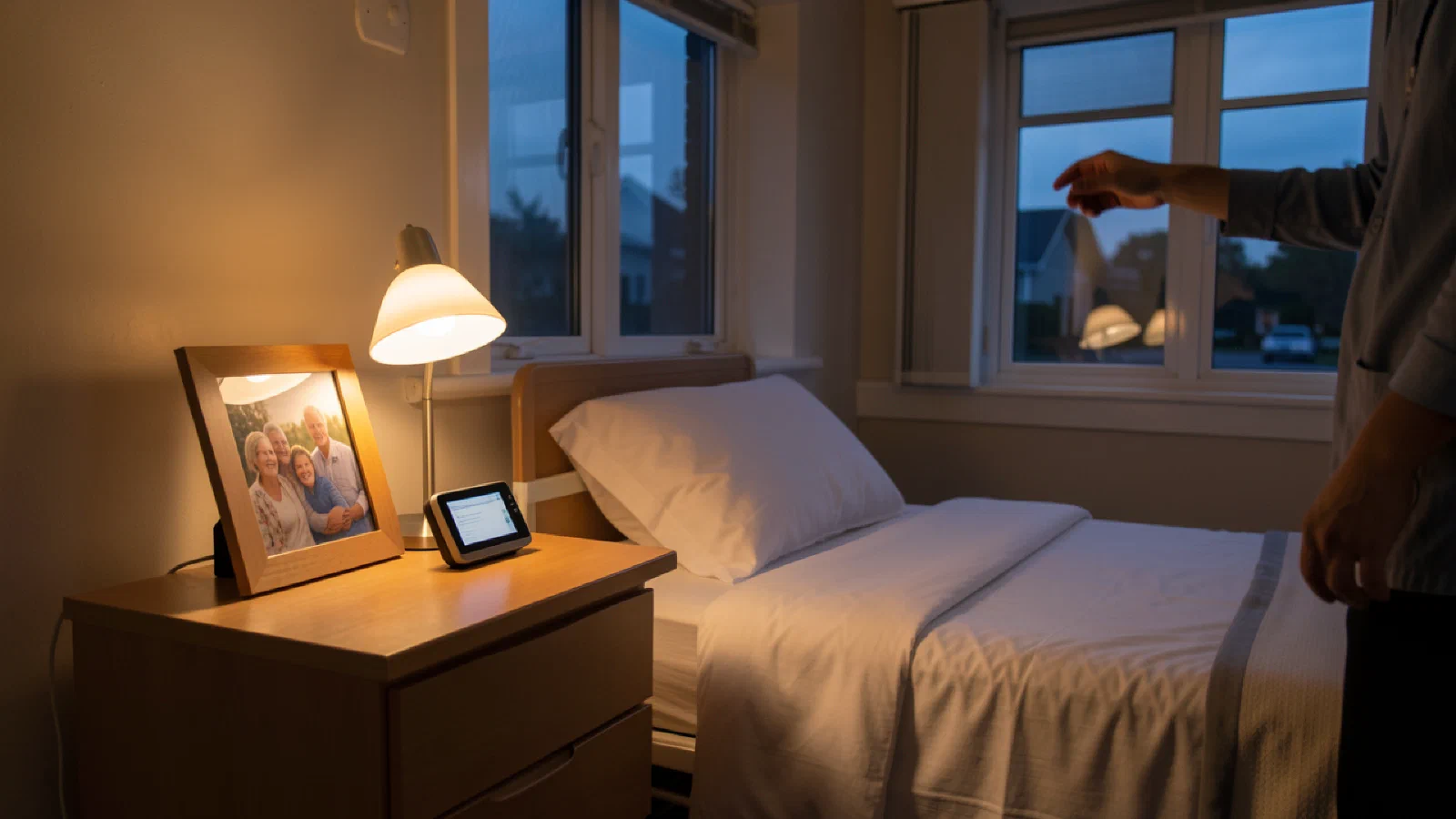
Margaret Yuen’s room at Laurel Heights Memory Care was configured before she arrived. Sandra Okafor, the activity director, set the lighting schedule: warm light from 6 AM, full light by 7:30, dimmed to 40% by 4 PM, night mode by 9. She set the music: Cantonese opera from 7 to 8 AM, NPR news at noon, classical piano in the evenings. She set the temperature: 68 degrees, dropping to 65 after 10 PM. Sandra had never met Margaret. She knew Margaret the way the home AI had known her: through two years of sensor data that recorded the texture of her daily life.
Margaret is 83. She lived in her San Francisco house for 44 years, raised three children in it, buried her husband’s ashes in the garden behind it. Her home AI system had been running for two years before her hospitalization and the dementia assessment that followed. When her daughter Lin brought Margaret to Laurel Heights, she also brought the home data. Sandra has guided 47 transitions using intelligent home data. She says Margaret’s was the smoothest she had seen.
On her third morning at Laurel Heights, the Cantonese opera started at 7 AM. Margaret hummed along. She did not know what had changed. She did not know the room had been configured. She hummed because the music was what she expected to hear at that time of morning, and the expectation was met, and the meeting of the expectation in an unfamiliar place was the thing that Sandra’s 47 transitions had taught her to value above almost any other intervention.
What Home Data Can Travel#
The health AI from the wearable and the health monitoring platform carries physiological data and care history. Blood pressure trends, medication records, sleep quality metrics, fall risk scores. This data is clinical. It informs the medical team at the facility about how to manage the medical conditions that accompany the person.
The behavioral profile from the home AI carries something different. It carries the texture of daily life. The temperature Margaret sleeps at. The music she listens to every morning without consciously knowing she listens to it every morning. The lighting level that does not startle her awake. The time of evening when she transitions from activity to rest. The volume she prefers on the television, which is louder than most people’s because her hearing has declined in the left ear.
This is not clinical data. It is personhood data. It is the record of who a person is in the environment where she is most herself, and it is precisely the data that a new environment needs if the new environment is going to feel like anything other than a hospital room with a bedspread.
Personhood data travels. Not because the technology makes it travel automatically, but because someone, Lin in this case, carried it from one system to another, and someone else, Sandra, knew what to do with it. The data is portable in principle. In practice, it requires a person on each end who understands what the data contains and why it matters.
What Cannot Travel#
The stairs Margaret climbed ten thousand times. The garden where her husband’s ashes are buried. The kitchen that smelled like his coffee on Sunday mornings for the fifteen years between his death and Margaret’s diagnosis. The 44-year accumulation of spatial familiarity that told her body where everything was without asking: the bathroom is left and then right, the light switch is at shoulder height on the wall by the door, the teacup lives on the second shelf behind the cereal.
The data helps. It does not replace what was left behind. The room at Laurel Heights is configured to match Margaret’s lighting preferences and her music schedule and her temperature curve, and it is still not her house. The hallway outside is not her hallway. The garden, if there is one, is not the garden where she buried the ashes. The spatial familiarity that forty-four years built is gone, and no amount of sensor data reconstructs it.
The home data makes the transition less disruptive. It does not make the transition painless. Margaret left a house that held 44 years of her life and entered a room that knew her temperature preferences. The distance between those two things is enormous, and the data that crossed the distance is valuable precisely because the distance is so large, not because the data closes it.
The Transition Problem#
What usually happens when someone moves to memory care without behavioral data from home: two to four weeks of behavioral disruption. The person adjusts to unfamiliar environmental cues. The lighting is wrong. The sounds are wrong. The temperature is wrong. The schedule is wrong. Everything is wrong, and for a person with dementia, everything being wrong produces agitation, sleep disruption, wandering, refusal to eat, and withdrawal from social engagement. The clinical team manages the disruption with patience and sometimes with medication. The family watches and wonders if the move was a mistake.
What happened with Margaret: two days of adjustment, then behavioral patterns resembling her home baseline within a week. She slept through her first night at Laurel Heights, which Sandra attributes directly to the temperature curve matching what her body expected. She ate breakfast on the first morning because the lighting in the dining room was at the level she was accustomed to at that hour. She did not wander at night because the room felt familiar enough to her body that the disorientation that drives nighttime wandering was reduced, not eliminated, but reduced enough that the first week was not a crisis.
Sandra’s 47 transitions are not a clinical trial. The sample is small, the conditions are not controlled, and the outcomes are self-reported by the facility staff rather than measured by independent researchers. Sandra knows this. She says it anyway because 47 transitions is 47 families, and the pattern she has observed is consistent enough that she considers home data intake a core part of her transition protocol. The signal is worth taking seriously. It is not yet proof.
The Intelligent Home as a Bridge#
The series has described the intelligent home as a system that extends safe independence. The learning model described in “The House That Learned Her Name.” The nighttime monitoring from “The Night Shift.” The room-by-room safety modifications. The clinical data it generates. Each article has treated the intelligent home as something that delays the transition to facility care.
This article adds a second function. The intelligent home is also a bridge. The two years that Margaret’s home AI ran before her transition were two years during which the system built a behavioral profile of Margaret at her most functional. The profile carries information the facility needs but cannot gather from a person with advancing dementia. What time does she prefer to wake? What music settles her? What temperature helps her sleep? What lighting level feels safe?
The facility can ask these questions of the family. Lin could have told Sandra that Margaret likes Cantonese opera in the morning. But Lin might not have known the exact time, or the exact duration, or that Margaret listens to it every day without exception, or that the volume is set to 40% because Margaret’s left-ear hearing loss makes that the level at which the music is audible without being overwhelming. The home AI knew all of this because the home AI measured it. The precision of the data is what makes the room configuration possible. “She likes Chinese music” is not the same as “Cantonese opera, 7:00 to 8:00 AM, volume 40%, every day.”
The Person Before the Diagnosis#
For people with dementia, the home AI was running during the period before the diagnosis changed everything. The behavioral profile it carries is, in an important sense, the person at her most intact.
Margaret before the diagnosis cooked dinner at 5:30 PM, listened to classical piano while she cooked, drank jasmine tea at 8 PM, read until 9:30, and went to sleep with the temperature dropping to 65. Margaret after the diagnosis cannot tell you any of this. She cannot tell you what music she likes, what time she prefers to eat, or what temperature she sleeps at. The disease has taken the words for these preferences and, increasingly, the conscious awareness that the preferences exist.
But the preferences persist in the body. The body that has listened to Cantonese opera every morning for thirty years still responds to Cantonese opera in the morning. The body that has slept at 65 degrees for a decade still sleeps best at 65 degrees. The preferences outlast the person’s ability to articulate them, and the home AI data carries the preferences to the next environment so the next environment can honor what the person can no longer request.
This is the data that tells the facility not only who Margaret is now but who Margaret was. The facility that uses this data is caring for the person Margaret was before the disease took the words away. Sandra calls this “meeting the person before the diagnosis.” It is the most important thing the data does, and it is the thing no intake form captures, because the intake form asks the family and the family answers from memory, which is partial, and from grief, which is distorting.
The Technology Gap That Still Exists#
Most home AI systems do not export data in a format that facility systems can receive. The data sits in a proprietary platform. The platform has an API, or it does not. The API produces data in a format the facility can ingest, or it does not. Most facilities do not have intake processes for home AI data even when the data exists and the export is technically possible. Sandra built her own intake protocol because no standard protocol exists.
This is a plumbing problem. The data exists. The value of the data is demonstrated. The pathway from the home system to the facility system is blocked by incompatible formats, missing APIs, proprietary data silos, and the absence of an interoperability standard that would make home-to-facility data transfer as straightforward as a medical record transfer under FHIR.
The plumbing will be fixed. Interoperability standards for home AI data portability are in development. FHIR-based pathways for home-generated health data are improving. Some memory care facilities are beginning to develop structured intake processes for behavioral data. The timeline is one to two years for limited availability and three to five years for anything approaching a standard practice. In the meantime, the data transfer depends on someone like Lin, who carried the data on a USB drive, and someone like Sandra, who knew what to do with it.
Margaret’s Third Morning#
On her third morning at Laurel Heights, the Cantonese opera started at 7 AM. The room was at 68 degrees. The lights had come on warm and low at 6 AM, the way they had come on in San Francisco for two years. Margaret sat in the chair by the window, which is positioned where the chair by the window was in her house, because Sandra asked Lin where the morning chair was and configured the room accordingly.
Margaret hummed along. She did not know the room had been configured. She did not know that the temperature, the music, the lighting, and the chair were all set to match a home she can no longer name. She hummed because the morning felt right, and the rightness was not accidental, and the person who made it right had never met her.
The house is 400 miles away. Margaret cannot tell you its address. She cannot describe the garden or the kitchen or the stairs she climbed for 44 years. But her body knows what morning sounds like, and this morning sounds like morning, and that is what Sandra’s 47 transitions have taught her: the body remembers what the mind forgets, and the data that carries the body’s memory from one environment to another is a form of care that the word “technology” does not adequately describe.
The room is not her home. The opera is the same opera. The temperature is the same temperature. Margaret hums. Sandra, in the hallway, hears her. The transition that could have been violent was less violent than it could have been, because the home had been watching, and the watching traveled, and the watching became a kind of knowing, and the knowing became a room that knew her before she arrived.
How this article connects to others in Blue Mirror.
Sources cited in this article.
- Alzheimer's Association. "Residential Care and Assisted Living." Alzheimer's Association, 2025.
- Chenoweth, Lynn, et al. "Caring for Aged Dementia Care Resident Study (CADRES) of Person-Centred Care." The Lancet Neurology, vol. 8, no. 4, 2009, pp. 317-325.
- Cohen-Mansfield, Jiska. "Nonpharmacological Interventions for Inappropriate Behaviors in Dementia." American Journal of Geriatric Psychiatry, vol. 9, no. 4, 2001, pp. 361-381.
- Health Level Seven International. "FHIR Overview." , 2025.
- National Institute on Aging. "Choosing a Care Facility." NIA, 2024.
- Gerdner, Linda A. "Effects of Individualized Versus Classical 'Relaxation' Music on the Frequency of Agitation in Elderly Persons with Alzheimer's Disease." International Psychogeriatrics, vol. 12, no. 1, 2000, pp. 49-65.