The Hands You Didn't Ask For
Series 03: The Home That Knows You
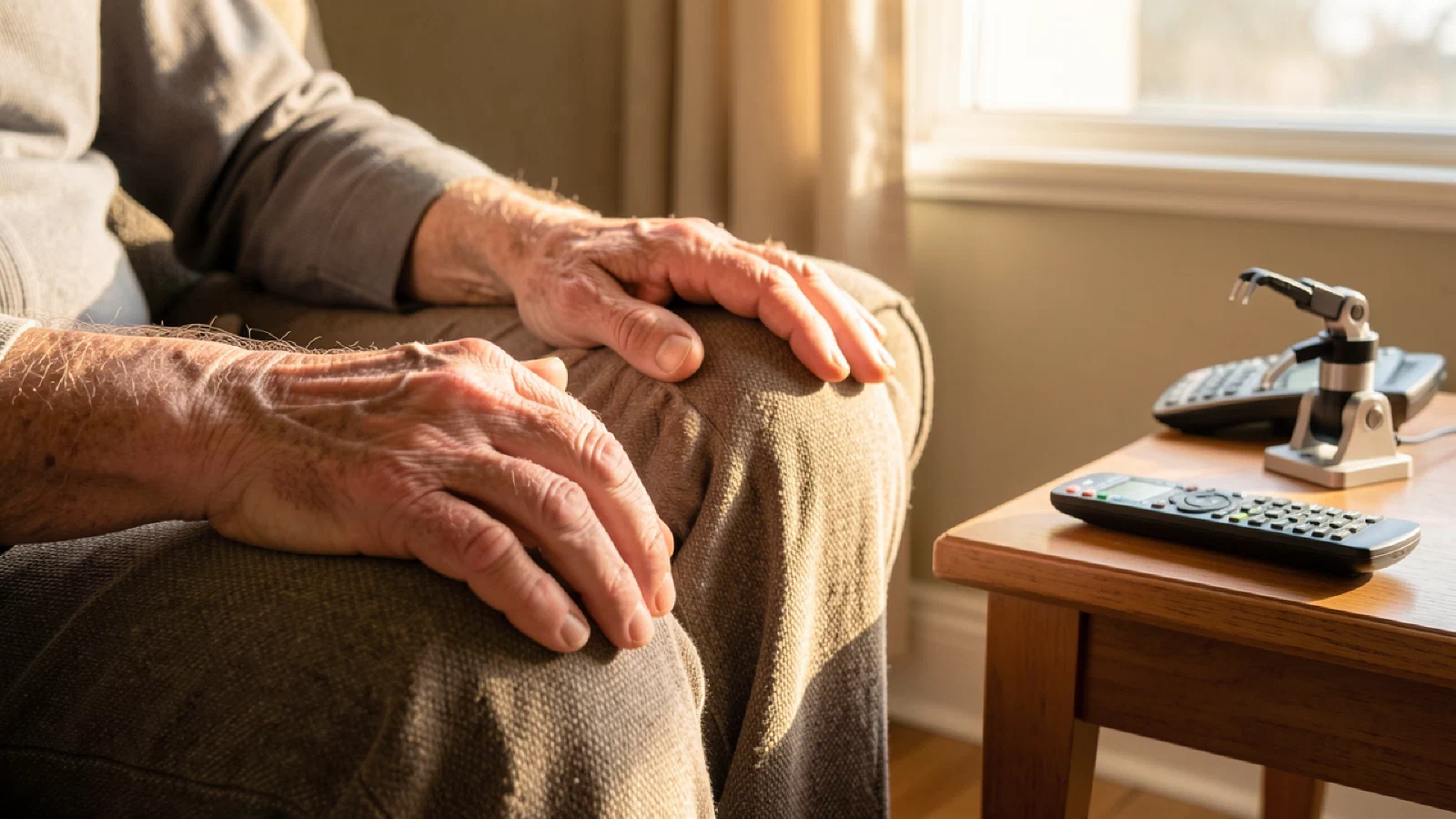
Arthur Szymanski’s phone is on the floor. It slipped from his hand while he was reading the news in his recliner, the way it does about four times a week now. Arthur is 76, a retired machinist from Pittsburgh, and he has severe rheumatoid arthritis in both hands. He cannot bend to retrieve anything below knee height. Not without pain that takes twenty minutes to subside, and not without the risk of losing his balance on the way down.
The retrieval robot crosses the living room, extends its arm, grasps the phone, and returns it to the tray beside his chair. The entire operation takes forty seconds. Arthur picks up the phone, finds his place in the article, and continues reading. He does not call his daughter. He does not wait for the aide who comes on Tuesdays. He does not decide the phone is not worth the trouble.
His son Michael is watching from the doorway. Michael is 48 and lives twenty minutes away. He drove over because he does, twice a week, because his father lives alone and Michael worries. He watched the robot retrieve the phone and he cried. Not because the robot worked. Because the robot meant his father could no longer bend down.
The Phone on the Floor#
Two people experienced the same forty seconds. Arthur experienced liberation. Michael experienced evidence. The robot retrieving the phone meant, to Arthur, that the house is his again. He can move through it without calculating whether a dropped item is worth the physical cost of retrieving it, without waiting for someone else to come, without the specific humiliation he feels when asking for help with small things. The house is his again because the small things no longer require another person.
Michael experienced the same forty seconds as a measurement of loss. His father, who machined engine parts with hands that could hold tolerances measured in thousandths of an inch, cannot pick up a phone from the floor. The robot is competent and efficient and it performs the retrieval without complaint. It is also a machine doing what his father’s body used to do, and watching it work is watching the distance between then and now.
Both experiences are true. Neither is wrong. The robot did not create this split. It made it visible.
The Independence Paradox#
Does assistive technology extend independence or confirm dependence? The answer depends entirely on whose perspective you take, and the perspectives do not converge.
For Arthur, the retrieval robot extends his independence. Before the robot, he had three options when he dropped something below knee height: call his daughter and wait, ask the aide on Tuesday and wait, or attempt the retrieval himself and risk a fall or twenty minutes of pain. Each option carried a cost. Calling his daughter meant admitting he could not manage. Waiting for Tuesday meant the item stayed on the floor for days. Attempting the retrieval himself meant risking the fall that would end his time in this house. The robot created a fourth option: retrieve the item now, by himself, without cost. By Arthur’s measure, his independence increased the day the robot arrived.
For Michael, the robot confirms his father’s dependence. His father needs a machine to pick up a phone. The fact that the machine works well does not change the fact that his father’s body requires it. Every time Michael watches the robot extend its arm, he sees the gap between what his father could do and what his father can do now. The robot is efficient and dignifying and Michael is grateful for it and it breaks his heart.
The independence paradox is not resolvable. It is not a misunderstanding that better communication fixes. Arthur and Michael are not seeing the same event differently because of inadequate information. They are seeing the same event differently because they occupy different positions relative to it. The person whose body has changed experiences assistive technology from inside the change. The person who loves that person experiences it from outside. Inside and outside produce different meanings, and both meanings are accurate.
The Dignity Test#
The dignity test asks: does this intervention serve the person, or does it comfort the family? Arthur’s retrieval robot serves Arthur. It does not comfort Michael. It distresses him. By the dignity test, the intervention is correct.
This does not mean Michael’s distress is illegitimate. It means his distress is not the deciding criterion. The person’s experience is the primary measure. Arthur’s daily life improved measurably on the day the robot arrived. He retrieves items without waiting, without asking, without performing the calculation about whether the dropped item is worth the social cost of requesting help. His autonomy in his own home increased. His dignity, as he defines it, increased.
Michael’s grief is real. Watching his father need the robot is watching his father age, and watching a parent age is one of the difficult experiences that no technology addresses. The robot is not causing Michael’s grief. The arthritis is causing Michael’s grief. The robot made the arthritis visible in a way that could not be unseen. This distinction matters because conflating the tool with the condition it addresses leads families to reject tools that help the person in order to avoid confronting what the tools make visible.
What “Help” Costs#
Before the robot, Arthur made a calculation dozens of times a day. The pen that rolled off the table. The remote control that slid between the cushions. The cat toy that lodged under the couch. The pill that missed the organizer and landed on the kitchen floor. Each dropped item triggered the same sequence: Is this item worth the cost of retrieving it? Can I reach it myself? How much pain will the attempt produce? Is the pain worth the item? Should I call someone? Is the item worth the call?
The calculation itself is the indignity. Not the arthritis. Not the dropped phone. The constant, grinding arithmetic of whether a small task justifies the cost of admitting you need help with it. Arthur’s daughter Diane, who lives forty minutes away, told him to call anytime. She means it. She is a good daughter. But Arthur knows what the call means. It means his daughter leaves work early, drives forty minutes, picks up a phone from the floor, drives forty minutes back, and has spent two hours and a tank of gas on an item he used to retrieve in two seconds. He would rather leave the phone on the floor than make that call. He has left things on the floor rather than make that call.
The robot eliminates the calculation. Every dropped item is retrieved. Every time. Without waiting, without calling, without the arithmetic of whether the item justifies the cost of asking. For a person who has spent three years making that calculation dozens of times a day, the elimination of the calculation changes the entire texture of living in this house. The house was hostile because every surface was a potential drop point and every drop point was a decision. The house is his again because the decisions are gone.
The Family Watching#
Michael’s response is not wrong. It is grief. The specific grief of seeing clearly, in a forty-second robot operation, what his father has lost. His father’s hands machined engine parts. His father taught him to use a lathe, guided his fingers along the calipers, showed him what a thousandth of an inch felt like. Those hands cannot close around a phone on the floor. The robot closes around it instead.
Michael’s grief does not make the robot the wrong choice. The robot’s utility does not make Michael’s grief irrational. Both exist simultaneously, and families that can hold both are better equipped for the conversations that follow. The conversations about the stairlift. The conversations about the bathroom modifications. The conversations about whether the house is still safe or whether it is time to consider something else. Each of these conversations will produce the same split: the person experiencing the change from inside, the family experiencing it from outside, and both perspectives sitting at the same kitchen table unable to fully occupy the other’s position.
Grief and gratitude can coexist. Michael is grateful for the robot. He is also grieving what the robot signifies. He can purchase the robot, install the robot, and maintain the robot while simultaneously wishing his father did not need it. This is the emotional landscape of assistive technology for families, and it is not a landscape that resolves. It is a landscape that is inhabited.
Where the Machine Ends#
The robot retrieves the phone. It does not know Arthur is in more pain today than yesterday. It does not notice he has been quieter than usual. It does not sit with him. It does not call to check on him on the days Michael cannot visit. It does not remember the engine parts or the lathe or the calipers.
This is not a failure of the robot. It is the honest scope of what the robot is for. The robot handles the physical tasks that Arthur’s body can no longer perform without cost. The presence that notices, cares, remembers, and stays is a different category of need entirely, and it is not addressed by anything in this series. The person who calls Arthur on Thursday evening and asks how his week was, the neighbor who brings soup when the weather is bad, the daughter who drives forty minutes to sit at the kitchen table and talk about nothing in particular: these are the forms of care that the robot does not replicate, cannot approximate, and does not pretend to replace.
The Conversation They Did Not Have#
Arthur ordered the robot after reading about it in an article his daughter forwarded. Michael learned about it when he saw the box in the hallway. They did not have the conversation that should have happened before the robot arrived: What does Arthur want his independence to look like? What does Michael fear most? These are not the same question, and not answering them before the robot arrived meant the robot became the occasion for a conversation that was already waiting to happen.
The conversation waiting to happen was about Arthur’s body, Arthur’s house, and Arthur’s future. The robot made the conversation urgent because the robot made the decline visible. But the decline was there before the robot. The dropped items were there. The calculations were there. The things left on the floor because the call was not worth making were there. The robot did not create the situation. It resolved part of the situation and surfaced the rest.
Families navigating assistive technology decisions do better when the conversation happens before the device arrives. Not because the conversation prevents grief, but because it gives grief a place to exist that is separate from the evaluation of the tool. The tool can be the right choice and the grief can be real and the two can coexist if they are not forced to occupy the same conversation at the same moment.
The House Is His Again#
Arthur’s words. The house is his again. He means: he can move through it without assistance for the small things that accumulate into dependence. He can drop the phone and have it back in forty seconds. He can lose a pen under the couch and retrieve it before lunch. He can live in his house the way he lived in it before the arthritis made every surface a potential site of failure.
Michael understands this differently. The house is his again means the house required a machine to become his again, and that is not the same as the house simply being his. The difference is not nothing. Michael is right about the difference. Arthur is right that the house is his again. The tension between these two truths is the tension this technology asks every family to hold, and the tension does not resolve on a schedule. It lives in the house alongside the robot, alongside the phone on the tray, alongside the father and the son who love each other and see the same forty seconds from irreconcilable positions.
How this article connects to others in Blue Mirror.
Sources cited in this article.
- Agree, Emily M., and Vicki A. Freedman. "A Quality-of-Life Scale for Assistive Technology: Results of a Pilot Study of Aging and Technology." Physical Therapy, vol. 91, no. 12, 2011, pp. 1780-1788.
- Gitlin, Laura N., et al. "Effects of the Home Environmental Skill-Building Program on the Caregiver-Care Recipient Dyad." The Gerontologist, vol. 43, no. 4, 2003, pp. 532-546.
- Arthritis Foundation. "Rheumatoid Arthritis and Daily Living." Arthritis Foundation, 2025.
- Schulz, Richard, and Scott R. Beach. "Caregiving as a Risk Factor for Mortality." JAMA, vol. 282, no. 23, 1999, pp. 2215-2219.
- Kinova. "Jaco Robotic Arm for Assistive Technology." , 2025.