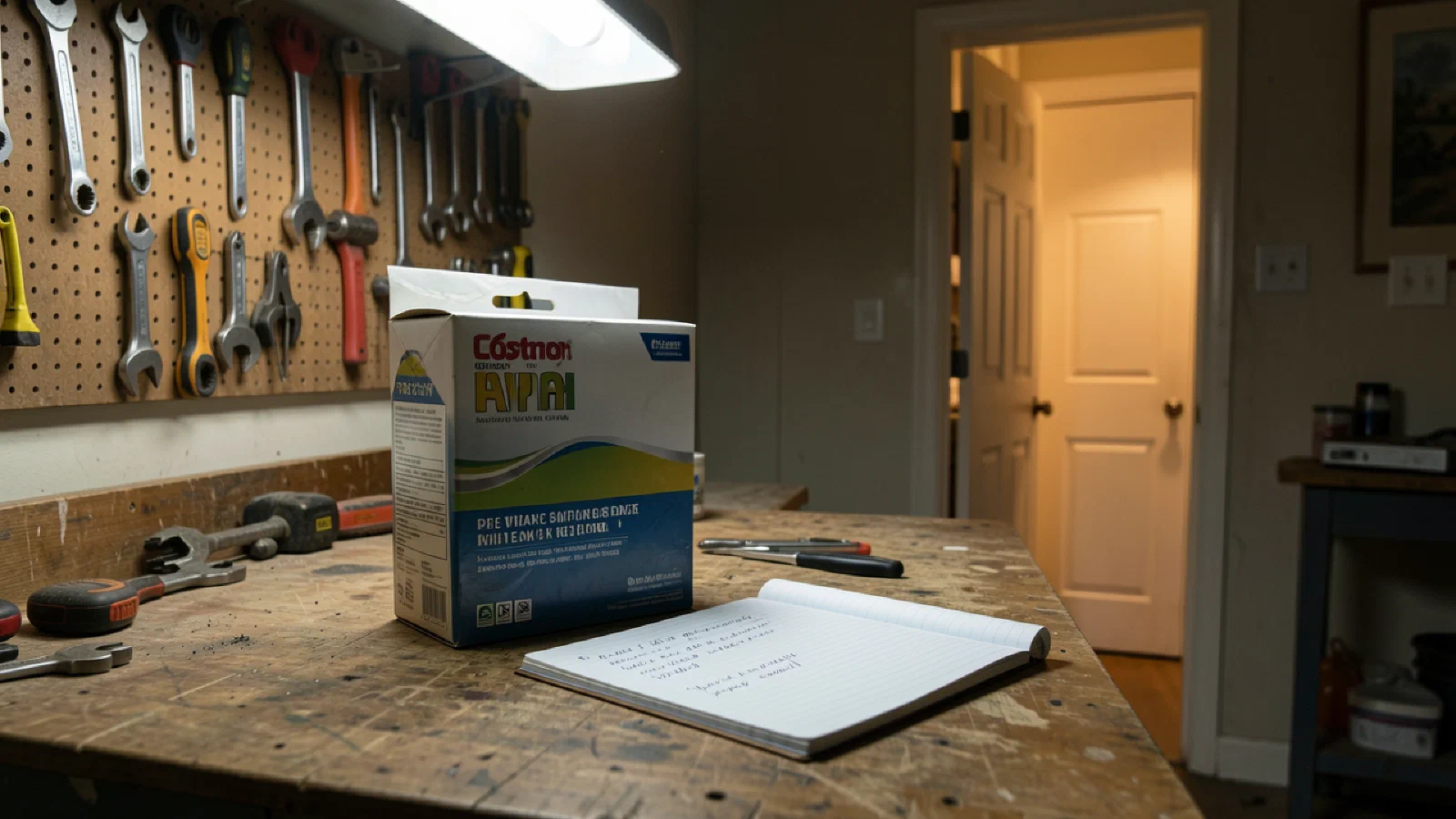
The House, the Car, and the List That Never Ends
Series 02: The Agent at Your Table
Donald Merritt is 71, a widower, a retired industrial electrician from Dayton, Ohio. His wife Barbara managed the house for 40 years. Donald managed the garage, the yard work, and anything that required a circuit breaker. They never discussed the division. It was how things were. Eighteen months after Barbara died, on an August afternoon when the temperature inside the house reached 95 degrees, the HVAC system failed.
The repair technician told him the compressor had burned out because the air filter had not been changed in two years. The filter costs $12 at the hardware store. It needs to be changed every 90 days. Donald did not know this. Barbara had changed the filter every quarter for as long as they lived in the house. She had a calendar in the kitchen with the maintenance items written in blue ink. Donald threw the calendar away after the funeral because looking at her handwriting was harder than not knowing what the house needed.
The compressor replacement cost $4,200. The repair technician was decent about it. He did not say the words “if you had changed the filter,” but the information was in the room. Donald has a legal pad on the kitchen table now with 22 things he suspects need attention. He does not know how to prioritize them. He does not know who to call for most of them. He does not know what any of them should cost.
What the List Contains#
A house that is 25 years old in the Midwest requires a specific set of maintenance tasks on a specific schedule, and the schedule does not care whether the person who used to manage it is still alive. The HVAC filter every 90 days. The water heater flushed annually to prevent sediment buildup that shortens the unit’s life by three to five years. Smoke detector batteries replaced twice a year, and the units themselves replaced every ten years. Gutters cleaned in spring and fall to prevent water damage to the foundation and fascia. The dryer vent cleaned annually, because clogged dryer vents are the leading cause of residential clothes dryer fires, producing roughly 2,900 fires per year according to the U.S. Fire Administration. Roof inspection every three years by a qualified inspector, not the roofer trying to sell a replacement. Sump pump tested before the rainy season, because the pump that fails during the first heavy rain of spring fails when the basement is flooding, not before.
Then the car. Oil changes at manufacturer intervals, not the 3,000-mile standard the quick-lube shop posts on the door. Tire rotation every 5,000 to 7,500 miles. Brake inspection annually. Timing belt replacement at the manufacturer’s mileage interval, which is a $1,200 repair that prevents a $4,000 engine failure. Transmission fluid change at 60,000 to 100,000 miles depending on the vehicle. Coolant flush every 30,000 miles.
The reader who managed a household for decades recognizes every item on this list and could add ten more. The reader who is reading it for the first time because the person who managed these things is gone is seeing the full scope of what they did not know they did not know. Donald’s legal pad has 22 items. The actual list for his house and his car is closer to 40.
What Deferred Maintenance Costs#
The $12 filter that leads to a $4,200 compressor failure is the most instructive example because the ratio is absurd. But the pattern repeats across every maintenance category. The clogged dryer vent that produces a house fire carries an average residential fire claim of $35,000 and a risk to life that no dollar figure covers. The missed roof inspection that allows water intrusion to reach the drywall before anyone notices produces a remediation bill of $8,000 to $15,000 depending on how far the moisture traveled. The water heater that was never flushed develops sediment deposits that reduce efficiency by 25% to 40% and shorten the unit’s life by five years, producing a $1,800 replacement cost that proper maintenance would have delayed.
These are not speculative numbers. They are the documented repair costs for failures that proper maintenance prevents. The arithmetic is not complicated. What is complicated is knowing the schedule, tracking the tasks, and finding someone trustworthy to perform them, especially when the person doing the knowing and the tracking and the finding used to be someone else.
The Contractor Problem#
Donald needs an HVAC technician, a plumber, a general handyman, a gutter service, and a roofer. Barbara had relationships with all of them. She knew who was reliable, who charged fairly, who showed up when they said they would, and who she had stopped calling after the kitchen faucet incident of 2014. Donald has none of these relationships and no way to evaluate the people he finds.
The contractor market has significant quality variance. Licensing requirements differ by state and by trade. Online reviews are helpful and also manipulable. The referral from a neighbor is worth something, and Donald’s neighbors are a 78-year-old woman who hires her grandson and a young couple who moved in six months ago. Angi and TaskRabbit provide contractor finding services, but they require the user to know what needs doing and when. Donald does not know what needs doing. He has a legal pad.
The information gap is not just about finding a contractor. It is about knowing what the work should cost. A furnace tune-up in the Dayton market runs $89 to $150 depending on the provider and the scope. Donald does not know this range. He will pay whatever the first company he calls charges, because he has no reference point and no leverage, and the company knows it. The person managing a home alone for the first time is the most profitable customer a home service company can find, because that person does not know the market and does not have the energy to learn it.
What a Maintenance Agent Does#
A maintenance agent builds a property profile from the information the homeowner provides or the agent can access: the house’s age, square footage, HVAC system type and installation date, water heater type and age, roof material and last inspection date, major appliances and their warranty status. From this profile, the agent generates a seasonal maintenance calendar specific to the property. Not a generic list from a home improvement website. A schedule that accounts for the specific systems in the specific house in the specific climate zone.
The agent schedules routine maintenance with contractors it has vetted through licensing verification, insurance confirmation, review analysis, and pricing comparison against regional averages. It tracks service history for each contractor and flags quality inconsistency. If the HVAC technician’s seasonal tune-up took 45 minutes last spring and 15 minutes this spring with no documented reason for the difference, the agent notes it. If a plumber’s invoice exceeds the regional average for the specific repair by more than 30%, the agent flags the variance.
For the car, the agent tracks mileage-based and time-based maintenance intervals using the vehicle’s specific manufacturer recommendations rather than the generic intervals the dealership posts. It schedules service, compares pricing between the dealer and independent mechanics, and tracks warranty coverage to ensure covered repairs are not paid out of pocket.
What the agent cannot do is inspect the house. No software replaces the physical walk-through that reveals the small crack in the foundation wall, the discolored ceiling tile that suggests a slow leak above, the soft spot in the deck boards that means the joists underneath are rotting. The agent manages the schedule. The inspection requires a human who knows what to look for. For the homeowner managing alone, the agent can schedule an annual home inspection by a qualified inspector, which is a service most people associate with buying a house and never consider for a house they already own.
The Fourteen Small Repairs#
Every person managing a house alone recognizes this category. The leaky faucet in the hall bathroom. The window that sticks in the guest bedroom. The loose railing on the back steps. The outlet cover in the kitchen that has been cracked since the grandchildren visited in March. The cabinet door that does not close all the way. None of these is large enough to justify calling a contractor. A plumber’s minimum service call is $85 to $125. Paying $125 for someone to come fix a dripping faucet feels disproportionate. So the faucet drips. The railing stays loose. The outlet cover stays cracked.
Over months, the small repairs accumulate into a house that feels slightly broken in a dozen places, and the cumulative effect is not just financial. It is the daily experience of living in a home that is gently deteriorating, each small failure a reminder that the person who used to fix these things, or who used to know who to call, is not here.
A maintenance agent that batches small repairs into a single quarterly handyman visit resolves this category entirely. The agent maintains a running list of small repairs as the homeowner reports them. When the list reaches a threshold, or when the quarterly schedule arrives, the agent books a handyman for a half-day visit. The handyman addresses seven or eight items in a single trip. The cost is lower per item because the service call is amortized across multiple repairs. The house stops feeling broken.
What the Agent Cannot Replace#
The agent cannot replace the expertise of the plumber who has worked on Donald’s boiler for fifteen years and knows the specific sounds it makes when the expansion tank is low. It cannot replace Barbara’s knowledge of the house, accumulated over 40 years, the knowledge that the basement floods if the sump pump is not tested before March, that the oak tree’s roots grow into the sewer line every seven years, that the west-facing windows need to be recaulked every three years or the bedroom wall gets damp. That knowledge was never written down. It lived in Barbara and it left with her.
The agent starts from scratch with the property profile and builds its knowledge over time. It will never know the house the way Barbara did. What it will know is the maintenance schedule that keeps the house from failing in ways that are preventable, the contractor network that ensures the work gets done by people who are licensed and fairly priced, and the seasonal calendar that ensures the $12 filter gets changed every 90 days.
Donald’s Second August#
The following August, the HVAC system ran. The filter had been changed in May and again in August according to the maintenance schedule the agent set up after the compressor replacement. The gutters had been cleaned in April. The dryer vent had been cleaned in March. The smoke detector batteries had been replaced in January and June. The water heater had been flushed in February.
Donald did not know any of these things had happened in the sense that Barbara would have known. He reviewed the agent’s quarterly summary. He approved the payments. He opened the door when the contractors arrived. The house is managed. The managing is different from what it used to be, and Donald does not pretend otherwise. He does not have Barbara’s calendar. He has a system that does what the calendar did, imperfectly, without her handwriting, and the house runs.
How this article connects to others in Blue Mirror.
Sources cited in this article.
- U.S. Fire Administration. "Clothes Dryer Fires in Residential Buildings." FEMA Topical Fire Report Series, 2024.
- National Association of Home Inspectors. "Recommended Home Maintenance Schedule." , 2025.
- U.S. Department of Energy. "Water Heater Maintenance." energy.gov, 2024.
- Bureau of Labor Statistics. "Occupational Employment and Wages: Plumbers, Pipefitters, and Steamfitters." , 2025.
- National Roofing Contractors Association. "Homeowner's Guide to Roof Maintenance." , 2025.