The Fall You Never Had
Series 01: The Body's New Partner
Eleanor Voss is 79, and she lives alone in the house she has occupied for 41 years in rural Licking County, Ohio. Her daughter Patricia is in Denver. Patricia has lived with the specific fear of the 2 AM call for three years, since Eleanor’s neighbor had a hip fracture and spent four months in rehabilitation before going to memory care. The fear is not abstract. It has a shape: the phone on the nightstand, the area code she recognizes, the drive to the airport she has rehearsed in her mind more times than she will admit.
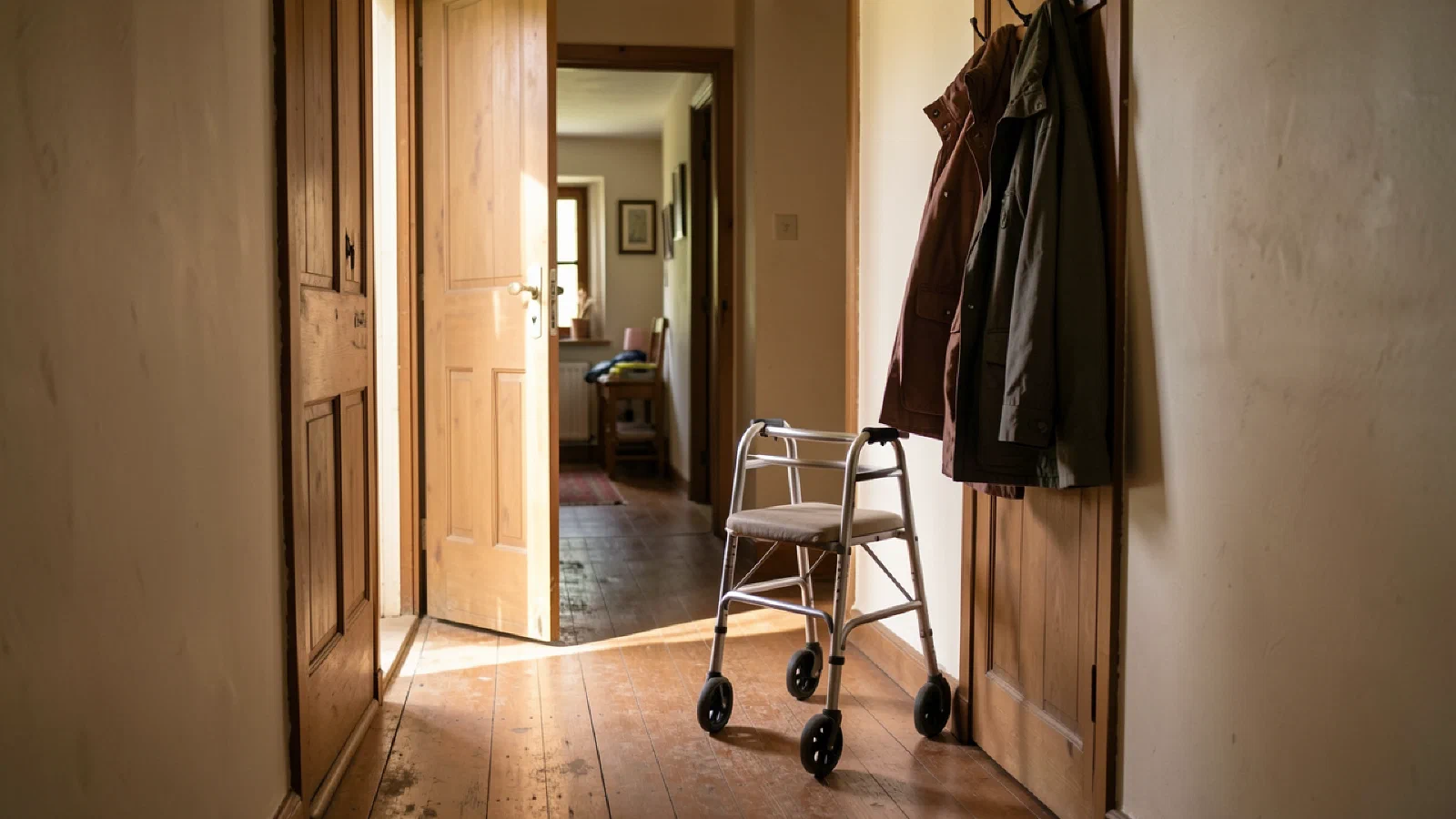
On a Tuesday evening at 7 PM, Patricia’s phone shows a notification from her mother’s health AI. Sleep disrupted three nights running. Blood pressure medication changed two days ago. Step count 40% below Eleanor’s seven-day average. Outdoor temperature forecast dropping 18 degrees by morning, and Eleanor’s joint stiffness patterns correlate with cold snaps in her eight-month data history. High-risk day flagged. Patricia calls. Eleanor agrees to use the walker to get the mail Wednesday morning. There is no fall. There is no story.
What a Fall Actually Costs#
The statistics are known and impersonal. Here is what they mean for Eleanor, specifically. A hip fracture at 79, living alone in a rural Ohio county with one hospital and no inpatient rehabilitation facility within 30 miles, ends her independent living with a probability that her daughter has looked up and cannot forget. Recovery from a hip fracture at Eleanor’s age requires supervised rehabilitation for weeks to months. The nearest facility is in Newark, 40 minutes away. Patricia would fly from Denver, take family leave, sleep in a motel off Route 16, and spend the next four months watching her mother try to walk again in a place that is not her home.
The cost is not only medical. It is the contraction of a life. Eleanor’s house is where she gardens. It is where the neighbor’s dog visits on Thursday mornings. It is where she has agency, routine, and the particular independence of a woman who has lived on her own terms for decades. A single fall, a single fracture, and the conversation shifts from “how long can Mom stay in the house” to “when does Mom leave the house.” That conversation is on the table every day Eleanor lives alone. The AI does not eliminate it. It changes the odds on any given Wednesday.
Detection Is Not Prediction#
Fall detection devices save lives. The Apple Watch that senses an impact and calls 911 when Eleanor does not respond has prevented people from lying on the floor for hours. Medical alert systems from Medical Guardian, Bay Alarm Medical, and Lively do the same thing with dedicated hardware. These are mature, reliable products. If Eleanor falls and cannot get up, they ensure someone knows.
But detection and prediction are not the same intervention. Detection responds after the floor has become the outcome. The ambulance arrives, the fracture is diagnosed, the rehabilitation begins. Prediction creates the possibility that the floor never becomes the outcome at all. The walker on Wednesday morning is a different category of response than the ambulance on Wednesday afternoon. Both matter. They are not interchangeable.
The distinction is not a criticism of detection technology. It is a statement about what risk aggregation can do that event response cannot. The AI that told Patricia about the converging risk factors on Tuesday evening was not detecting a fall. It was reading four data streams that, taken individually, meant little, and together described a day worth being careful about.
What the AI Saw on Tuesday#
Four data streams, none alarming alone. Eleanor’s sleep had been disrupted for three consecutive nights, with fragmented sleep architecture and increased nighttime restlessness. Her blood pressure medication had been changed two days prior, introducing a new antihypertensive that can cause orthostatic dizziness during the adjustment period. Her step count was 40% below her personal seven-day rolling average, which could mean she was already feeling unsteady or simply that she had stayed inside. The temperature was forecast to drop 18 degrees overnight, and in Eleanor’s eight-month data history, cold-weather days correlate with increased joint stiffness reports and slower walking speed.
No single factor is a fall risk. Three nights of poor sleep happen. A medication change is routine. A low step count has a dozen explanations. A cold snap is weather. But the four together, assessed against Eleanor’s personal baseline patterns, produced a composite risk score that the platform flagged as worth notifying Patricia. The AI did not predict a fall. It identified a convergence of conditions that, in the clinical literature and in Eleanor’s own history, correlate with increased risk. The word “correlate” is doing important work in that sentence.
What Exists Today#
Consumer fall detection is mature and widely available. Consumer fall prediction is early and uneven. The CDC’s STEADI program provides clinical fall risk assessment tools for physicians, but clinics use them inconsistently, and the assessment happens during an office visit that may be months away from the high-risk day. Gait analysis through smartphone cameras has been validated in research but is not yet available in consumer products.
AI-based platforms that integrate multiple data streams into composite fall risk scores are beginning to reach the market. Some remote patient monitoring programs through Medicare Advantage plans are incorporating multi-stream risk scoring. But the consumer who wants what Patricia has, a notification on her phone when her mother’s risk factors converge, has limited options today and will have substantially more in 12 to 18 months. Passive fall prediction through ambient sensors in the home, floor pressure mats, camera-based gait analysis that requires no wearable, is three to five years from the living room. It will matter when it arrives. It has not arrived.
The Geography of Caregiving#
Patricia lives 1,800 miles from her mother. Before the AI, her relationship with Eleanor’s safety consisted of a phone call every evening and the sustained low-frequency anxiety of not knowing what happened between calls. She could ask how Eleanor felt. She could not see how Eleanor walked.
The AI did not replace proximity. Patricia cannot drive to Eleanor’s house on a Tuesday night. But the notification changed what happened on Wednesday morning because it gave Patricia specific, actionable information at a moment when action was possible. Eleanor agreed to use the walker. The agreement was not automatic. It followed a conversation in which Patricia could say something more precise than “be careful” and Eleanor could hear something more specific than worry.
Remote caregiving is a structural reality for millions of families. The adult child lives where the job is. The parent lives where the life is. The distance between them is measured in flight time and in the particular helplessness of knowing that something could be happening right now and you would not know until afterward. An AI that narrows the information gap does not close the distance. It changes the quality of the distance from silent to informed, which is not the same as fixing it, and is not nothing.
The Autonomy Question#
Eleanor did not particularly want the AI. She agreed to it as a concession to Patricia, the way she agreed to the grab bars in the bathroom and the nightlight in the hallway: because her daughter asked, and because the alternative was a longer conversation about moving.
She uses the walker on high-risk days because she chooses to, not because she is required to. The AI sends the alert to Patricia, and Patricia calls, and Eleanor decides. The distinction matters enormously. A system that removes Eleanor’s autonomy in the name of her safety misunderstands what safety means to a 79-year-old woman who has lived alone for a decade. Safety, for Eleanor, includes the right to get her own mail, to garden in March, to walk to the mailbox without a helmet and a spotter. The AI that supports her autonomy by giving her better information is a different tool than the AI that monitors her compliance for someone else’s peace of mind.
The Fall That Never Appears#
The fall that never happens is invisible. It does not appear in medical records. It does not generate an insurance claim. Eleanor will never know whether she would have fallen on Wednesday morning without the walker. Patricia will never know whether the notification prevented anything or whether Tuesday was just a cold day when her mother slept badly. The AI produces no drama and no story when it works correctly. Just a Wednesday morning when Eleanor gets the mail, comes inside, makes coffee, and calls Patricia to complain about the cold.
That invisibility is the point, and also the challenge. The value of prevention is always harder to see than the value of response, because prevention erases the event it prevents. You cannot count what did not happen. You can only know that the conditions were present, the information was available, the conversation happened, and the morning passed without incident. For Patricia, that is enough. For Eleanor, it is the price of keeping the house.
How this article connects to others in Blue Mirror.
Sources cited in this article.
- Bergen, Gwen, et al. "Falls and Fall Injuries Among Adults Aged 65 and Older, United States, 2014." Morbidity and Mortality Weekly Report, vol. 65, no. 37, 2016, pp. 993-998.
- Phelan, Elizabeth A., et al. "Assessment and Management of Fall Risk in Primary Care Settings." Medical Clinics of North America, vol. 99, no. 2, 2015, pp. 281-293.
- Robinovitch, Stephen N., et al. "Video Capture of the Circumstances of Falls in Elderly People Residing in Long-Term Care." Lancet, vol. 381, no. 9860, 2013, pp. 47-54.
- Stevens, Judy A., and Ellen D. Sogolow. "Gender Differences for Non-Fatal Unintentional Fall Related Injuries Among Older Adults." Injury Prevention, vol. 11, no. 2, 2005, pp. 115-119.
- Howland, Jonathan, et al. "Covariates of Fear of Falling and Associated Activity Curtailment." Gerontologist, vol. 38, no. 5, 1998, pp. 549-555.