The Dot Nobody Else Connects
Series 01: The Body's New Partner
Rosellen Chastain is 68, a retired high school principal from Atlanta, and she has been tired for five months. Not the tired that follows a bad night. The tired that sits behind your eyes at 10 AM after nine hours of sleep and makes you cancel lunch with your sister because the restaurant is twenty minutes away and twenty minutes feels like too much.
She has seen her cardiologist. Normal EKG, normal stress test. She has seen her endocrinologist. Thyroid levels in range. Her PCP referred her to a rheumatologist, who found nothing acute. All three physicians are competent. All three are looking at their slice of her body. None of them found anything wrong because, within their slice, nothing is wrong.
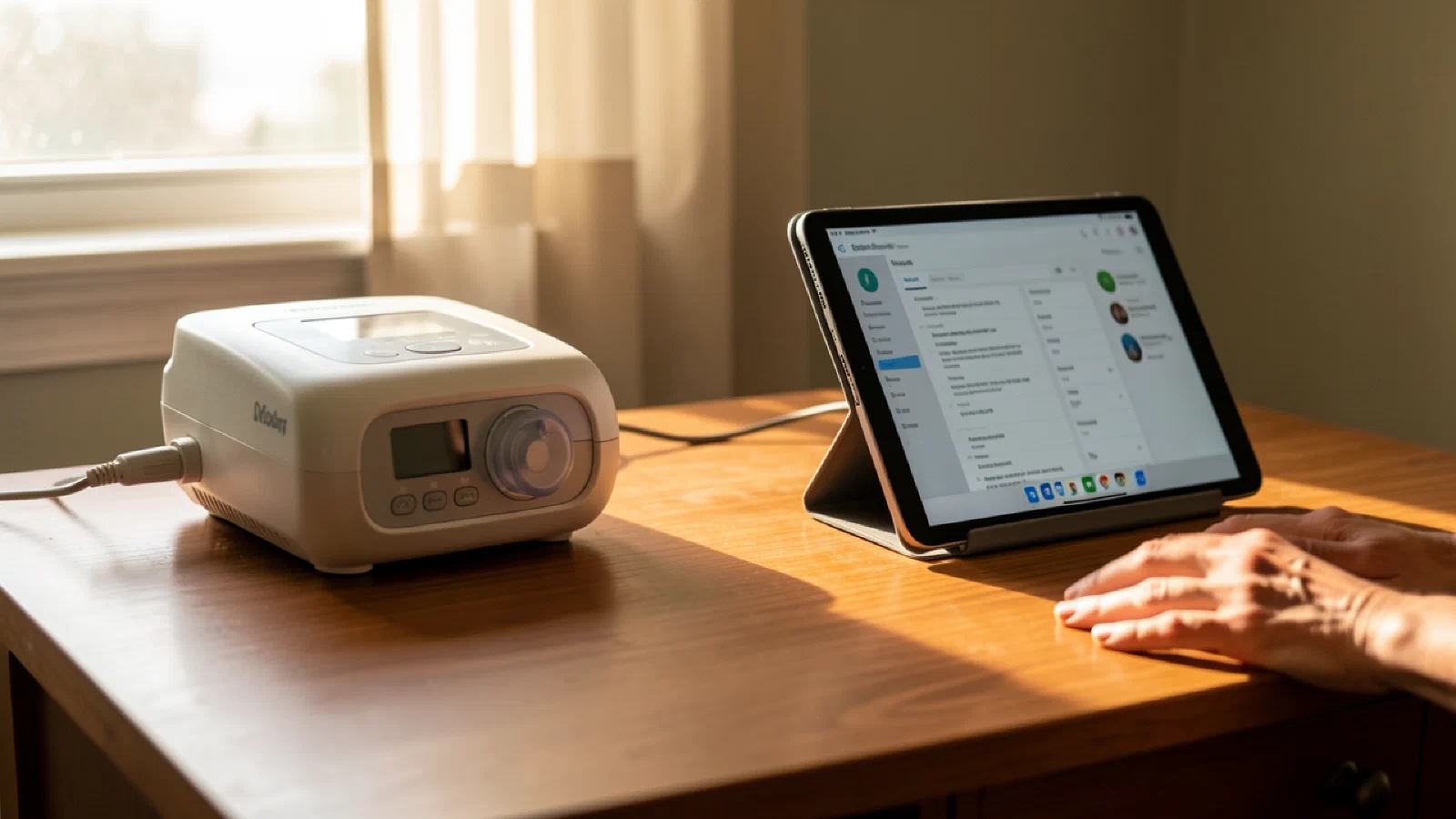
On a Thursday afternoon, Rosellen reviews a cross-system correlation report from her personal health AI. The system has noticed that her fatigue onset aligns precisely with a four-week period during which her CPAP compliance dropped below 60%. Her pulmonologist renewed the prescription six months ago and has not seen compliance data since. Nobody in her care team knew she had stopped tolerating the mask. Nobody thought to check, because the CPAP data lived in a different silo than the fatigue workup, and no human being was standing in both silos at once.
Why This Is a Design Problem#
American medicine assigns individual organs to individual specialists. This is not a flaw. Specialization produces excellent organ-level care. The cardiologist who sees 30 hearts a day knows things about hearts that a generalist cannot. The endocrinologist who manages thyroid function across hundreds of patients develops pattern recognition that training alone does not produce. The system does exactly what it was designed to do, which is deliver expert care within defined domains.
The cost of that design is the gap between the domains. Rosellen’s cardiologist owns the cardiovascular assessment. Her endocrinologist owns the metabolic assessment. Her PCP theoretically coordinates, but coordination requires data that nobody sends, and the PCP sees Rosellen for twelve minutes twice a year. None of them owns the CPAP compliance data. None of them thought to ask about it, because it lives in a pulmonology portal that none of them access, managed by a sleep practice that communicates with nobody unless the patient initiates the conversation.
The dot Rosellen’s AI connected was not hidden. It was sitting in plain view inside a CPAP platform called ResMed myAir, generating nightly compliance scores that nobody outside the sleep practice had any reason to look at. The AI looked because it had been authorized to pull from every data source Rosellen gave it access to, and it held no assumptions about which sources were relevant to which symptoms.
Corticosteroids and Blood Sugar#
Rosellen’s case is one pattern. Here is another, equally common and equally invisible to the specialists involved.
A rheumatologist prescribes prednisone for joint inflammation. Prednisone reliably elevates blood glucose, sometimes substantially. Six weeks later, the endocrinologist runs an A1C and sees a number that has climbed from 6.1 to 6.8. She increases the metformin dose. The rheumatologist does not know about the metformin increase. The endocrinologist does not know about the prednisone, because the prescription came from a different practice, filled at a different pharmacy, and documented in a different medical record.
An AI that holds both the rheumatology prescription and the endocrinology lab results sees the temporal correlation immediately: blood glucose began climbing within ten days of the prednisone start date. It cannot diagnose the cause. It can surface the pattern and point to the clinical literature on corticosteroid-induced hyperglycemia, which is well established and not controversial. The endocrinologist, shown this correlation, does not need AI to understand it. She needs AI only because the system that generates the data does not share it across the walls it built for itself.
What Cross-System Analysis Actually Does#
The difference between what Rosellen’s AI produced and what a physician produces is the difference between correlation and causation. The AI can say: your fatigue onset began approximately five weeks ago; your CPAP compliance dropped below 60% beginning four weeks and six days ago; the clinical literature documents a strong association between untreated obstructive sleep apnea and chronic fatigue; here is the correlation. The AI cannot say: this is definitively why you are tired.
That distinction is not a limitation to apologize for. It is the correct scope of the tool. A cross-system correlation engine surfaces hypotheses that no single specialist could generate because no single specialist holds all the data. The hypothesis still requires a physician to evaluate it, order the confirmatory tests, and make the clinical judgment. What the AI eliminates is the months-long diagnostic wander that happens when each specialist clears their organ and sends the patient home.
In Rosellen’s case, the AI generated a hypothesis that took her pulmonologist less than ten minutes to evaluate. The CPAP mask fit had deteriorated. Rosellen had been removing it at 2 AM most nights because it was leaking air into her eyes. She had not mentioned this to anyone because she did not connect the mask discomfort with the fatigue, and her pulmonologist had not asked because the renewal was routine. The fix was a mask refitting. The fatigue began improving within two weeks.
Rosellen’s Conversation With Her Pulmonologist#
How Rosellen brought this finding to her pulmonologist mattered. She did not say “my AI says you missed something.” She said: “I found a pattern in my data that I wanted to bring to you. My CPAP compliance dropped around the same time my fatigue started. I wanted to ask whether that could be related.”
The framing is not a courtesy. It is a strategy. Physicians who feel corrected by a patient’s technology respond differently than physicians who feel consulted by a patient with data. The clinical outcome may be identical, but the relationship sustains or fractures depending on which version the patient chooses. Rosellen spent 35 years managing difficult conversations in a high school front office. She understood that the person with the finding and the person with the authority to act on it are not always the same person, and that the gap between them is closed by language, not by being right.
Getting Device Data to the Right Providers#
Most patients do not know they own their CPAP data. They do not know they can download compliance reports from ResMed myAir or Philips DreamMapper and share them with any physician, not just the prescribing pulmonologist. They do not know that their continuous glucose monitor data, their blood pressure monitor history, and their wearable fitness data are all theirs to route wherever they choose.
The practical barrier is not legal. It is logistical. Downloading a compliance report from one platform, converting it to a format another provider can read, and delivering it in a way that enters the medical record rather than sitting in an inbox that nobody checks requires technical comfort that many patients over 65 do not have and should not be expected to have. The AI platforms that automate this routing, pulling authorized data from multiple sources and generating integrated summaries, are solving a real problem. The platforms that do this well are not free, and the patients who need them most are often the patients least able to afford them or use them without help.
Correlation Is Not Causation#
Rosellen’s AI was right about the correlation. But the AI did not know it was right. It surfaced a temporal pattern. The pattern happened to match a well-documented clinical relationship. Had the pattern been between her CPAP compliance and, say, a change in weather, the AI would have surfaced that correlation too, with equal confidence and far less clinical value.
This is the honest limitation of cross-system analysis at the consumer level. The AI does not understand medicine. It understands time series. It finds patterns between data streams that move together, and it presents those patterns to the user. Some patterns will be clinically meaningful. Some will be coincidental. The user, or the user’s physician, must determine which is which, and the AI cannot help with that determination because it does not know the difference.
The value is not in the AI’s judgment. The value is in the AI’s visibility. It sees across the walls that the specialists cannot see across, and it surfaces candidates for investigation that would otherwise sit undiscovered in separate databases for months or years. That is a genuine contribution. It is not a diagnosis, and the patient who treats it as one will eventually act on a correlation that turns out to mean nothing.
The Beginning of an Explanation#
Rosellen spent five months being tired and being told, in various clinical registers, that nothing was wrong. Her cardiologist found nothing cardiac. Her endocrinologist found nothing metabolic. Her rheumatologist found nothing inflammatory. Each of them was correct within their domain, and the cumulative effect of three correct assessments was a woman sitting in her living room at 2 PM on a Thursday, too tired to make dinner, convinced that something was wrong and unable to get anyone in a white coat to agree with her.
The AI did not cure her fatigue. The mask refitting did. But the AI gave her something that five months of specialist visits had not: the beginning of an explanation, grounded in her own data, pointing to a specific and testable hypothesis. For readers who have been told their symptoms are “just aging” when they know something has changed, the hypothesis with a data trail is not nothing. It is the thing you bring to the appointment when you have run out of appointments that help.
How this article connects to others in Blue Mirror.
Sources cited in this article.
- Peppard, Paul E., et al. "Increased Prevalence of Sleep-Disordered Breathing in Adults." American Journal of Epidemiology, vol. 177, no. 9, 2013, pp. 1006-1014.
- Weaver, Terri E., and Ronald R. Grunstein. "Adherence to Continuous Positive Airway Pressure Therapy: The Challenge to Effective Treatment." Proceedings of the American Thoracic Society, vol. 5, no. 2, 2008, pp. 173-178.
- Liu, Diana, et al. "Association Between Corticosteroid Use and Glucose Levels in Patients with Type 2 Diabetes." JAMA Internal Medicine, vol. 173, no. 14, 2013, pp. 1273-1280.
- Hwang, Daniel, et al. "Effect of Telemedicine Education and Telemonitoring on CPAP Adherence." American Journal of Respiratory and Critical Care Medicine, vol. 197, no. 1, 2018, pp. 117-126.