The Doctor Who Finally Sees All of You
Series 01: The Body's New Partner
Dr. Amara Osei is 58, a geriatrician in Minneapolis, and she has practiced for 26 years. In that time she has seen the Palm Pilot, the first-generation electronic health records, the patient portal, the wellness app, and the Apple Watch arrive in her exam rooms carried by patients who believed each one would change their care. Most did not. Dr. Osei is not a skeptic by temperament. She is a skeptic by experience, which is harder to argue with.
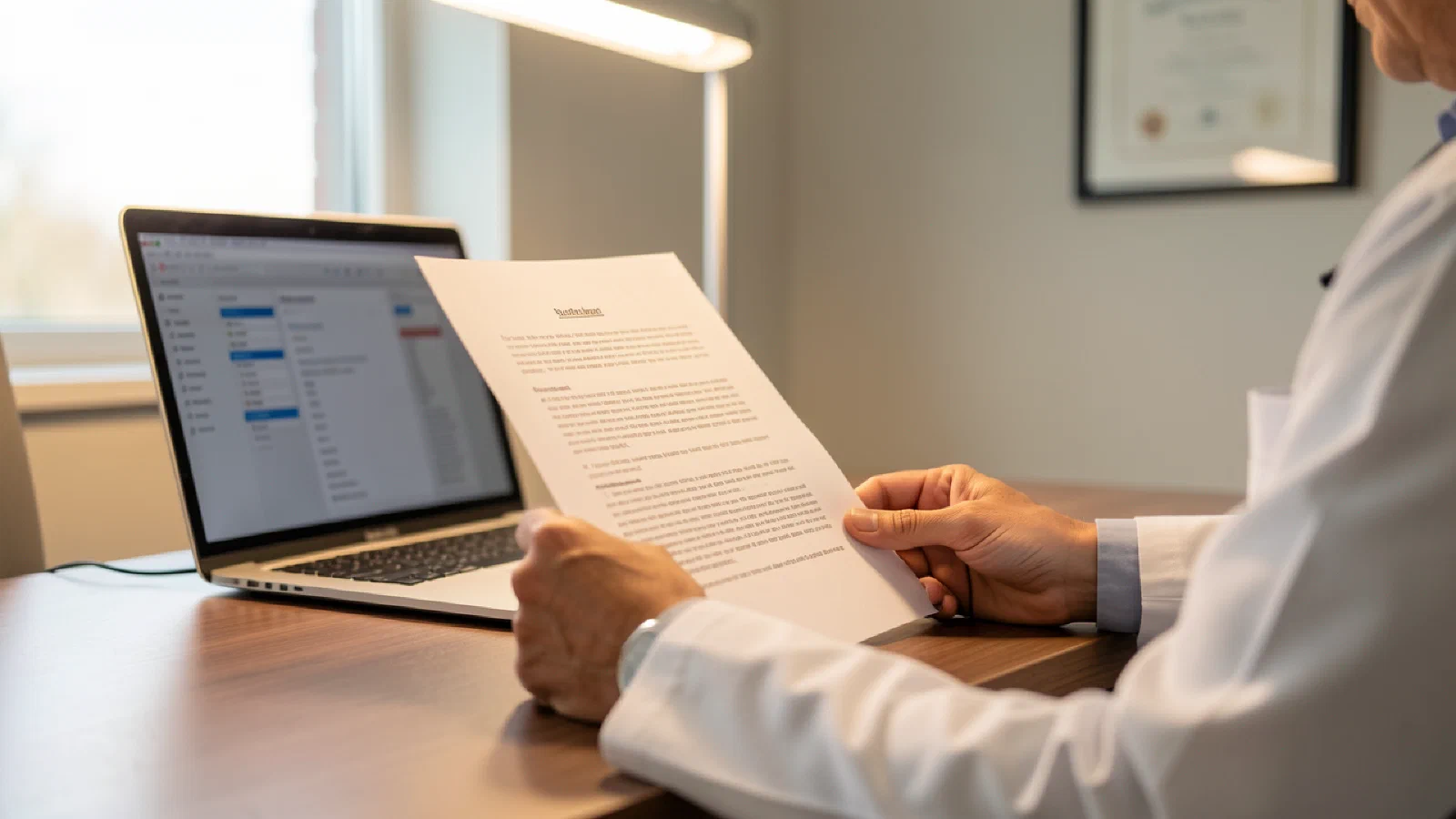
On a Thursday afternoon, Franklin Hayden, 77, retired high school coach, hands her a two-page document before she has said a word. It is an AI-generated pre-visit summary: his medication list verified against three pharmacy records, his blood pressure and resting heart rate trends for the prior six months, three numbered questions, and a flagged note about a potassium supplement he started four months ago. Dr. Osei reads the flag, cross-references the ACE inhibitor in Franklin’s medication list, and recognizes a drug-supplement interaction that raises his hyperkalemia risk. She has been managing his blood pressure for seven months. She did not know about the potassium because Franklin did not know to tell her.
She looks up from the document and has eleven minutes left. She uses them.
The Twelve Minutes From the Other Side#
This series has spent five pieces on the patient’s experience. The physician’s perspective earns a moment, because what happens in the exam room requires both sides of the conversation to change.
From Dr. Osei’s side, the twelve-minute appointment looks like this. Franklin arrives. She opens his chart. The chart contains what was documented at his last visit four months ago, which was accurate four months ago. She asks what has changed. Franklin says he feels fine. She asks about medications. He lists the ones he remembers, which is most of them but not the potassium supplement, because he bought it at a drugstore and does not think of it as a medication. She checks blood pressure, reviews the labs from three weeks ago, and makes a clinical decision based on the information available to her, which is incomplete in a way neither of them knows.
Eight minutes on reconstruction. Three minutes on documentation. One minute on the clinical thinking her training prepared her to do. This is the math of the standard geriatric appointment, and it is not the math Dr. Osei went to medical school to practice. She went to medical school to think about patients, not to inventory them.
What the Summary Changed#
Dr. Osei read Franklin’s document in two minutes before he entered the room. By the time he sat down, she had three questions prepared, all clinical, none logistical. She spent four minutes confirming the potassium-ACE inhibitor interaction and adjusting his plan. She spent seven minutes on the conversation she had been wanting to have with Franklin for three visits: his exercise capacity is declining faster than his cardiac profile explains, and she wants to talk about what that means and what he wants to do about it.
Without the summary, the exercise conversation would not have happened. It would have been crowded out by the eight minutes of reconstruction that the summary eliminated. Franklin would have gone home feeling fine about an appointment that missed the question his physician most wanted to ask him. The potassium supplement would have continued for another four months until his next visit, or longer, accumulating risk that nobody was tracking because nobody knew it existed.
The document did not make Dr. Osei a better physician. She was already a good physician working inside a system that made it hard to be one. The document made the twelve minutes available for the work she was trained to do.
What a Physician Wants From Patient Data#
Dr. Osei does not want Franklin’s raw heart rate data. She does not want his sleep scores or his step count leaderboard. She wants a verified medication list that she can trust did not come from memory. She wants vital sign trends annotated with the dates of medication changes, so she can see what happened to his blood pressure when the amlodipine dose increased in January. She wants the flagged interactions, because the interaction databases update faster than she can review them for each of her 400 patients. She wants his questions, numbered, so she can prioritize them against the clinical agenda she has already formed.
The difference between useful and useless patient-generated data is specificity. “I’ve been having trouble sleeping” is a complaint. “Sleep efficiency has averaged 71% over six months compared to a prior baseline of 84%, with the drop correlating to the metoprolol dose increase in week 14” is clinical intelligence. The first requires follow-up questions. The second requires a clinical decision. The first takes time. The second saves it.
Most patient attempts at preparation fall somewhere between heroic and incomplete. The notebook with the medication list written from memory. The printout from WebMD about a symptom that may or may not apply. The earnest, well-intentioned effort that lacks the structure a clinician can act on in two minutes. The AI-generated summary does not replace the patient’s voice. It frees the patient’s voice to say things that matter more than medication names.
The EHR Cannot Receive This#
Franklin’s summary is a printed document. Dr. Osei reads it, acts on it, and places it on the counter. It does not enter his electronic health record. There is no intake pathway for patient-generated AI summaries in her health system’s Epic installation. The interaction she caught will be documented in her notes, attributed to her clinical review, not to the document that surfaced it.
This is the central infrastructure gap. What patients can now generate is ahead of what clinical systems can receive. FHIR-based data intake pathways are beginning to create structured channels for patient-generated health data, and some health systems are piloting patient data integration in limited contexts. But the gap between a PDF printed at home and a data feed that populates the clinical record will take years of standards work, vendor adoption, and workflow redesign to close.
In the meantime, the workaround is the one Franklin used: print it, bring it, hand it to the physician, and trust that the physician will read it. Most will, if it is concise and clinically structured. Some will not, for reasons that range from workflow pressure to legitimate skepticism about data they cannot verify.
The Liability Question#
Dr. Osei raises this with her partners after the last patient leaves. If Franklin’s AI-generated medication list had contained an error, and she had made a clinical decision based on that error, who bears responsibility? She verified the potassium supplement against her own knowledge and the interaction database. But she relied on the AI’s assertion that the pharmacy records were current and complete. If they were not, the liability chain is unclear.
The platforms that generate these summaries are not licensed medical providers. The patient who hands over the document is not qualified to certify its accuracy. The physician who acts on it did not generate it. The legal frameworks have not resolved this, and no one in the room, not Dr. Osei, not Franklin, not the AI, holds clean liability for the accuracy of a document that all three contributed to and none of them fully controls. This is not a reason to reject the tool. It is a fact that everyone in the room should know before relying on it.
Who Has Always Arrived Prepared#
The patients who have always arrived at Dr. Osei’s practice with organized medical histories are the patients who had the education, time, health literacy, and family support to prepare. They arrived with typed medication lists. They brought their adult children to take notes. They called ahead to request records from other providers. These patients received better care, not because Dr. Osei treated them differently, but because the information available during their appointments was more complete.
A personal health AI makes that preparation available to patients who did not previously have the resources to do it manually. But “available” is not the same as “accessible.” The platforms cost money. They require a smartphone or tablet. They require digital literacy and a willingness to authorize data sharing. The patients who need the most coordination, the ones on fourteen medications from four providers with no family nearby, are often the patients least likely to have the tools or the support to set up the system. The equity problem in clinical information is not solved by making better tools. It is solved by making better tools accessible, which is a different and harder problem.
The Conversation After Hours#
Dr. Osei brings the question to her partners over coffee after the last patient leaves. What does it mean if patients start arriving this prepared? What changes in the workflow, in the scheduling, in the expectations on both sides of the room?
Her colleague Dr. Halvorsen says he would restructure his appointments to ten minutes if the first five minutes of reconstruction were eliminated. Her colleague Dr. Pham says she worries about the patients who cannot or do not use these tools falling further behind in care quality. Dr. Osei says she does not know yet what it means, but she knows what it felt like on Thursday afternoon: it felt like practicing medicine the way she was trained to practice it, and she has not felt that in a long time.
No resolution. The beginning of a shift.
How this article connects to others in Blue Mirror.
Sources cited in this article.
- Sinsky, Christine, et al. "Allocation of Physician Time in Ambulatory Practice: A Time and Motion Study in 4 Specialties." Annals of Internal Medicine, vol. 165, no. 11, 2016, pp. 753-760.
- Arndt, Brian G., et al. "Tethered to the EHR: Primary Care Physician Workload Assessment Using EHR Event Log Data and Time-Motion Observations." Annals of Family Medicine, vol. 15, no. 5, 2017, pp. 419-426.
- Adler-Milstein, Julia, and Ashish K. Jha. "HITECH Act Drove Large Gains in Hospital Electronic Health Record Adoption." Health Affairs, vol. 36, no. 8, 2017, pp. 1416-1422.
- Mandl, Kenneth D., and Isaac S. Kohane. "A 21st-Century Health IT System: Creating a Real-World Information Economy." New England Journal of Medicine, vol. 386, no. 21, 2022, pp. 2027-2029.