The Body as a Conversation
Series 01: The Body's New Partner
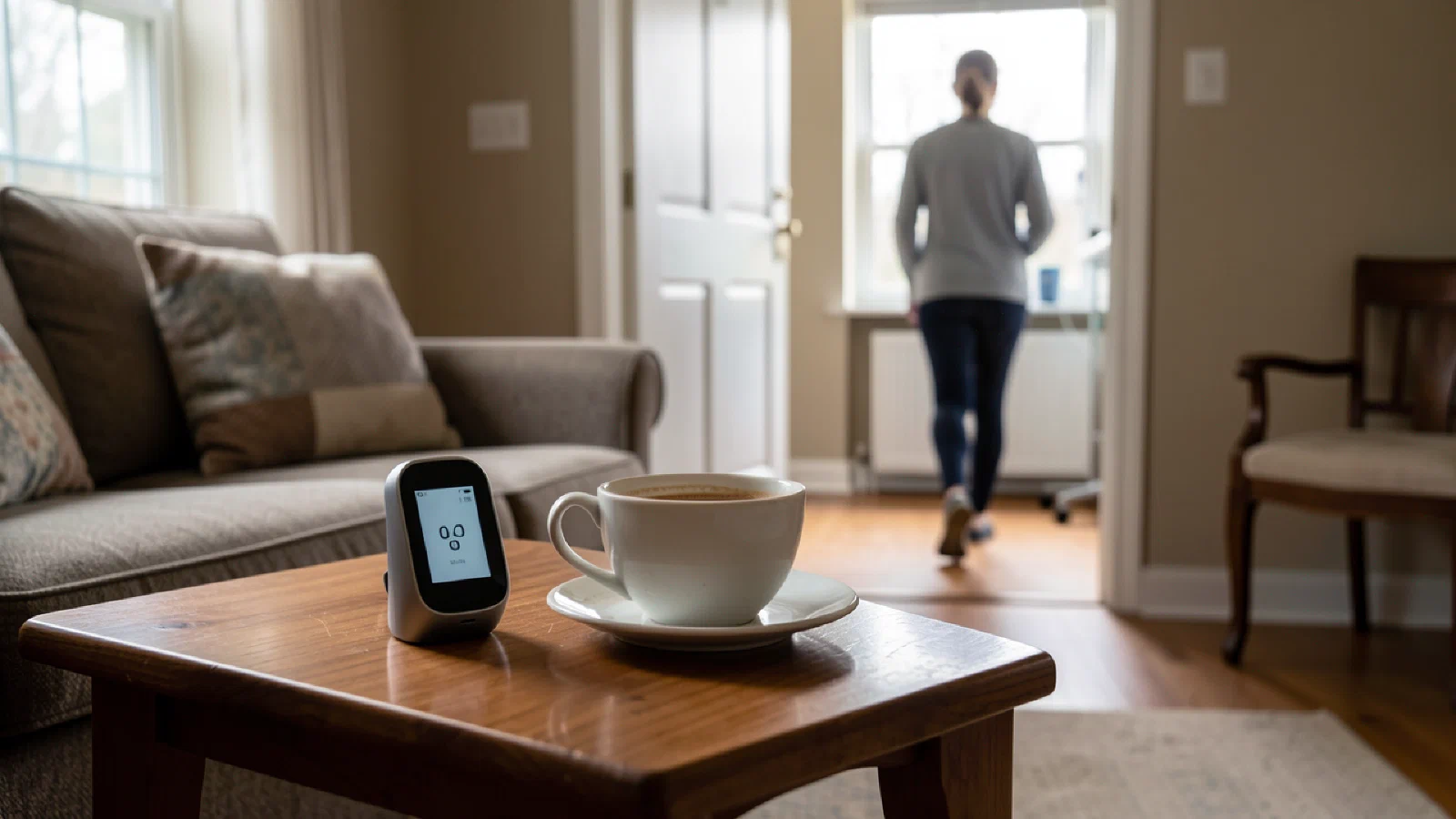
Helen Marquez is 72, a retired middle school science teacher from Tucson, and she reviews her overnight health data at 7 AM each morning with her coffee. She has worn her tracker for fourteen months. She knows her resting heart rate range, her sleep efficiency average, her typical recovery score after a day when she walks more than 8,000 steps. She says her AI knows her body better than she does, and she means it as a compliment.
David Kaplan is 68, a retired accountant from Philadelphia, and his health tracker is in the kitchen drawer, where it has been for eleven months. He wore it for three weeks. He checked his heart rate constantly. He could not decide whether 74 was fine or alarming. He could not sleep without wondering what the sleep score would say about his sleeping. He took it off on a Sunday afternoon and felt something he could not immediately name: relief, or loss, or both.
Same technology. Same general age. Two entirely different relationships with the data their bodies generate.
What Continuous Monitoring Actually Means#
The phrase “continuous monitoring” sounds clinical. What it means, practically, is that a device on your wrist or finger collects your heart rate every few seconds, your movement throughout the day, your blood oxygen at intervals, your skin temperature overnight, and, in some configurations, your heart rhythm for arrhythmia screening. This data flows to a platform that processes it into a daily summary: a sleep score, a readiness score, trend lines, anomaly flags if something deviates from your baseline.
Most users see the summary, not the raw data. Helen reads a morning briefing that tells her she slept seven hours and twelve minutes with 83% efficiency, that her resting heart rate was 61 (one beat above her 30-day average), and that no anomalies were detected. The entire review takes her four minutes. She finishes her coffee and starts her day.
David saw the same kind of summary and could not stop pulling at the threads behind it. He opened the heart rate graph. He zoomed in on the overnight dip. He noticed a spike at 3 AM and spent forty minutes trying to determine whether it was a cardiac event or a trip to the bathroom. The summary was designed to reduce complexity. For David, it increased it, because the summary implied there was more to know, and he could not stop himself from looking.
The Information Case#
The evidence that continuous monitoring improves health outcomes in some people is real. Earlier care-seeking: patients who track their baselines notice deviations sooner and present to physicians before symptoms become acute. Medication adherence: visual feedback on blood pressure trends reinforces the daily habit. Exercise motivation: step counts and activity scores create a feedback loop that keeps some people moving. Reduced emergency presentation: conditions that are tracked and caught during a routine deviation check do not become the 2 AM ER visit.
Helen’s story is a version of this. Fourteen months into monitoring, she noticed her resting heart rate running three beats above baseline for a week during a period of unusual fatigue. She called her physician. A thyroid panel caught subclinical hypothyroidism early, before the fatigue became debilitating. Without the baseline, she would have attributed the tiredness to age, or weather, or the week she had, and the thyroid problem would have been caught at her annual physical eight months later, or not at all.
For Helen, the data is a conversation with her own body. She reads the morning summary the way she reads the weather: it informs her day without dictating it. The elevated heart rate was information. She acted on it. The action had value. The monitoring served her, and she can tell the difference between being served and being managed.
The Anxiety Case#
The evidence that continuous monitoring increases health anxiety in susceptible individuals is also real. Cyberchondria, the amplification of health worry through easy access to health information, is a documented phenomenon. Monitoring-induced hypervigilance, the inability to stop checking, is reported by a meaningful minority of health tracker users. The person who cannot interpret normal variation as normal, who reads every fluctuation as a potential crisis, experiences monitoring not as a tool but as a source of sustained low-grade dread.
David’s three weeks fit this pattern. He did not have a framework for interpreting the numbers his watch produced. A resting heart rate of 74 is unremarkable by any clinical standard, but David did not know that. He knew it was higher than the 68 his watch showed yesterday, and the six-beat difference felt like it might mean something. It did not. Normal heart rate variability in a healthy 68-year-old man can span ten beats or more across a week. But David did not know what was normal for him because he had not worn the device long enough to build a baseline, and in the absence of a baseline, every number felt like a verdict.
He did not have a health anxiety diagnosis. He did not consider himself an anxious person. He was a retired accountant who had spent a career reading numbers carefully, and when the numbers were about his heart, reading them carefully felt different from reading them casually. The watch went into the drawer not because David decided the technology was bad, but because he recognized, with the precision of a man trained to read data honestly, that this particular data was not making him healthier. It was making him afraid.
The Agency Question#
A person who understands her own body’s patterns makes different decisions than a person who waits for symptoms. Helen walks an extra 2,000 steps on days when her recovery score is high because she has learned that those are the days her body can absorb more activity without fatigue the next morning. She schedules her harder errands on high-readiness days. She has become, in a specific and practical sense, a better manager of her own physical capacity because the data gave her a language for what her body had been telling her without words.
This is not an argument for universal monitoring. It is an argument for the kind of monitoring that serves agency, that gives the person more control over decisions that were already hers to make. The monitoring that serves agency feels like fluency. The monitoring that replaces agency feels like surveillance. The line between them is not in the technology. It is in the person using it.
Finding Your Calibration#
Before you buy the device or set up the platform, three questions are worth answering honestly. Do you tend toward health anxiety? Not clinical anxiety, just the tendency to look up symptoms online and feel worse afterward. Have you found information about your health empowering or frightening in the past? When a physician gives you a number, a blood pressure reading, a cholesterol count, does the number give you something to act on or something to worry about?
If the answer to those questions suggests you are closer to Helen, the monitoring will probably serve you. Start with the daily summary. Do not open the raw data graphs for the first month. Let the baseline build. Learn your ranges before you start interpreting deviations. If the answer suggests you are closer to David, the monitoring may not serve you, or may serve you only in limited form: a weekly summary rather than a daily one, anomaly alerts without the underlying graphs, or the simplest possible configuration that catches the important signals without feeding the interpretive spiral.
In the first month, watch for the signs. If you check the app more than twice a day, the tool may be managing you rather than serving you. If you feel better after checking, it is working. If you feel worse, it is not, and the technology did not fail. It simply was not the right fit for the way your mind processes information about your body.
Information That Serves Agency#
Helen still wears her tracker. David still does not. Neither of them is wrong. The difference between them is not intelligence, or courage, or commitment to health. It is the difference between two nervous systems, two life histories, two relationships with uncertainty. The technology is the same. The person inside the data is not.
The goal, for anyone considering continuous monitoring, is information in the service of agency. Information that helps you make better decisions about your body, your activity, your care. Not information as a replacement for the lived experience of having a body you already know something about. Helen learned her resting heart rate range. David learned that knowing his resting heart rate range made him less able to rest. Both pieces of knowledge are valuable. Both required wearing the watch to discover. Only one required keeping it on.
How this article connects to others in Blue Mirror.
Sources cited in this article.
- Starcevic, Vladan, and David Berle. "Cyberchondria: Towards a Better Understanding of Excessive Health-Related Internet Use." Expert Review of Neurotherapeutics, vol. 13, no. 2, 2013, pp. 205-213.
- Kelley, Christine, et al. "Self-Tracking Health Data and Personalized Health: A Meta-Synthesis of Qualitative Research." Journal of Medical Internet Research, vol. 24, no. 8, 2022, e35702.
- Simblett, Sara, et al. "Barriers to and Facilitators of Engagement With Remote Measurement Technology for Managing Health." Journal of Medical Internet Research, vol. 21, no. 3, 2019, e10480.
- Hunkin, Joanna L., et al. "Wearable Devices as Adjuncts in the Management of Anxiety and Depression." Frontiers in Psychiatry, vol. 13, 2022, 825508.